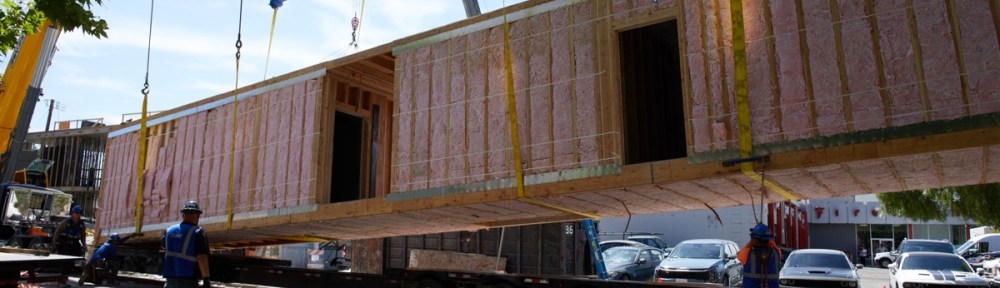
It has been a long time coming, but the seven-story, 178-unit affordable housing project at 112 Vera Ave. in Redwood City is finally receiving its modular units. This building, which when complete won’t even hint at the fact that it was built from some 100 prefabricated modules (at least from the outside), is currently having its modules “flown” (apparently that is an industry term) to their final resting places atop the building’s two-story concrete podium.
I was extremely fortunate to happen by the site just as the very first module was being trailered in. On Monday, my wife and I had just left Redwood City’s downtown public library and were heading home, and as we drove up Maple and made ready to turn onto El Camino Real, we saw a semi with an extremely long trailer struggling to back onto Vera Avenue from El Camino. Since I was driving, my wife took a quick photo through the passenger-side window:
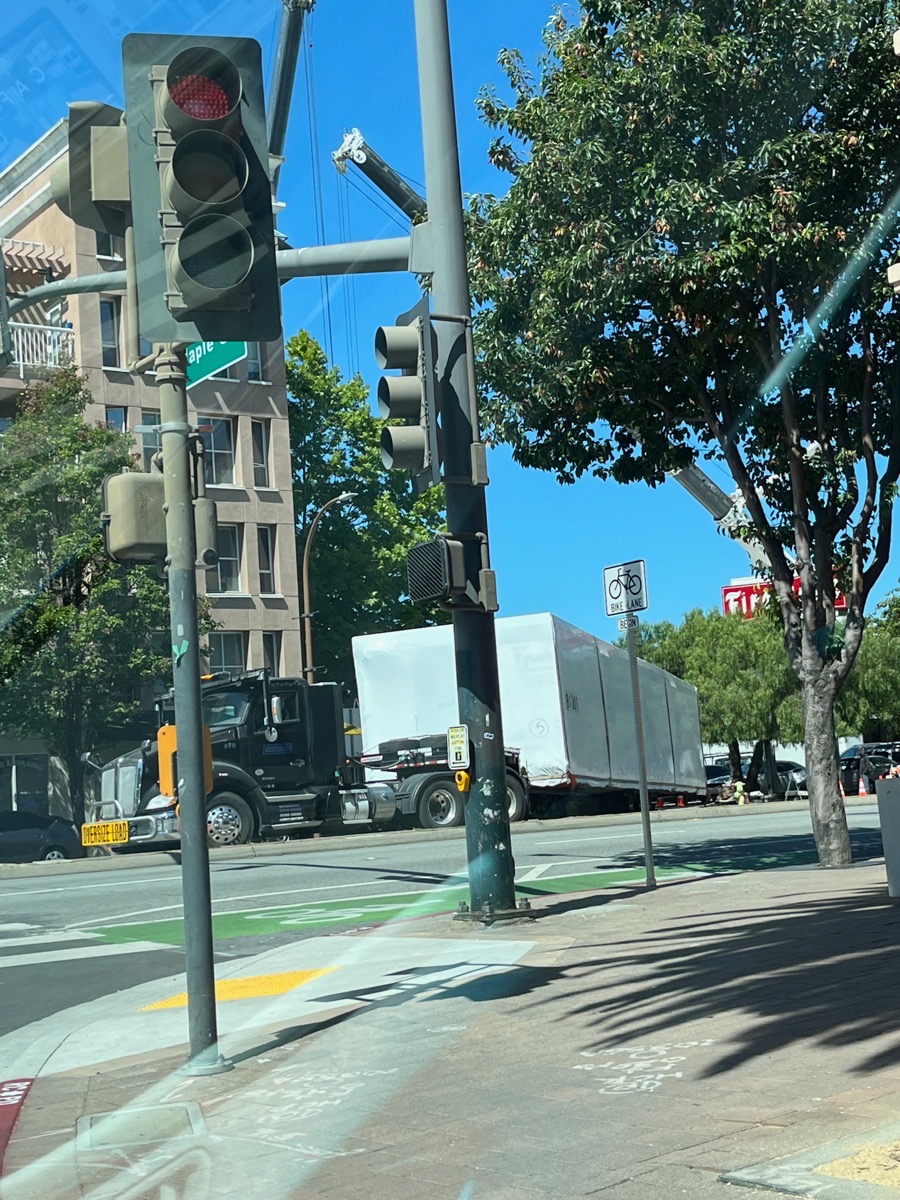
Although I wasn’t able to walk down to the site until later that afternoon, I nevertheless saw plenty of activity. I had originally planned to pay the site a quick visit, followed by a longer one the next day, but I ended up staying for about an hour on Monday and then spent another hour-plus the next day. I just can’t get enough of watching the on-site mobile cranes hoist these giant modules into position.
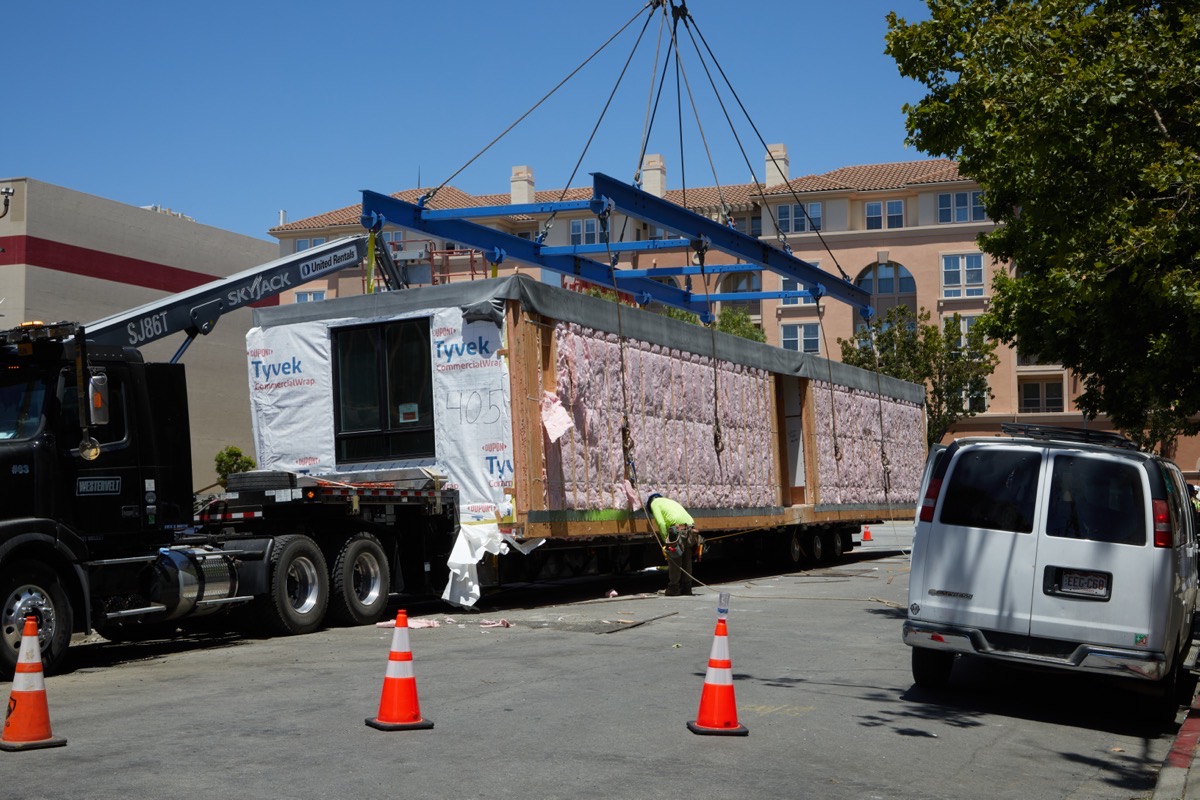
The modules are so long — just shy of 75 feet — because they span the entire width of the building. Most contain two apartments (in place of one or both apartments, some contain other spaces: laundry rooms, stairwells, utility spaces, residential common areas, etc.) with a gap in between that will ultimately form the central hallways that will run nearly the entire length of the building on each floor. Here is a picture of one of the modules shortly after its plastic wrap had been removed:
And here is a close-up of that central hallway:
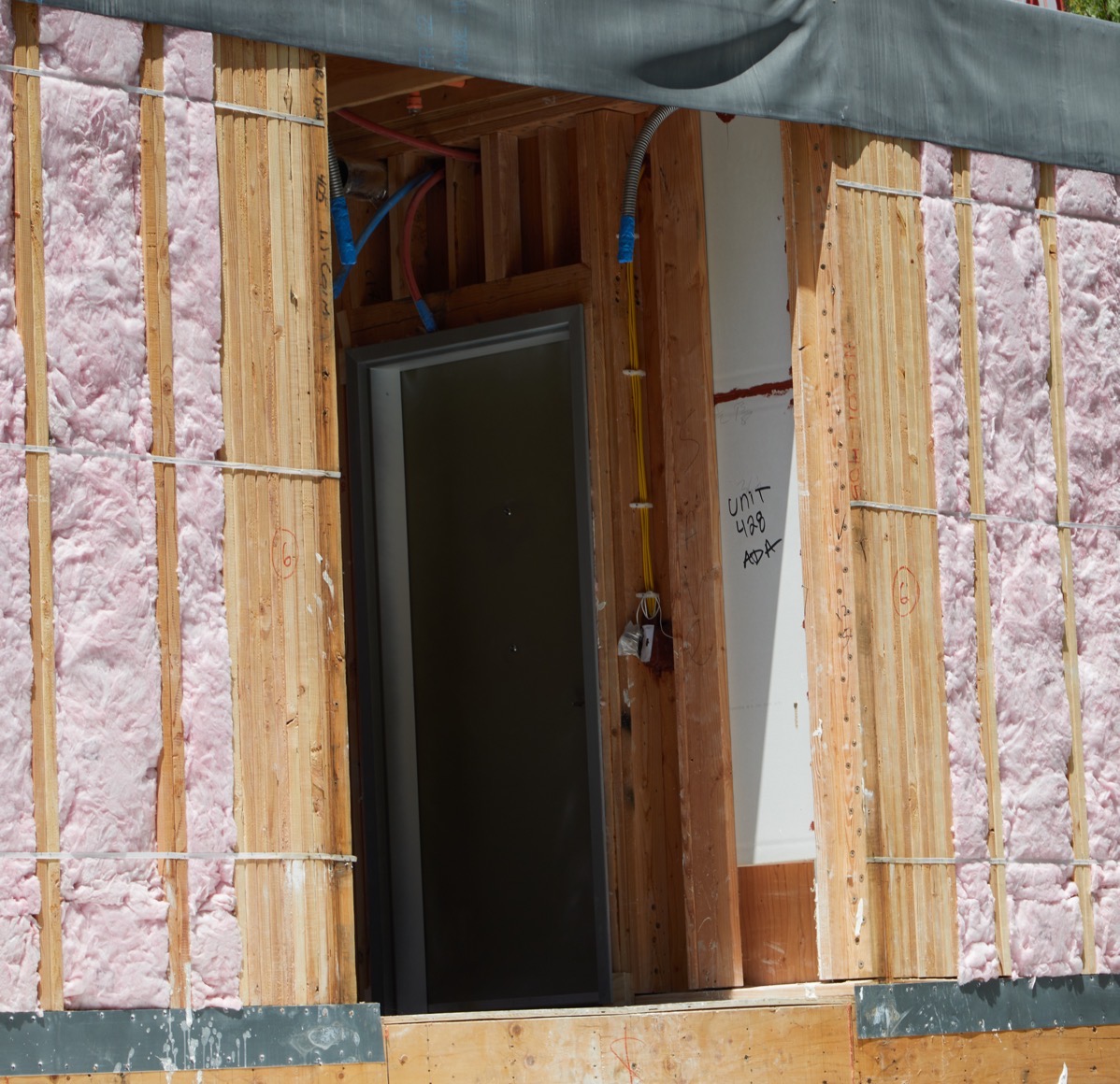
Note the entry door into the apartment (unit 428, which apparently is handicapped-accessible). And note the various connections for plumbing and electrical. The blue and the red flex pipes coming out from above the door are presumably the hot and cold water lines, while I’m guessing that the grey lines are electrical. As for the doors, they and the frames appear to be steel.
Although there are some shorter modules, most are these full-length ones. And most are about 13-1/2 feet wide, although again some of the specialty modules are narrower. The modules come on a trailer that actually extends somewhat like a dining table that you can stretch to add leaves to. Once the module has been lifted off the trailer, it is collapsed to a more manageable length, and the semi goes on its way, making room for the next one to pull in.
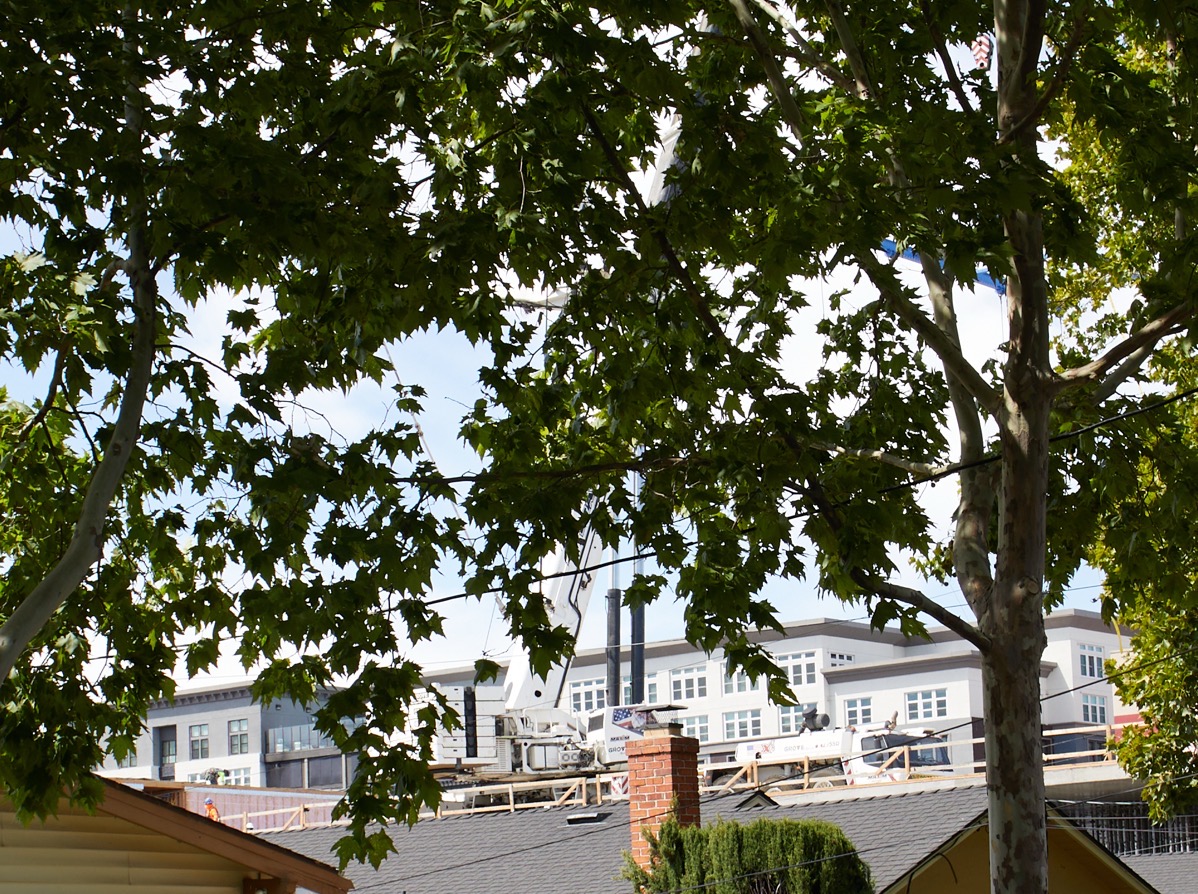
With the building being around 246 feet deep, it just isn’t possible for the mobile crane located in front of the building to place modules all the way at the back. Although there is space on either side of the building separating it from its neighbors (five side-by-side duplexes on one side, and Firestone Complete Auto Care on the other), those spaces vary from five feet to just short of 17 feet in width, which is plenty wide enough to walk down, but not nearly wide enough to accommodate a crane. There is an alley in the back, with possibly enough room for a crane, but that crane would block access to homes and businesses that are accessed from that alley, and in any case there really isn’t enough room to get a semi with a module on it in there along with the crane. So the only option is to unload the modules on Vera and crane them from there. So how do they place the modules that go towards the rear of the building? With a second mobile crane, one that the contractor actually hoisted up and placed on top of the podium. From the ground, that second crane was a bit hard to see (except for the crane’s boom; it you can see from almost any angle); this is the best picture I could get of it:
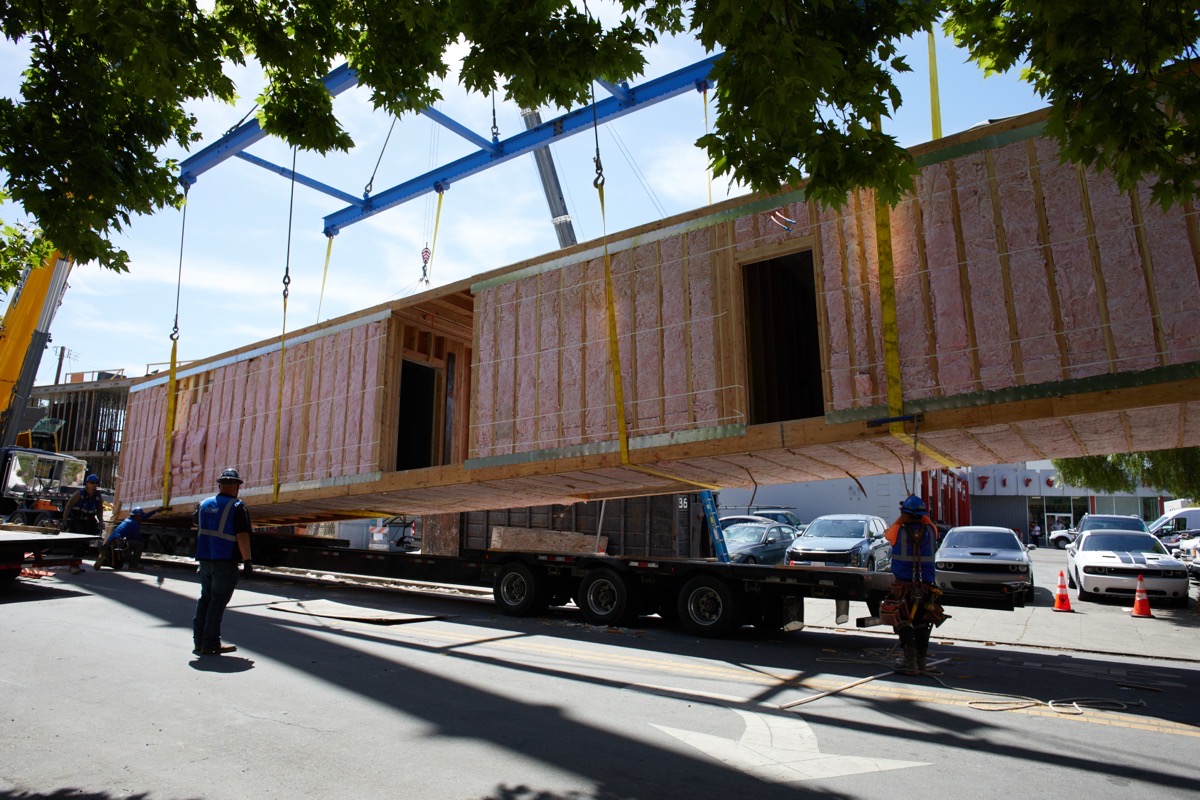
So, the way it works is this. The large crane on Vera (which is yellow) picks up a module — modules range in weight from 18 to 22 tons — with the help of a metal frame, some cables, and four fabric straps:
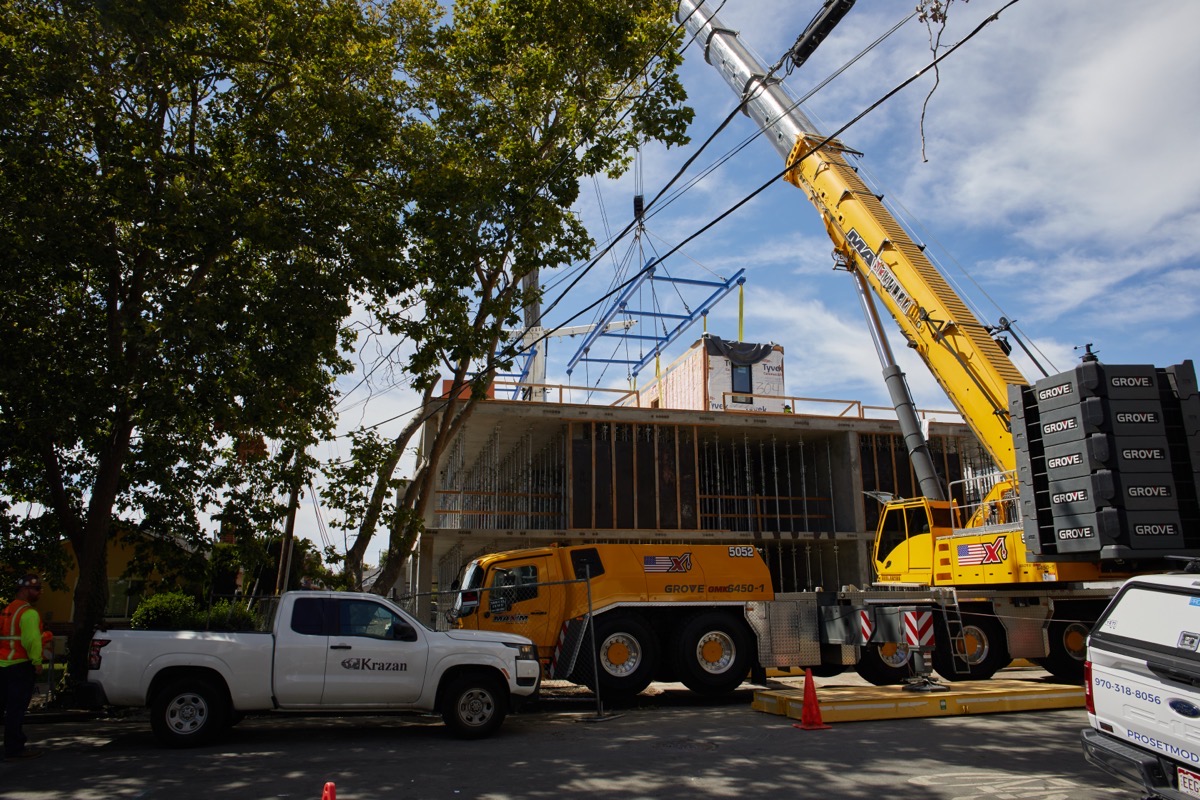
The crane “flies” the module up to the top of the podium, and places it near the front of the building:
Then, the white crane, up on the podium, picks the module up, swings around, and sets it in its designated place. Although the crane operators appear to be very good, setting each module into place still takes the assistance of a couple of workers who are literally pushing and pulling the module into place (using ropes) while it is lowered the final few inches.
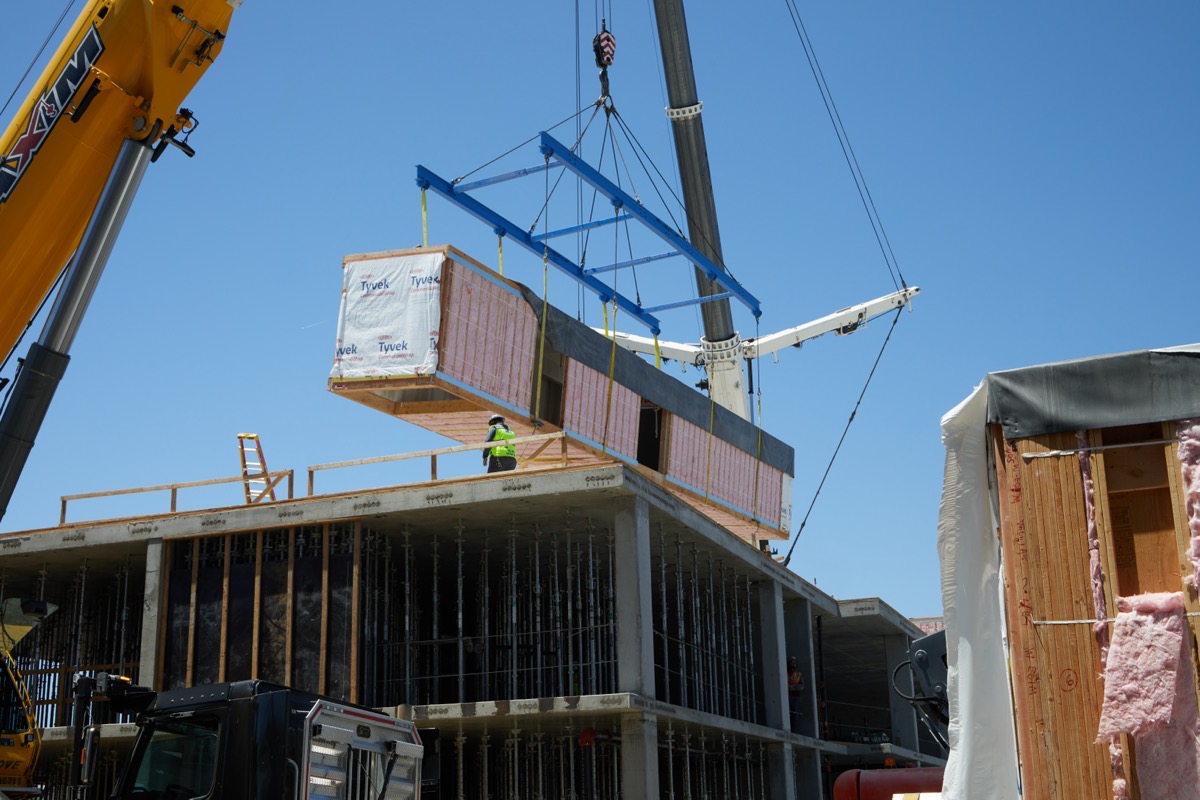
The white crane will stack up the modules towards the back of the building to their final height, after which it will be repositioned towards the front of the building, from where it can continue to stack modules. Eventually, though, modules will need to be placed where that crane is located. But by then, the modules can be placed directly (and more quickly!) using the crane parked on Vera Avenue. So at that point, the large yellow crane will pick up the somewhat smaller white crane and lower it to Vera — at which point I presume it’ll be taken away.
The goal is to place ten modules per day. With a total of about 100 modules, that means that this building’s five upper stories will be in place after only ten days, which is pretty amazing when you consider how long it would take, using conventional building techniques, to build out the 138 apartments plus the ancillary rooms that will be located on those five floors. I was told that, in reality, the process will probably take about 12 days, thanks to a couple of hiccups early in the process. But things seem to be moving smoothly now, and once the white crane is no longer needed, the process will go even faster, since the modules won’t have to be transferred from one crane to the other.
By about 2 p.m. on Tuesday, they already had nine modules in place towards the rear of the building:
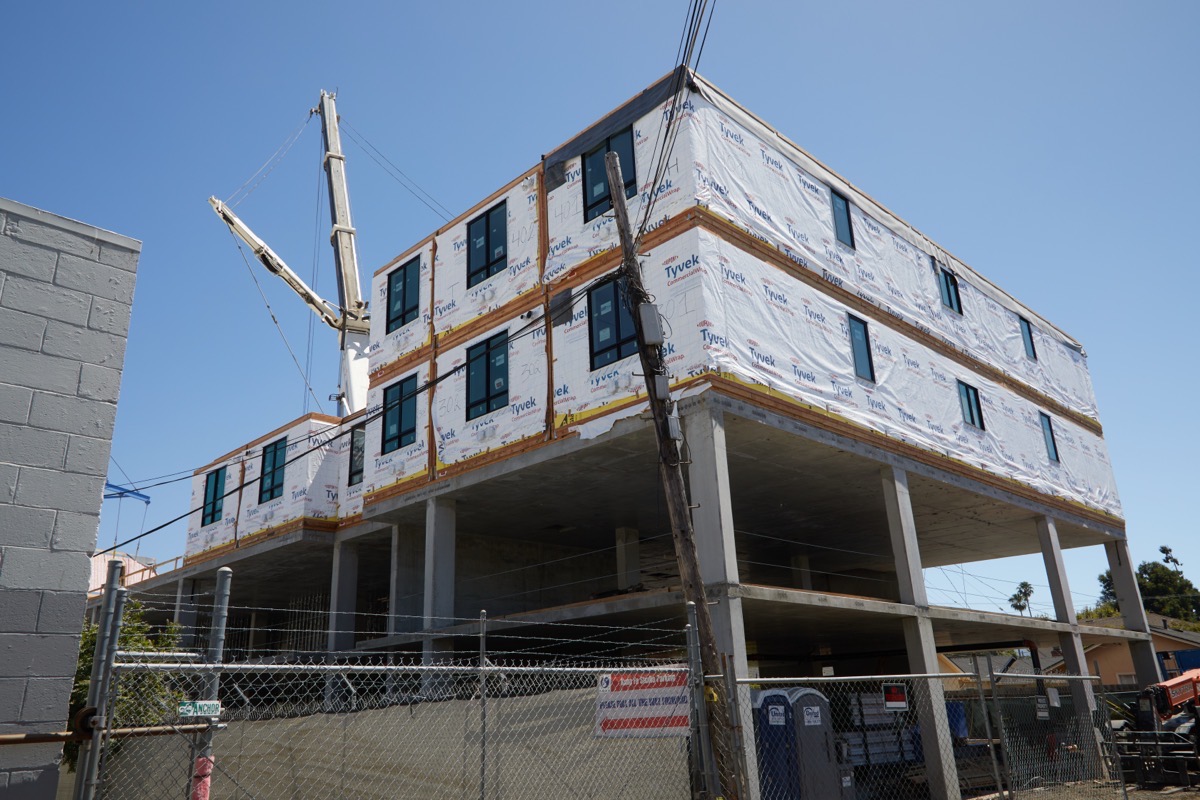
The building’s first floor will contain 15 apartments plus the lobby, mailroom, a laundry room, and various utility spaces, while the second will have 23 apartments plus two laundry rooms, a fitness center, a double-wide multipurpose room, and the manager’s office. I presume that those floors will be built using traditional techniques, since I cannot see how they could slide modules in from the side. But regardless, by using modules fabricated offsite, the developer has saved a great deal of time and on-site effort by employing modular construction. Note that although the building’s exterior will still need to be applied once all of the modules are in place, each modular apartment is most likely complete inside, with interior finishes, windows, doors, bathrooms, and kitchens all ready to go. The modules will still need to be hooked up to power, water, and sewage, but that is likely a simple process. Taking longer will be the buildout of the first two floors, the finishing of the hallways on the modular levels, the exterior of the building, the installation of the two elevators, and the roof — but again, all of that will take far less time than it would have taken to construct the building conventionally. Which means less neighborhood disruption, something that the many residents along and around Vera Avenue will surely appreciate.
As I noted when I began, once this building is complete the only evidence of its modular construction will likely be pictures like mine. In the end, it should look like this:
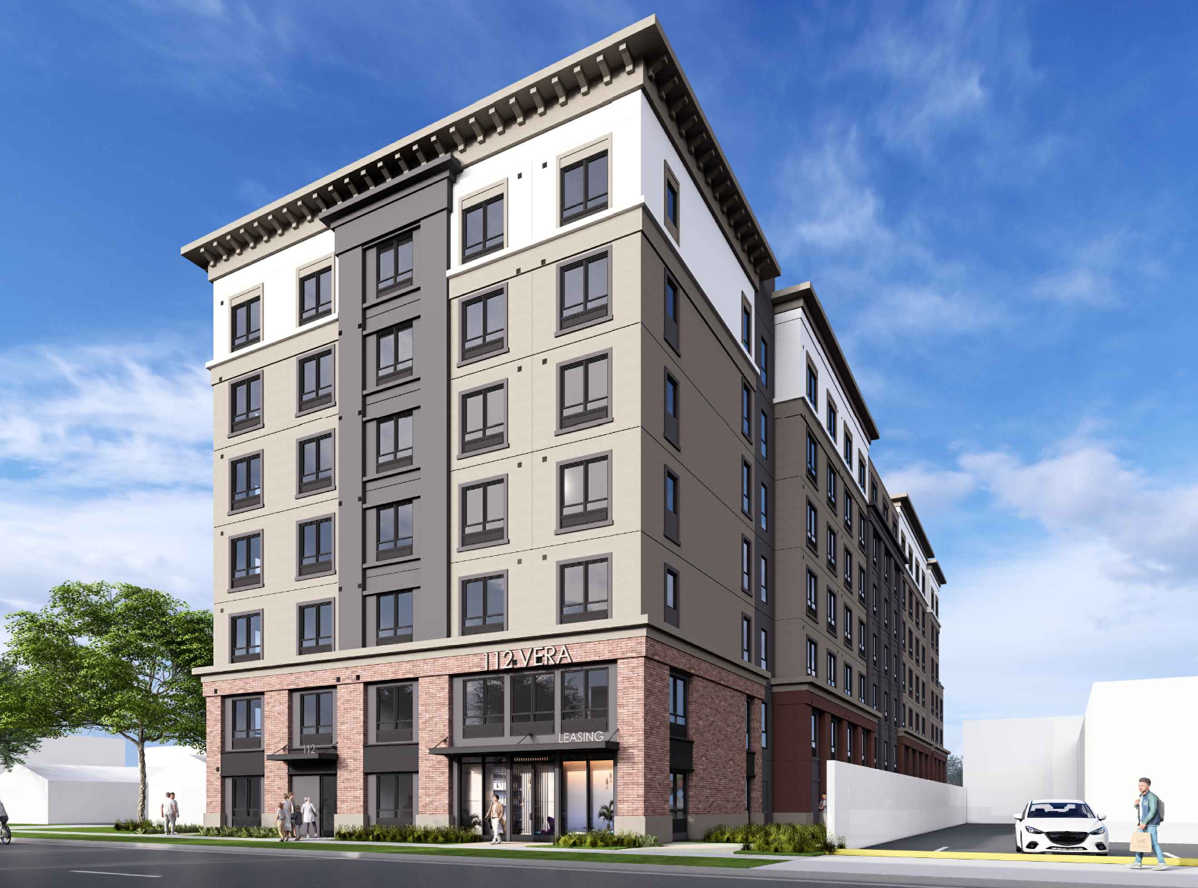
And 176 households will be able to have new, more affordable, homes (the building will have two additional units — one-bedroom units, apparently — for the building’s on-site managers). To squeeze that many apartments into a building this size, the apartments necessarily have to be on the small side. Twenty-five of them will be 411-square-foot studios, with the rest being 450-square-foot one-bedroom units. But they are complete apartments, with full kitchens — including dishwashers — and proper bathrooms with what appear to be tub/showers. And with two common laundry rooms on each floor, doing that regular chore should be convenient enough.
The building’s ground floor includes a bicycle storage room with space for 109 bicycles. In the rear, the ground floor of the building is recessed to provide space for six vehicles — but those spaces are not for residents. This building’s biggest drawback is its complete lack of resident parking, and given that the street parking along Vera Avenue and the streets surrounding it already seem to be fully occupied by the area’s many existing residents, hopefully the building’s management will be able to find enough demand from people who don’t own cars (whether or not a resident owns a car cannot be made a condition of residency, so undoubtedly many will find themselves struggling for somewhere to park). It’ll be interesting to see how that plays out…
In the mean time, if you or your kids enjoy watching this kind of activity, head over there in the next week or so. After all the modules are in place, from the outside the on-site activity level is going to drop significantly.
I was sad to see that Das Bierhauz, the German “beer garden” on Theatre Way, has closed. It opened on August 5, 2024, after an amazingly short remodel of the former Cafe La Tartine space. I certainly enjoyed their food and drink on my admittedly few visits, but perhaps not enough others did. Whatever the actual reason for the closure, they have a location on Castro Street in Mountain View that they claim is only a 15 minute drive away. Or, of course, people can just head over to Gourmet Haus Staudt on Broadway. But it’ll be interesting to see who next occupies this great dining space on Redwood City’s Theatre Way.
Thanks to an article in the Redwood City Pulse, I learned that Redwood Bistro, the Chinese restaurant at 711 El Camino Real in Redwood City, closed about two weeks ago. According to a sign on the door, though, that space will next be the home of “Mr. Pan Bistro.”


Do you know what is happening at the golf course at Woodside and Alameda? I thought they were just smoothing out a storage area, but now there is a crane, so I don’t know what is going on.
No idea; I haven’t been over that way in quite a while, so I don’t even know that any work was going on. I’ll give it a look and try to do some research.
I rode my bicycle by the other day and it looked like there might be something going on related to water infrastructure. I think it’s probably this: https://ceqanet.lci.ca.gov/2025041047 a system to use recycled water ( not drinking water) for irrigation.
I agree; it looks like you figured it out! Thanks for doing the research.
It seems to me that a lot of the new buildings in RWC have kinda the same style. I don’t know how to describe it tho. Is there a name for this so-called style? Looks 👍 good tho. California modern perhaps?😃
I don’t have a background in architecture or design, so I have no clue. California Modern sounds good to me! But perhaps someone with some actual knowledge will chime in