
This week’s post is a day late: I’m traveling at the moment. But earlier in the week I was able to take a tour of the Veterans Memorial Building/Senior Center project (which is still very much under construction along Madison Avenue in Red Morton Park) and I’ve been eager to share some photos and one or two interesting tidbits with you. Thus, read on to take a mini-tour of your own.
I’ve been studying this project and writing about it off and on since 2016 (when the project was still being publicly debated; ground-breaking took place in mid-2021), but no amount of poring over the public plans and imagining what the finished project might be like can do the actual project justice. My tour was led by Robin Mathers, General Superintendent, Gilbane Building Company; and Chris Beth, Redwood City’s director of Parks, Recreation & Community Services, both of whom proved to be delightful and informative guides. The tour lasted about an hour, and we managed to poke our noses into pretty much every nook and cranny of the new building. We didn’t go on the roof, but we spent a bunch of time on the upstairs outdoor area where there will be a walking track and an outdoor garden of sorts. We also went up into the catwalks above the new theater, which was an adventure in itself.
We saw a lot of small rooms — offices and multi-purpose rooms, utility closets, and the like — that I am not necessarily going to show here. If I did, this post would go on for days! But I will give you some of the highlights that I think show why this building is going to be so special, and such a great place for people to spend time in.
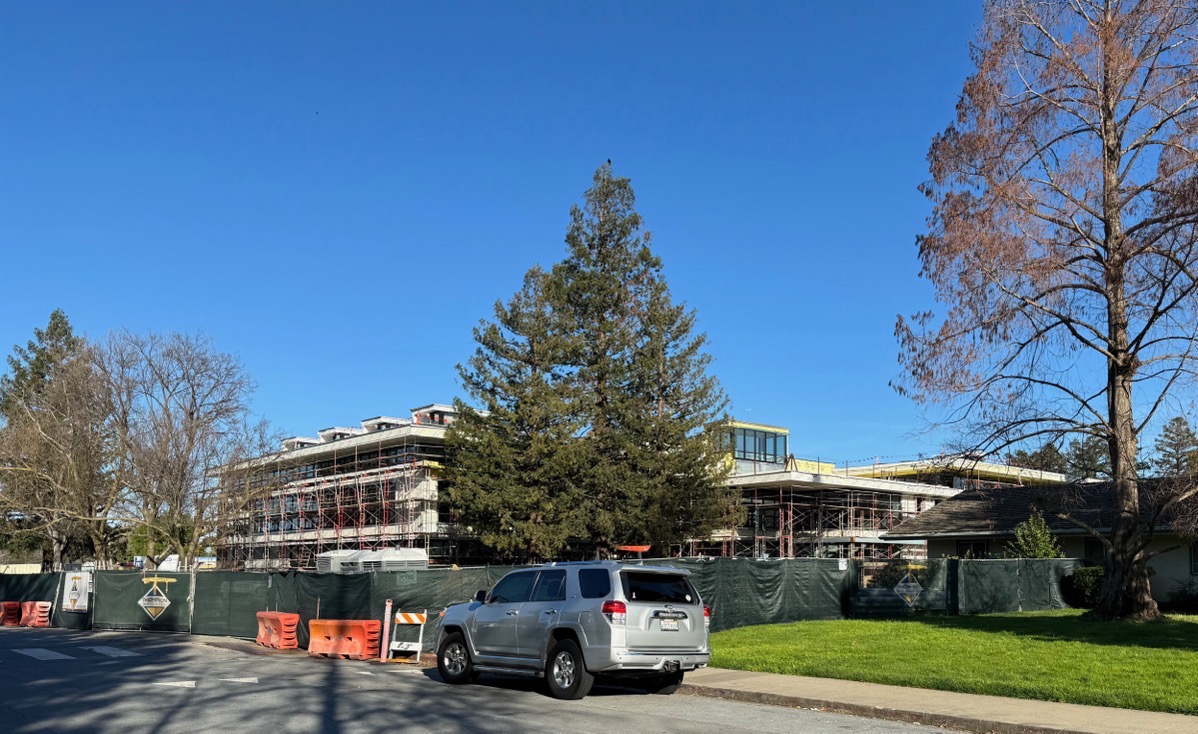
This first picture is from the outside, of course, and shows the corner where the roughly L-shaped building bends to run along Madison Avenue. The longer leg of the ‘L’ heads off to the right, behind the existing Veterans Memorial Building/Senior Center (VMSC), a building which has been in use since the 1950s. Its replacement, as you can probably tell, is far more modern and significantly bigger than the old. At one time a short segment of Nevada Street extended into the park between the old and new buildings, but no longer; where that section of street once ran will become a grand promenade for pedestrians. One day it’ll separate the new VMSC from the new YMCA building, which in a couple of years should replace the old VMSC building.
In the above photograph, the main entrance to the new building will be to the right of those redwood trees occupying the center of the image. Apparently, the designers wanted the building to be more of a clean ‘L’, but had to notch the outer corner in order to preserve those two trees. Which seems to be appropriate given the name of our city…
Although we couldn’t actually enter the building through the main entry (due to construction), we came in through a side door and made our way into the lobby, which is open to the second floor and is thus quite grand:

As you can see, there are a lot of windows letting in a lot of natural light. That is a theme throughout this building: it is designed to be extremely energy efficient, and allowing natural light into nearly every room of the building will help with that. Upstairs, near the upper left corner of the photo, note the long opening looking out over the lobby: that will be a window between the lobby and a nice-sized conference room (which will be one of the nine or so rooms within the building that organizations can rent).
The two reddish ladder-like structures in the center of the room will hold digital displays that can let people know what activities are going on, and where. I suspect that they will also show pictures of Redwood City residents and such.
The ‘L’ shaped building lies along two sides of the soccer field near Madison Avenue. Much of the shorter part of the ‘L’ is consumed by the building’s theater:
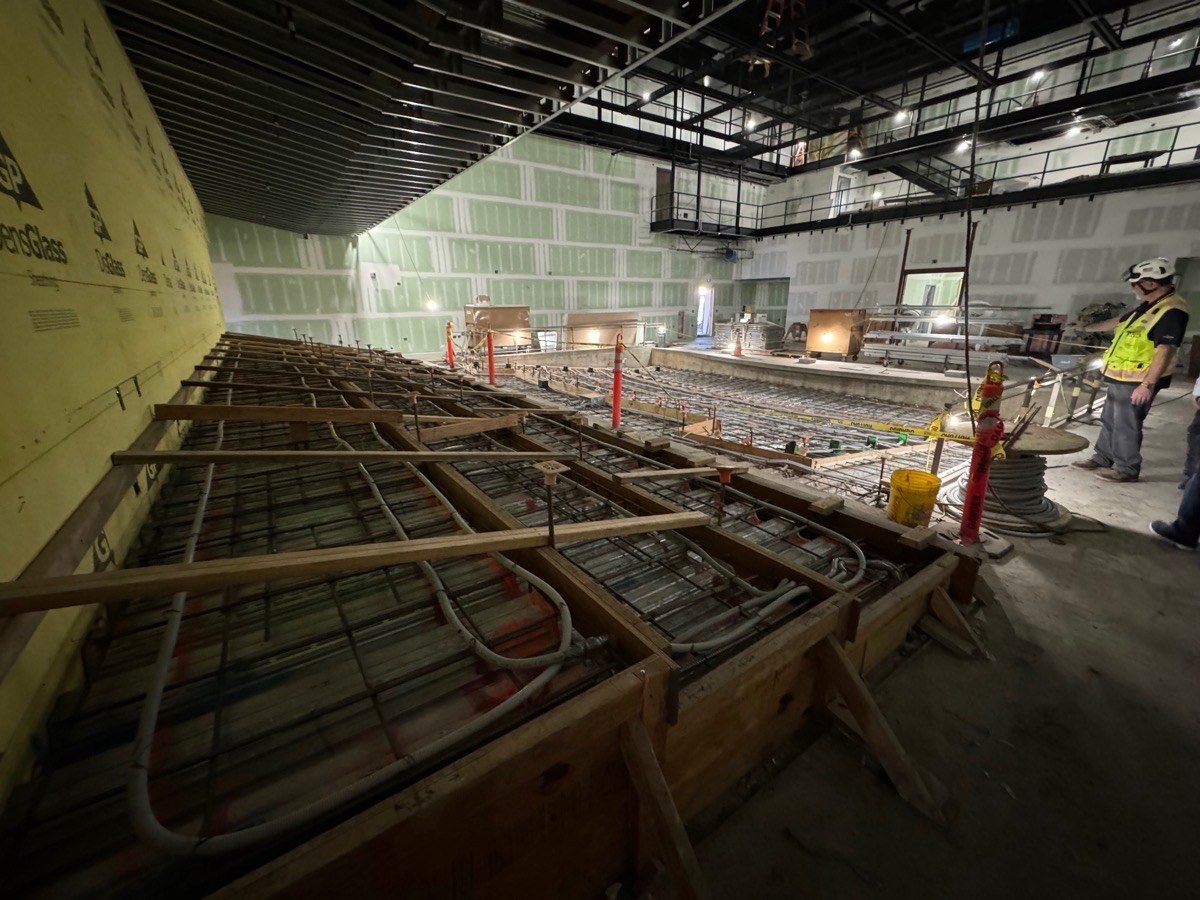
The concrete floor beneath where the seats go has yet to be poured, but as you can see there will be a large sloped area for seating facing a stage with a rounded front. Above the main seating area is a balcony that will have two rows of seats. Altogether this theater will have seating for something like 290 audience members. As you would expect, this being a senior center, there will be room for wheelchairs (both upstairs and down) and access to both areas will be straightforward, with no stairs. The balcony is easily accessible from the building’s second floor, and there is of course an elevator just off the lobby to transport people up to that second floor.
The theater will be quite flexible, with projectors and a screen (movies will be shown on a regular — perhaps even daily — basis), plus all of the necessary infrastructure to host lectures, concerts, and even plays. Backstage, there will be a “green room,” changing areas, bathrooms, and showers. There will also be an oversized door enabling access to the backstage area from the adjacent parking lot (which has yet to be constructed); sets and large musical instruments can be wheeled in through that door.
Here is a view of the theater from the stage:

In this image you can see the balcony and, behind it, the projection booth/control room. Note the catwalks running along the sides of the theater, high up. Although it is a bit hard to see in these photos, between those catwalks, extending all the way across the room, is an open metal framework upon which is stretched a metal mesh:

That mesh is strong enough to support a person (and more); we walked out on it and were able to look straight down at the theater. Not something I’d recommend for anyone who has a problem with heights…
The theater occupies the “toe” of the ‘L’. Closer to where the two arms meet (right behind the yellow insulated wall in the previous photograph) is the building’s industrial kitchen. The appliances have yet to be installed, but we were able to see where the food would be stored and prepped:

In the center of the above photo you can see a “serving window” that passes through into the building’s glass-walled dining room. That dining room will open out onto patios on the Madison Avenue and (former) Nevada Street sides of the building, so people can enjoy a meal either indoors or out. This dining room will also serve as a multi-purpose room, one that can be divided in two thanks to an electrically operated partition.
Directly above the dining room, still on the outer corner where the two arms of the building come together, is one of the building’s multi-purpose rooms that organizations can rent for meetings or activities. As you can see, especially because this is on an outer corner of the building, this one has a lot of glass and thus a ton of natural light:

There will be a couple of other multipurpose rooms adjacent to this one along the Madison Avenue side of the building, plus an “art room” that will be used for arts and crafts-type activities.
That about covers the short arm of the ‘L’. Before I get to the longer arm, though, I want to pass on a cute bit of trivia that will not be apparent when the building is complete. Take a look at the following photo:

See that gap running right down the center of the photo? It turns out that this ‘L’-shaped building isn’t really that. Instead, it is two roughly rectangular buildings standing extremely close together in an ‘L’ configuration, with a tiny gap between them. Apparently, there were a couple of reasons for this: Robin thought it might help make the building more resilient during an earthquake, and to address some building code issues. I was told that this gap won’t be visible when the building is completed, and it of course will have no effect on the functioning of what everyone will think of as just one large building, but I thought it was interesting.
Downstairs, on the (former) Nevada Street side of the long arm of the ‘L’, there will be some small offices followed by three larger rooms: a lounge/game room with an electric fireplace, a wellness room (for classes, including things like yoga and light exercise, I believe), and an Adaptive PE room with workout equipment appropriate for those with special needs. All of these rooms will be accessed via a long window-lined hallway that will run along and look out onto the adjacent soccer field:

In the above photo, the red panels you can see along the right-hand wall will be displays of veteran’s and/or 49’ers material, so people walking the hallway to get to the specialty rooms (or to the gym, which is at the far end of the hallway) can enjoy some local history as they go. Similar panels throughout the building indicate that there will be other displays scattered throughout the building.
Here is a view through the hallway windows out onto the soccer field. Note that between the windows and the field are scaffolding, construction fencing, and green construction cloth on that fencing, all of which will not be there when the building is complete.

Before I leave this hallway, the small windows closest to the floor are electrically openable, as part of the building’s energy-efficient heating and cooling systems (about which I’ll get to later).
So. The gym:
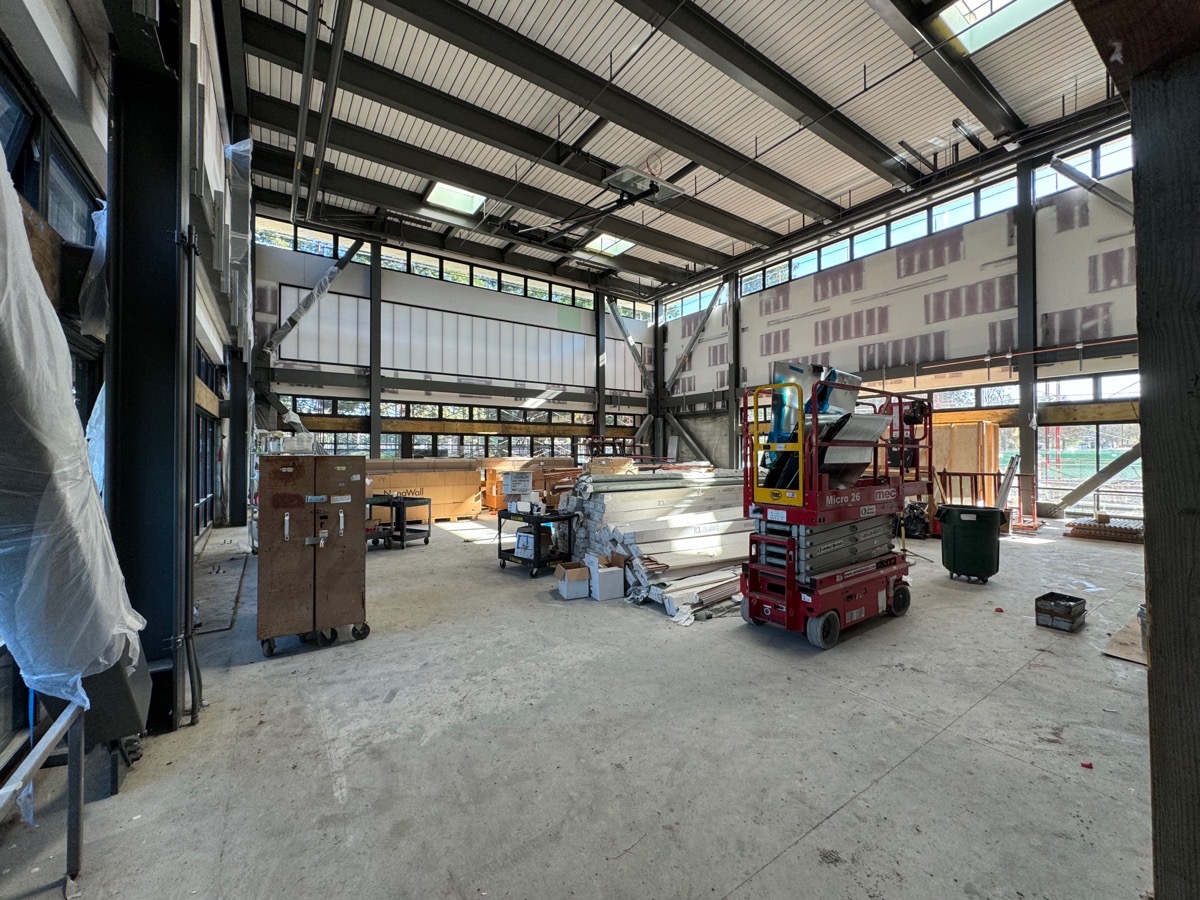
As you can see, it is double-height (as it would need to be!), with more windows than you would see in most gyms. It isn’t a huge space, but it isn’t meant to be: a full-sized one can be found in the Red Morton Community Center (over on the Roosevelt Avenue side of the park), and the YMCA building, when it is built, will also have gym space. So here we have one just large enough for a half basketball court (note the basketball backboard flat up against the ceiling; it can be lowered when people want to play) or two side-by-side Pickleball courts. When needed, this space can also double as another large meeting room: it can accommodate chairs for 250 or so people.
There is a small balcony area upstairs that looks out over the gym; here is a view of the gym from up there:

The gym is at the very end of the long arm of the building’s ‘L’. Here is a photograph showing that arm from the outside:

In this image, the gym is on the right, and the lobby and such are just beyond the left edge of the photograph. The large rooms along the long hallway are beneath that bright-yellow insulated strip running through the middle of the building. And above that strip, the building is open: that is where the walking track and “rooftop garden” will be located.

As you can see, there is a structure above the open rooftop area. However, the large central opening you see in the above photograph will remain open. As for the smaller openings you see running the length of the overhead structure, those will actually be filled with transparent solar panels, which will generate electricity while still letting some sunlight through (I for one am very curious to see how transparent these panels actually will be). Thus, there will be a bit of protection from the rain. As for why you might want to be up there in the rain, well, for one that balcony area that looks out over the gym is in the portion of the building you can see in the distance in the above photo.
Those oddly shaped structures you can see in the center of the rooftop area are planters (some with built-in seating); they will contain the building’s “rooftop garden” and will be maintained by UC Master Gardeners. The track will describe an oval around those planters. And as I understand it, between the track and the left edge of the rooftop — which looks out over the soccer field — there will be tables and chairs, for those wanting to sit and watch the sporting action below. There will of course be railings on both sides; those have yet to be installed (those orange flags you can see toward the right side of the previous image are all that keeps one from falling off the building at the moment!).
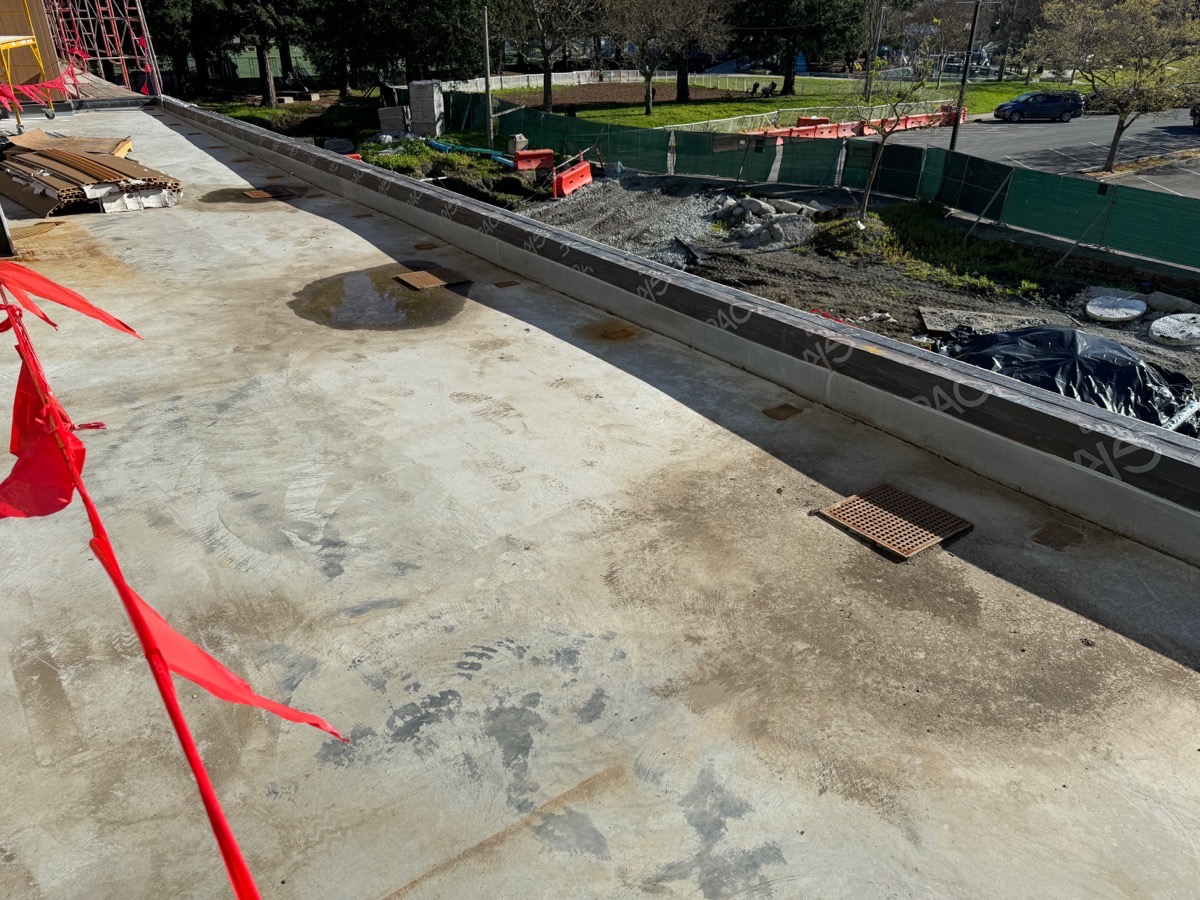
Finally, another bit of interesting trivia: there are drains all along both sides of the rooftop area (clearly visible in the above photo) that lead to two large underground cisterns. Together those cisterns will be able to capture and store 3,000 gallons of rainwater, water that will be available in case of a major emergency (think earthquake). To go with that water, the building will also be equipped with batteries and a generator capable of powering the building for three days.
You may have noticed a large something sticking up through the center of two of the planters: those are two of the building’s “solar chimneys,” which will help keep the building cool on hot days. These use no energy, but simply allow hot air, which naturally rises, to flow up and out of the building. As the air flows out of these chimneys, the small drop in air pressure will then pull cooler air in through windows like those along the floor of the building’s main hallway downstairs. Other solar chimneys are scattered throughout the building; together they should go a long way towards keeping the building comfortable on hot summer days while using little or no energy. Of course, energy will be needed for other functions, and this all-electric building aims to generate nearly all of what will be needed. Those transparent solar panels above the walking track are just the tip of the iceberg: the rest of the building’s rooftop is almost entirely covered with conventional solar panels.
That pretty much completes our tour. As you can probably tell, this building has been carefully designed to meet the needs of a great many groups and individuals; I suspect it will be buzzing with activity once it is open. Which everyone has been hoping will be this fall (after some significant delays earlier in the process), but realistically may be closer to the end of this year. Whenever it does open, though, although it is a “senior center,” with many of the activities geared towards seniors, it appears that those members of the public not yet of senior age will nevertheless find occasion to enjoy this building as well. So keep an eye out for this building’s grand opening, and then keep an eye out for activities that you might be able to participate in. Maybe I’ll see you there!
 Walking Redwood City
Thanks for the tour and interesting info.
Looking forward to the opening.
Senior Citizen Dave
It looms like a beautiful facility, I look forward to seeing it complete!
The “two buildings meeting as one” design is surprisingly common due to seismic considerations in California. In my role of designing overhead network cabling, we had to provide a flexible connection at that point. It was often as simple as a break in the supporting tray and slack in the cables, but it was taken quite seriously.
Interesting. I’d never seen this before, but I guess it makes sense. Thanks for the added info!