
Before I get into this week’s main topic — which, as I indicated at the end of last week’s post, are the two Stanford projects that were approved by the Planning Commission this week — I have some follow-up from other parts of that earlier post, plus a handful of quick items.
First, my wife and I dropped in on the one-day “Festive Finds” holiday event that was held last Saturday at 1080 Main St., where you’ll find the two historic homes adjacent to the main library parking lot. One of those homes — the yellow, historic John Offerman House (apparently, it is the oldest surviving building in Redwood City) — will, if all goes well, at some point next year become The Yard Coffeehouse. I had the good fortune to have a brief chat with both Chris, the operations manager (and former owner of Back Yard Coffee) and John, the new venture’s owner. They let me know that although they have contractors ready to do the necessary refitting of the old house’s interior, they are still working to obtain the necessary building permits. So look for them to open sometime next year (hopefully, early on). From their website, they plan to have counter service and seating in “The House,” as well as an outdoor counter (in “The Shed”) plus seating in the adjacent lovely open garden. John had apparently hoped to open last fall, but clearly that didn’t happen. So keep an eye on the site, and drop by and check it out when The Yard opens. I certainly will, and I’ll let you know when I do.
Tomorrow, Saturday, December 9, Redwood Trading Post (at 1455 Veterans Blvd. in Redwood City) will be holding their “Holiday Sale & Disaster Preparedness Event” (hopefully they aren’t suggesting that your holiday is likely to be a disaster…!). Their sign says they will be offering “deep discounts on major brands,” and that there will be prize giveaways and free refreshments. There will be presentations on a handful of disaster-related topics, with the first starting at 10:30 a.m. and the last beginning at 2 p.m.
Last weekend Courthouse Square hosted the Redwood City Downtown Business Group’s Hometown Holidays event, and this weekend — on Sunday, December 10, starting at 4 p.m. — it will be the place for Chabad Midpen’s 14th annual Chanukah Festival. The plan is to construct a seven-foot-tall Menorah out of 27 different pre-painted canvases. Hopefully all of the canvases have been, or are in the process of being, painted, but in case they have not, or if you simply want to make a donation or learn more, see their website for details.
This week I took a walk to check out something that I was pretty sure I noticed while taking my wife to JoAnn Fabrics, near Kohl’s. And yep, it seems that while I was away for a Thanksgiving break the old LifeMoves Maple Street shelter, at the very end of Maple Street where it dead-ends into the northeast side of the freeway, was completely demolished and hauled away. Until a couple of weeks ago, the shelter consisted of three small one-story buildings plus a fenced rear yard where residents could enjoy the outdoors with some measure of privacy. This week, however, as I reached the point where the recently extended Blomquist Street meets the recently shortened Maple Street, I was greeted with this view:

Soon Blomquist will continue to be extended, essentially to follow the roadway you see above until it hits Highway 101, at which point it will make a sharp right turn and run alongside the freeway until it meets Redwood Creek. The remainder of the property — most of where you can still see a large white concrete pad that was the foundation for the shelter buildings — will very likely soon be redeveloped by MidPen Housing as a 110-unit supportive housing project for low-income individuals. (See my post Project 2023 for a description and some renderings of that proposed project.)
After thoroughly exploring the site, I followed Blomquist Street out to its former terminus, and was interested to note that the office trailers that have been occupying part of the 1402 Maple Street site for nearly a decade finally appear to be on their way out. I believe that those trailers, which contained on-site offices for developers of various projects in the area, were first installed back in 2014, when the construction of the Maple Street Correctional Center first got underway. Most recently, I believe they were used by those managing the construction of the county’s new Navigation Center, just across the street from where the trailers were located. But this week, the temporary offices have been broken down to their component pieces, wheels have been attached, and plastic has been used to cover the open sides where one trailer attached to another:
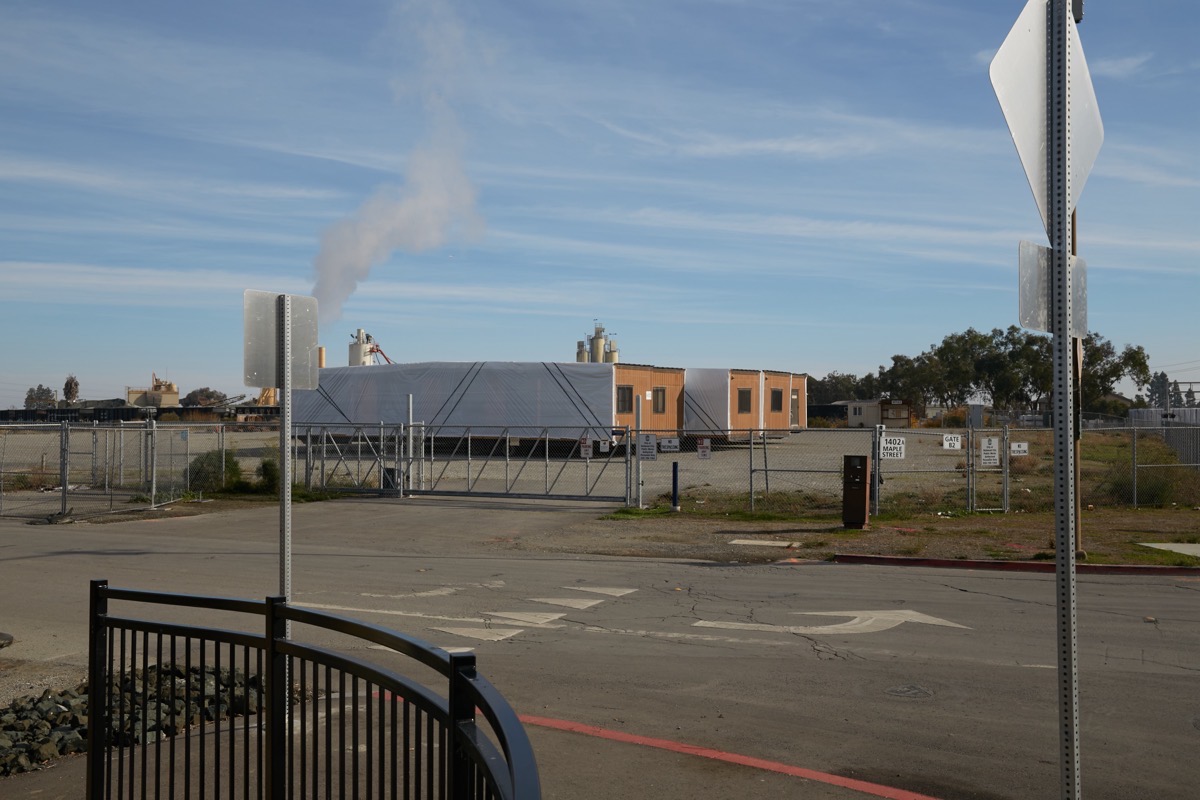
If the trailers haven’t already been hauled away, I expect them to go very soon, leaving the vast majority of the property clear and ready for a new use. (Norcal Crew still occupies a portion of the site closest to the creek. For a couple of years a portion of the site closest to the Correctional Center was used as a Safe Parking Lot for recreational vehicles, but that program was wrapped up some months ago.)
Finally — I’ll get to Stanford’s projects, I promise! — I stuck my head into the still-operating CVS Pharmacy on the Broadway Plaza project site and asked one of the cashiers when she thought they would be moving. She told me that the plan is to begin the move next month (that is, in January) and that the move itself will take about a month. So watch for Redwood City’s newest CVS Pharmacy, at Bay and Woodside roads, to be open in late January or early February. Oh, and as for the Broadway Plaza project itself, visible activity has finally kicked into high gear; peer into the giant excavation that will soon be part of the development’s subterranean garage, and you’ll see loads of activity going on all over the place:

OK. Stanford. As I stated at the outset of this week’s post, the Redwood City Planning Commission just approved two Stanford projects. One, Stanford Precise Plan Block C, is for the south (or what most people think of as east) side of Broadway, and is intended to add to the collection of buildings that make up Stanford’s administrative (that is, non-academic) campus in Redwood City. The other, Stanford Precise Plan Block E, is for the north side of Broadway and will enlarge Stanford Health Care’s medical center in Redwood City. Both items were dealt with by the Planning Commission as one item, which made for a slightly confusing, but presumably more efficient, process.
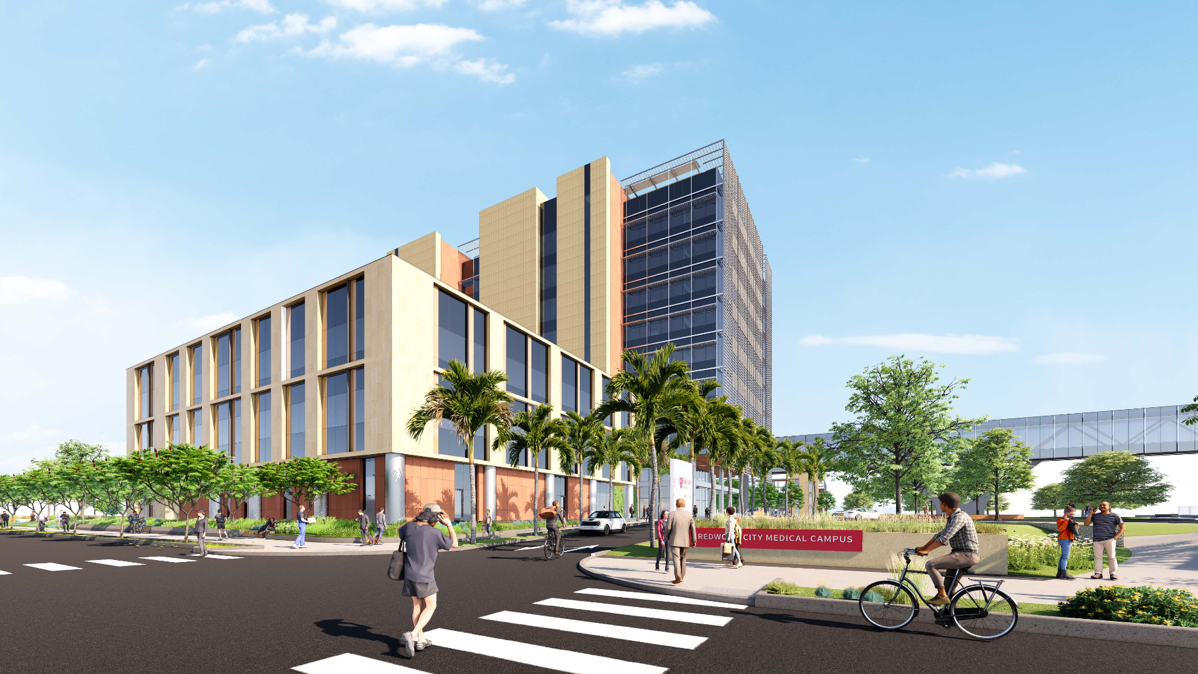
Starting with the medical center, the project will see the construction of a fairly large (265,000 square foot) medical office building and a three-level, 928-space parking garage. The building will be three stories high out close to Broadway, but nine stories high towards the rear, closer to Highway 101 (the parking garage will stand between the medical office building and the freeway). From Broadway, the building should look like this:
Today, there are two buildings on the site. The first sits right out on the street, at 500 Broadway. It is a two-story building that up until Stanford took over was home to Ampex:

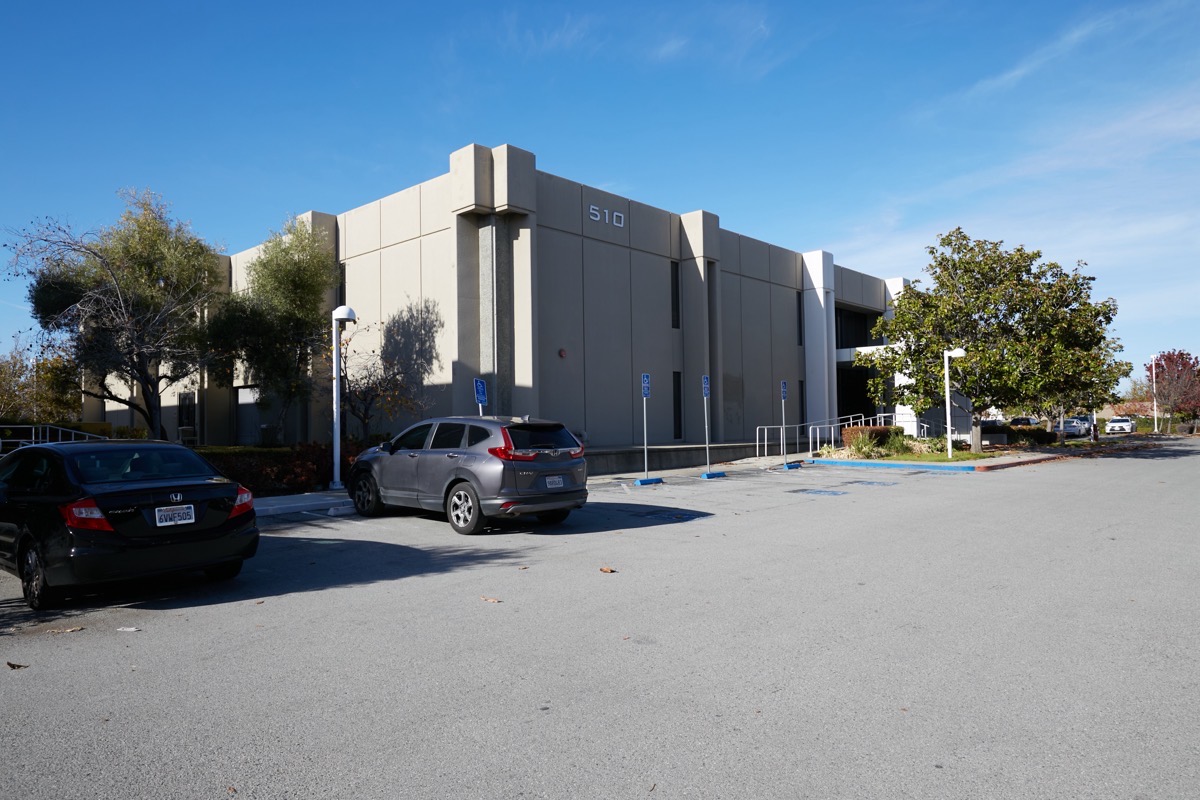
Behind it (towards the freeway) is a second building with the address 510 Broadway. That two-story building, too, will go:
Farther back, towards the freeway, currently there is just a bunch of surface parking:
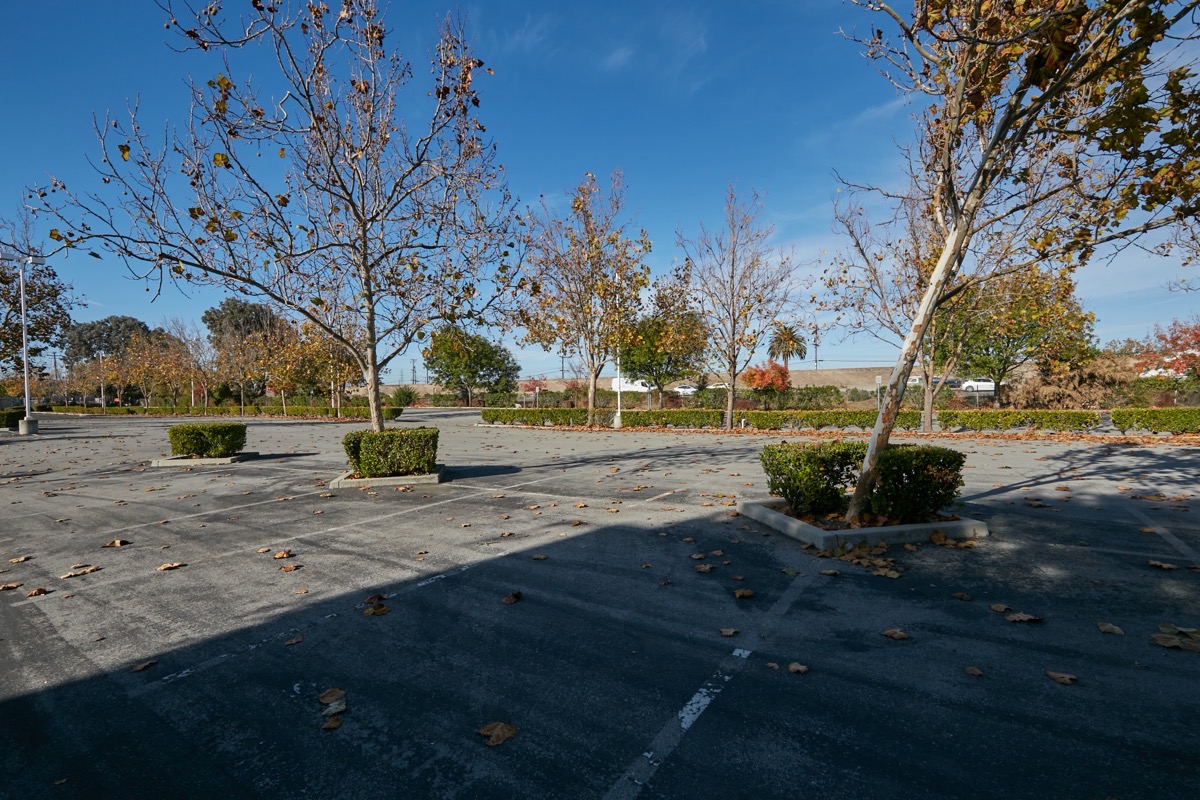
Stanford has owned these properties for a number of years now. For a while, that front building was home to Stanford University Press and some offices connected to the Stanford University Libraries. Once the administrative campus was constructed across the street, though, I believe those two functions were moved over there, and this building has sat empty. As for the smaller building in the rear, I never did work out what was in there (although the relative lack of windows makes me wonder if it contained electronic equipment or storage or some such). As for the parking lot, that actually came in handy over the last couple of years: Stanford used this lot as a drive-through vaccination and testing site during the height of the pandemic. My wife and I actually received most of our vaccinations there: we found it very convenient and efficient.
In any case, Stanford Health Care’s Redwood City medical campus, which began in the four buildings that had been constructed as company headquarters for Excite@Home (that company declared bankruptcy in mid-2002, just two years after moving in). The buildings sat empty until 2005, when Stanford Health Care purchased and remodeled them. It then did a subsequent remodel in 2018, which included the construction of the multi-level parking garage that sits between the existing medical buildings and the freeway:
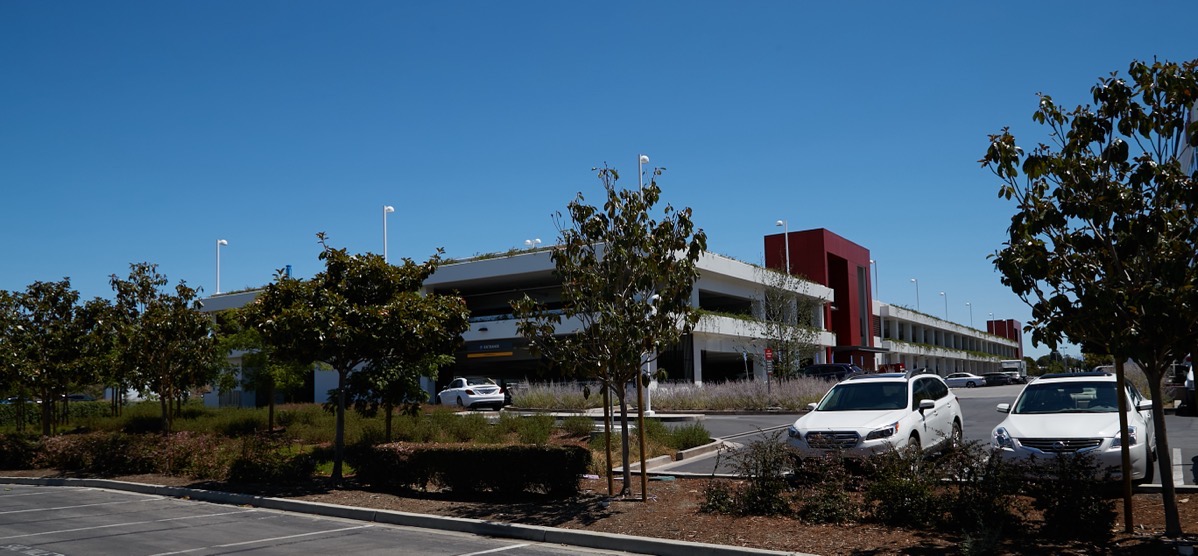
This recently approved project is just the next phase for this campus, and will enable Stanford Health Care to provide even more medical services to the local community. Interestingly enough, although Stanford knows which medical specialties will be occupying the new building, they haven’t yet identified enough of them to fill the entire space. Thus, their plan is to construct the entire building shown in the earlier rendering, but not to fully build-out the interior. Only around five of the building’s nine floors will be occupied at first, with other floors being built out at a later time once Stanford has a specific need for them.
One other interesting feature of the new building stands out pretty clearly in that rendering: an elevated walkway that will connect the new building to the existing ones. Here is a site map of Stanford’s medical campus in Redwood City, with the new medical building and parking garage added:

Broadway runs across the bottom of the map. Vehicles will enter the campus and proceed to the parking garages along a new section of Warrington Street that comes off of Broadway and runs around an oval between the new medical office building (“MOB”) and the four existing buildings (in gray, to the right). People walking between them would have to cross right through that oval drive between the two parts of the campus; given that much of the campus’s traffic would be making use of that oval, pedestrians would be navigating a lot of traffic. Thus, the elevated walkway which, if you look really closely at the map (click it to get a version you can zoom in on), you’ll see penciled in and running directly through the middle of the landscaped oval, between the MOB and what Stanford calls “Pavilion A”. Being elevated, the walkway would allow safe passage of patients, visitors, and medical staff while leaving vehicles free to pass beneath, unimpeded. I should note, though, that at this time Stanford Health Care doesn’t plan to construct that elevated walkway when it first builds the MOB; that walkway would be a later project.
For completeness’ sake, I should note that the map I included above doesn’t show the entirety of Stanford Health Care’s property: there is another parcel to the left that I omitted since it is not part of the current project. However, assuming the medical campus continues to thrive and even more space is needed, Stanford still has the space currently occupied by an older building at the corner of Douglas Avenue and Broadway to work with.
Directly across Broadway, we come to the second proposal. This one was brought to the city by Stanford University (the University and Stanford Health Care are sister organizations, but are not the same thing). Here, Stanford University has already constructed four office buildings (all along Broadway), three amenity buildings (a fitness center, a daycare center, and an “IT hub” and bike storage building), and a roughly 1,100-space multi-story parking garage. To this, they were asking permission to add two five-story office buildings (one on Broadway, and one at the rear of the property, along Bay Road), another small amenities building (containing café, kitchen, and conference spaces), and yet another multi-story parking garage, this one with room for around 1,000 vehicles.
Today, where the new buildings and garage would go are pretty much undeveloped; when Stanford University constructed the first phase of this campus, they landscaped the heck out of it, and where these newest buildings would sit they either landscaped or left as surface parking. Thus, pictures of the sites are not terribly exciting. For instance, the one office building along Broadway would sit, end-on, on what today is a surface parking lot:

From the plans, it appears that the building would sit right behind where that little tree, in the center of the photo, is standing today.
Beyond the parking lot you see above is, today, a grassy mound that apparently would disappear if these buildings are constructed:

The small amenities building and the parking garage would occupy part of this space, and extend back towards Bay Road. Walking over the mound towards Bay, I discovered that beyond it is another surface parking lot, one that would be replaced by the parking garage:

The cars you see lined up in the distance are parked along Bay Road.
Finally, the second office building would sit at the corner of Bay Road and Warrington Avenue, where today there is yet more surface parking:

Like I said, not that interesting (but nicely landscaped!).
If you’ve paid attention to the tenses I used when describing the university project, you might have caught on to the fact that although the project was approved, I’ve been using words like “if” and “may” when talking about the construction. That is because, thanks to recent work-from-home trends, Stanford University suddenly finds that it doesn’t actually need these buildings right now. Stanford University occupied the existing buildings on this campus not too long after completion: in late 2019. But then, just a handful of months later, the pandemic came on in full force and Stanford University found itself sending everyone home, in March 2020. Employees have been returning in recent months, but not yet to the point where additional space is needed on the university’s Redwood City campus. Accordingly, the development arm of the university decided to push on and gain project approval, which they’ve now done. They then intend to draw up construction plans and apply for building permits, which will take another year or two. Since they don’t actually have to put a shovel into the ground for a couple years after that before those permits expire, their strategy buys them a number of years before they actually have to decide to go ahead with the project, or put it on the shelf until a later date (at which time they would have to reapply for permits and/or project approval).
In any case, assuming that they do get around to building this particular project, here is a rendering of the office building that would sit along Broadway:
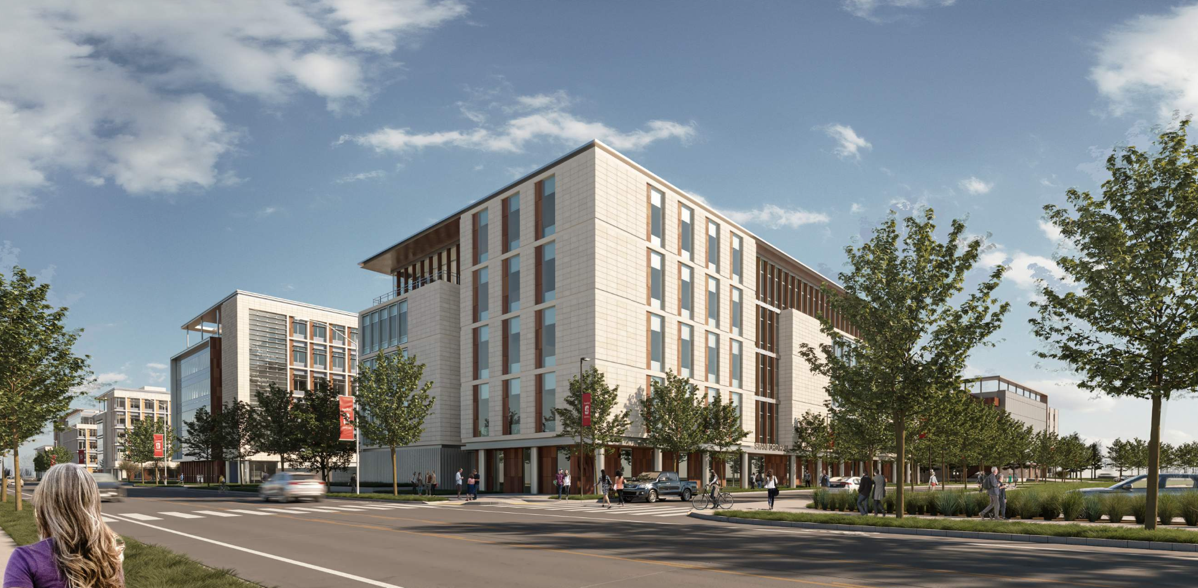
Note the buildings receding to the left; those are the existing office buildings on Stanford’s Redwood City campus. Also note the new parking garage, which would stand along the Bay Road side of the property, to the rear of the new office building.
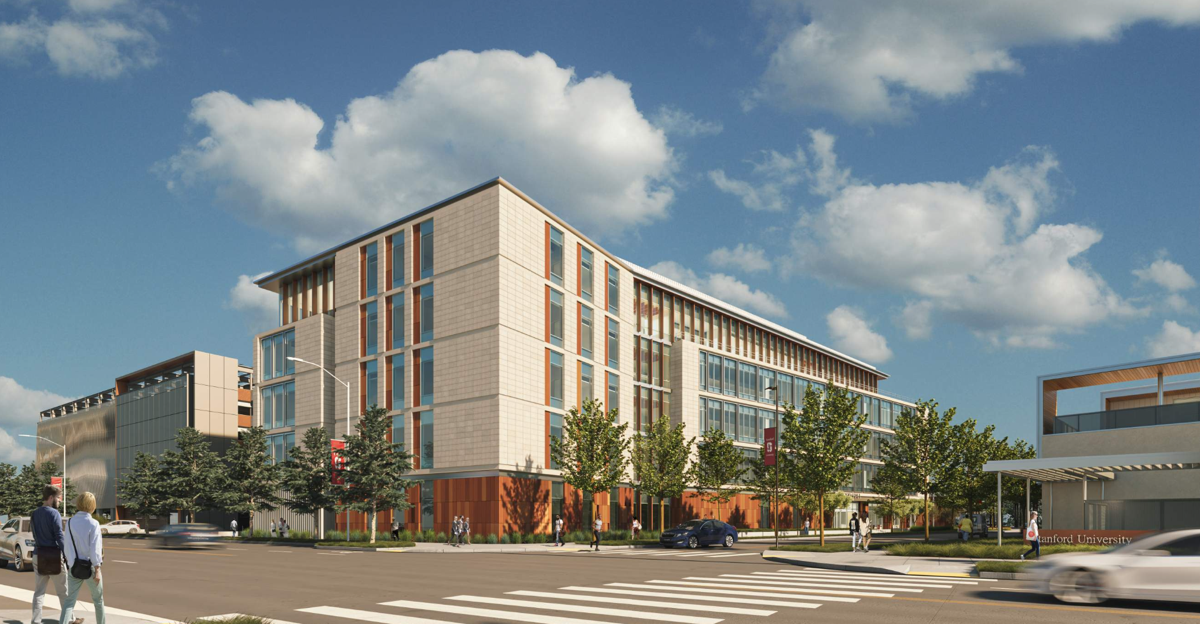
This rendering shows what the second office building, which would sit at the corner of Bay Road and Warrington Avenue, would look like. This rendering also shows the parking garage (albeit from the other side) and, on the right edge of the image, one of the campus’s existing buildings (the fitness center, in fact).
As you can see, the future buildings will take their cues from the existing ones, and will fit in nicely. Thus, if you like Stanford University’s Redwood City campus buildings today, you’ll like these new ones as well. And note that the heights of these new buildings are pretty non-controversial, at just five stories; they won’t rise above any of the existing ones.
So that is what is going on down in Redwood City’s Friendly Acres neighborhood, on Stanford’s two campuses. I continue to enjoy walking through the university campus, in particular, given its wide sidewalks, lovely landscaping, and large park-like area that connects directly to Redwood City’s public Andrew Spinas park, at the corner of Second Avenue and Bay Road. The landscaping has matured nicely since the campus was first constructed, and there are nice benches placed along the walkways where one can sit and enjoy what is a very quiet and peaceful place. I hear that the cafeteria (in one of the buildings right along Broadway) is open to the public, so there is food to be had. Lastly, the Marguerite shuttle runs between this campus and Redwood City’s Caltrain station — and it’s free and open to the public. So if you aren’t inclined to walk down there, check the schedule (weekdays only, no holidays) and consider taking a free ride.
 Walking Redwood City
Hi Greg, The Stanford campus was the former site of Ampex (where I worked for 27 years) – not Memorex. Most buildings have been demolished and replaced by Stanford already. I worked in both of those buildings that you featured in your article – 500 Broadway and 510 Broadway. 510 Broadway is relatively young, built in the mid-90’s and occupied by Ampex for a few years, but the other building was the Computer Center, probably built in the 1960’s, where the mainframe computer was located. It has been used by other companies since the demise of Ampex as a data center, but I think it’s been vacant for a while…
Thanks for your daily posts. I always read them to keep informed on what’s happening around town. Jill Clardy
Ugh. I knew that. I just was typing too fast… I’ll correct it right away. Thanks for keeping me honest! 😎
Wish the Stanford shuttle looped Brewster to Alameda and back to Sequoia Station via Jefferson.