
This week I spent time literally chasing a house (well, big parts of a house). Fortunately, I was driving at the time, or I wouldn’t have been able to keep up.
On Tuesday, I had two appointments: one at 11 a.m. in San Carlos, and another at 1 p.m. in Belmont. In between, rather than go home I grabbed a quick lunch and then set out to drive by some of Redwood City’s ongoing projects to check on their current progress. Fortunately, I had planned to do this, and had brought my camera along.
After checking in on the Veterans Memorial Building/Senior Center project (nothing significant to report), I turned north on Valota Road, intending to head down Jefferson Avenue and look in on the ELCO Yards project. I found myself in a line of cars, which seems unusual for that intersection; I’ve never noticed a great deal of traffic there before. But then I saw the reason for the backup: three large semis, flanked by cars equipped with flashing lights and “wide load” signs, that were slowly making their way eastward on Jefferson Avenue, and momentarily blocking our intersection. Each of those semis was was hauling a flatbed trailer, upon which was a portion of a modular home.
You won’t be surprised to hear that I immediately dropped any plans of checking in on additional projects, and instead elected to follow the convoy. Thanks to the cars ahead of me, though, I didn’t manage to catch up to the slowly moving modules until the El Camino Real/Jefferson Avenue intersection, where they were in the left-turn lane and was not. Knowing that they would be slow, I proceeded straight ahead and then cut through Sequoia Station, coming back out onto El Camino Real just a couple of blocks behind the little convoy.
Once on El Camino, it wasn’t too difficult to once again catch up. When the trucks turned left onto St. Francis Way (in San Carlos), this time I stayed with them. But at Elm Street I took a risk and jogged left over to Sunnyvale Avenue, returning to St. Francis Way via Chestnut Street. Doing so enabled me to reach the intersection of Chestnut and St. Francis before the parade went by:

I was able to get ahead of the convoy because things were going slowly along St. Francis Way. A guy with a long wooden pole was having to walk ahead of the trucks and, in one or two spots, lift the relatively low-hanging cables you can see in the above photograph out of the way.
Betting that the trucks would not go beyond Alameda de las Pulgas — otherwise, they probably wouldn’t have gone all the way down to El Camino Real — I next headed north on Elm Street to Belmont Avenue (which parallels St. Francis Way), turned left on Cordilleras Avenue, and stopped when I saw this:
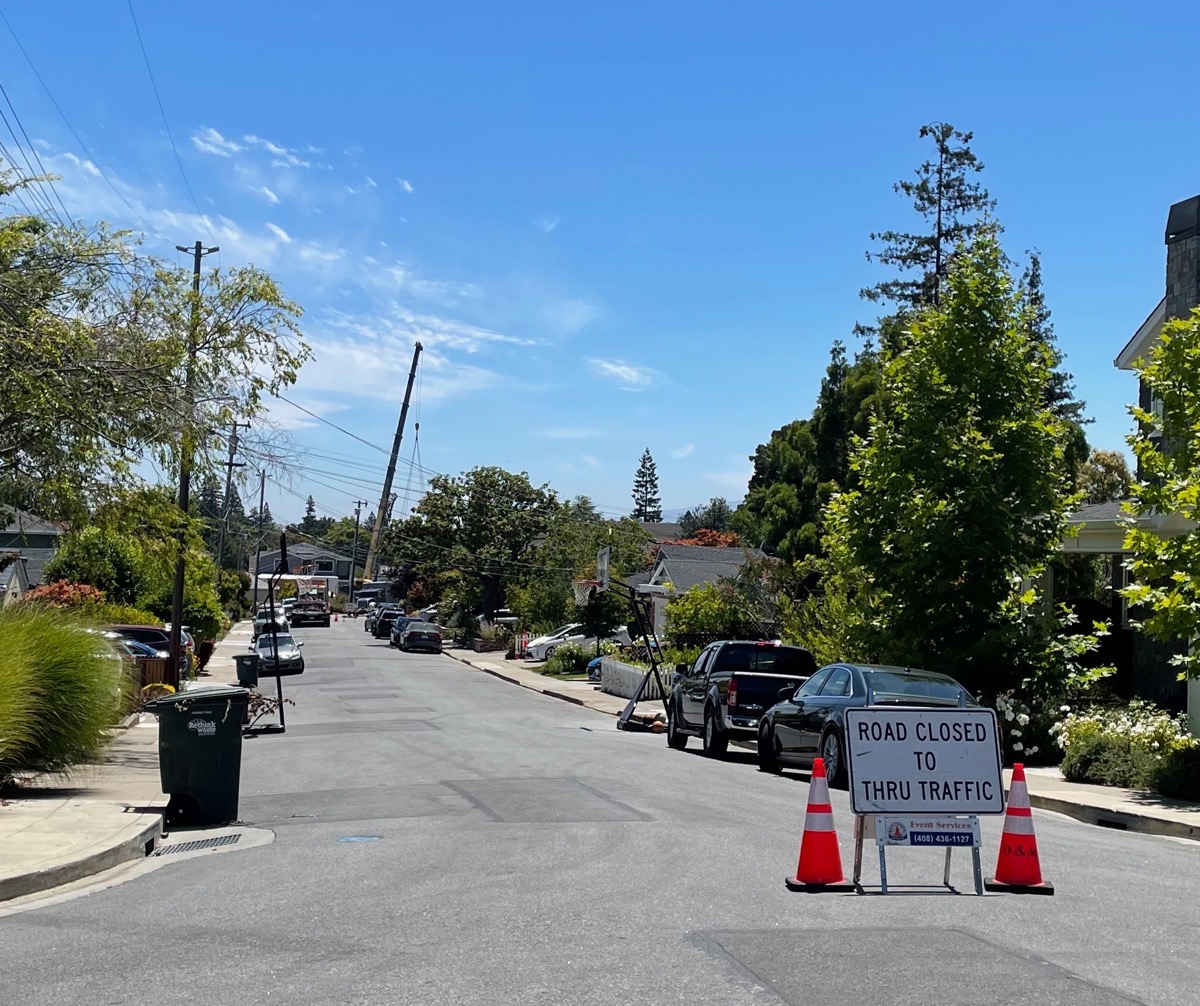
I had a bit of luck finding the construction site as easily as I did, although the crane you can see in the above picture certainly helped. I knew that a crane would be involved, and had hoped that it was already vertical, and not still lying flat, in transport mode. Luckily it was, serving as a beacon upon which I was able to home in. Now, though, having discovered the heart of the action, I needed to head to Belmont for my next appointment. I didn’t do so, though, before taking the above photo to mark the spot to which I needed to return. Thanks to that photo, an hour later I was back, parked, and settling in to watch the fun (I ended up staying for two and a half hours).
When I got to the site, I was delighted to discover that I would be able to stand on the sidewalk just across the street from the project site — 183 Ruby Avenue — and watch the action close up. While I had been gone, the largest of the three modules I had seen being transported had been placed atop a module that had apparently been installed earlier that day (along with two others; in total, the new home will be made up of six modules, plus a small stick-built garage). That module was still attached to the crane, though:

It took a while before the yellow straps that supported the module were unhooked. Once they were, the crane was swung around and the metal framework that enabled the straps to hang straight was lowered to the street. Then, the framework was quickly disassembled, and a new one was put together that was properly sized for the next, somewhat smaller, module:
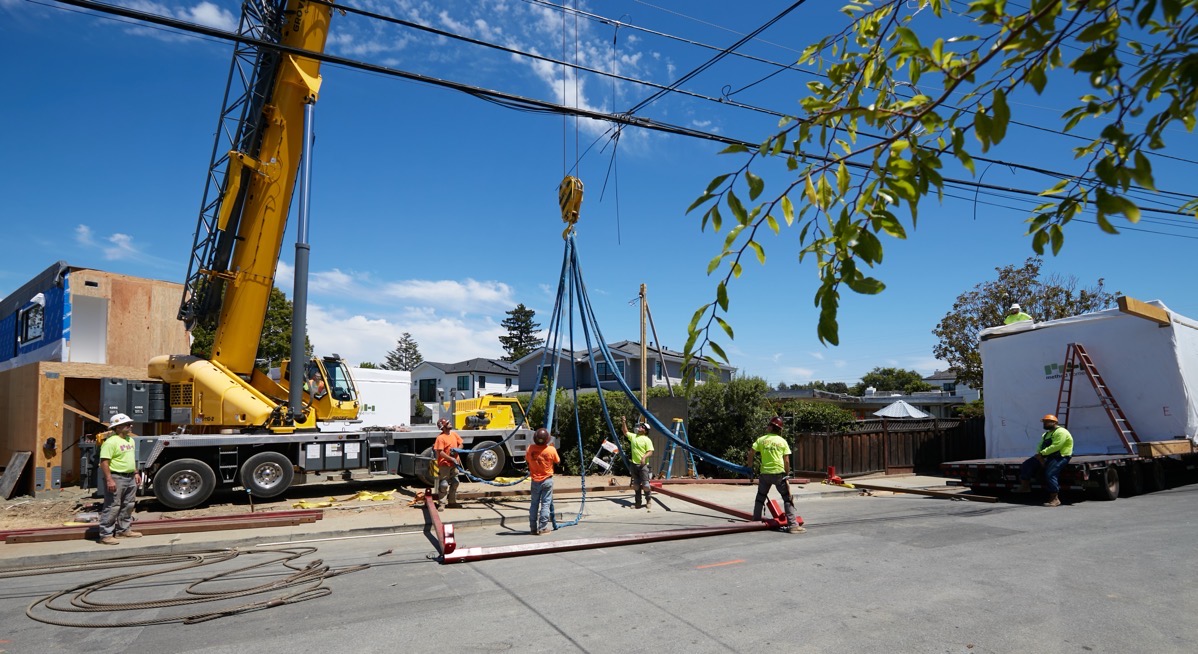
A fresh set of yellow straps were then brought out — each set was used only once — and threaded beneath the module on its trailer (the modules sat a couple of inches above the trailer, leaving a gap that the straps could be pushed through using a long pole). After a lot of careful checking and adjusting, the module was finally lifted high into the air:
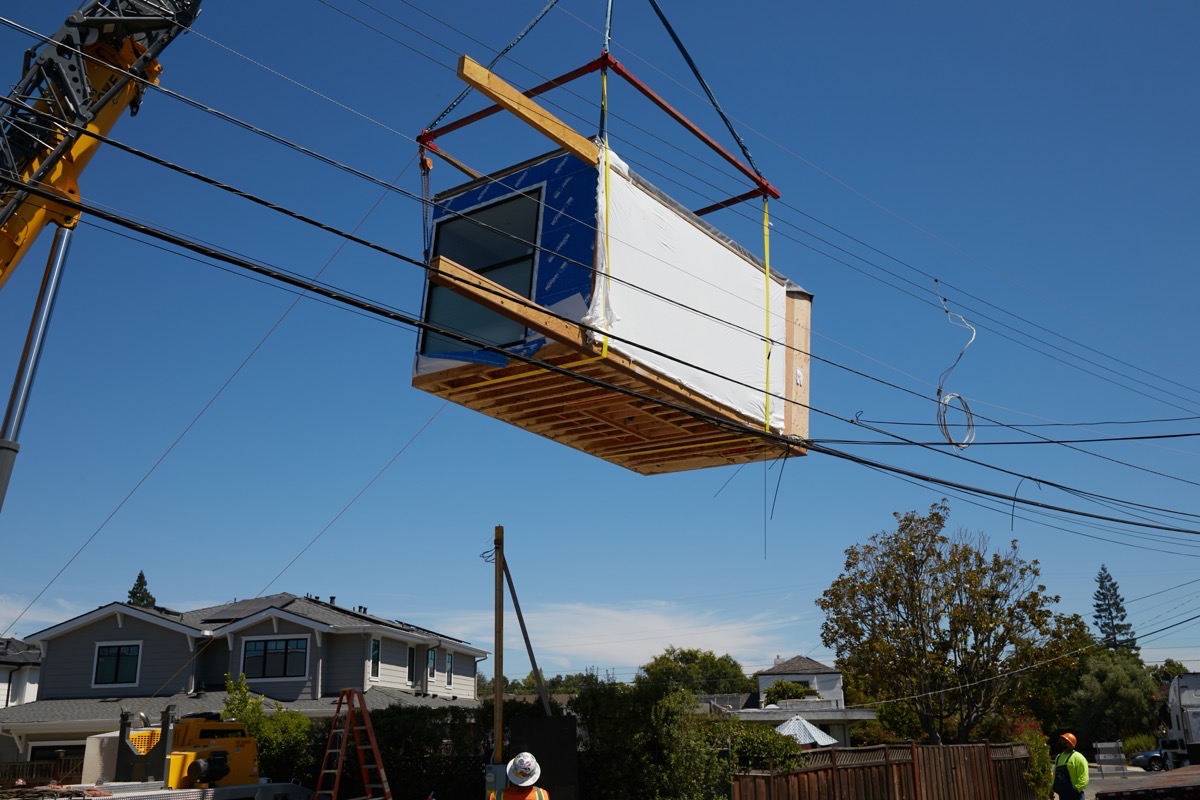
Then it was a simple matter of lowering the module carefully into place, using a lot of manual labor to make sure it was properly oriented:

Then it was time to do it all again, with the third module.
I neglected to mention that the modules came tightly wrapped in white plastic; wherever one module was going to touch another, that plastic was removed before the module was lifted from its trailer:
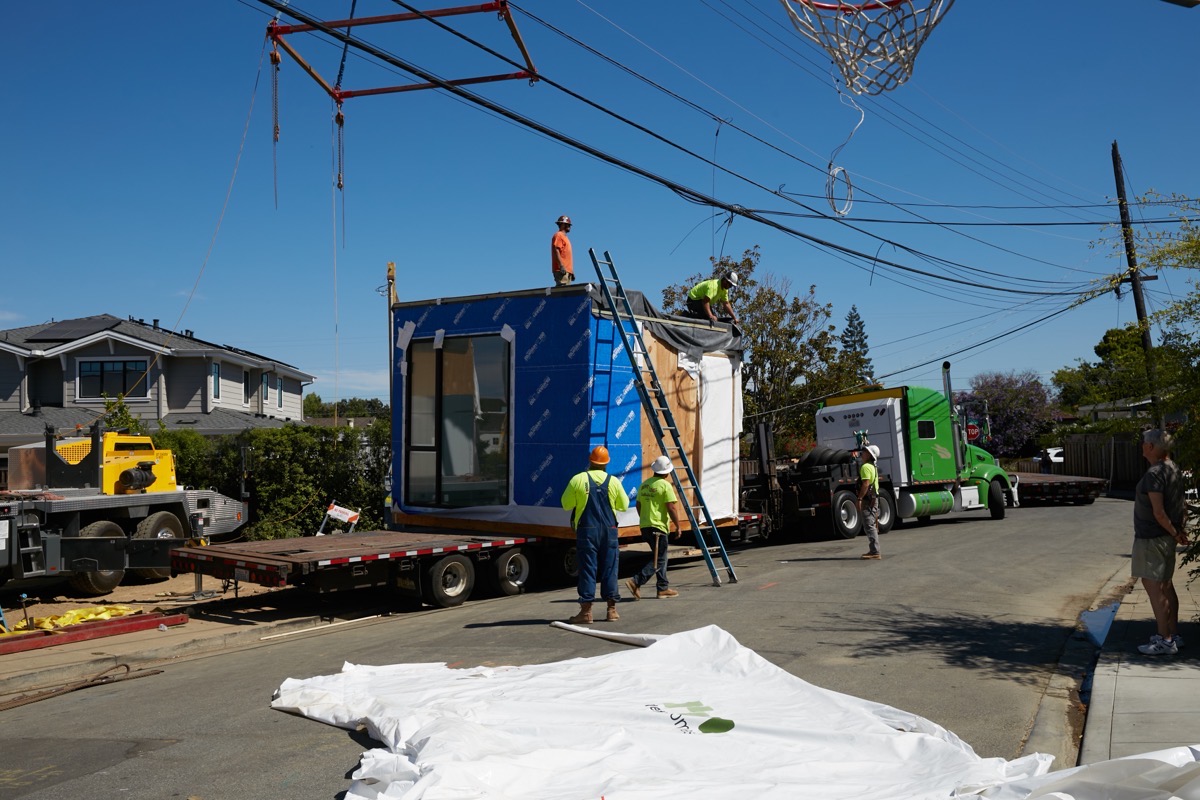
The modules come as assembled as they can be: windows and doors are in place, the walls, floors, and ceilings are already insulated, and even the rubber membrane that forms the first layer of the final building’s flat roof is in place (that’s the black stuff on the top of the above module). Some of the building’s siding may even be pre-installed, although in this case I didn’t see any, leading me to wonder if the house will receive a stucco finish after the building is otherwise assembled. At least the layer of plastic wrap (blue, in this case) that is applied to buildings these days to help keep them airtight is pre-applied at the factory.
Here is a picture showing one side of the house, pretty much fully assembled:

This part of the house is made up of three modules (two on top, and one, still with much of its white protective plastic, below) plus the stick-built garage. The remaining three modules form a parallel stack that you can’t see from that angle. Because the crane blocked my view of the remaining modules that day, I went back on Friday and took a photo of the complete stack, now partly blocked by a construction fence:
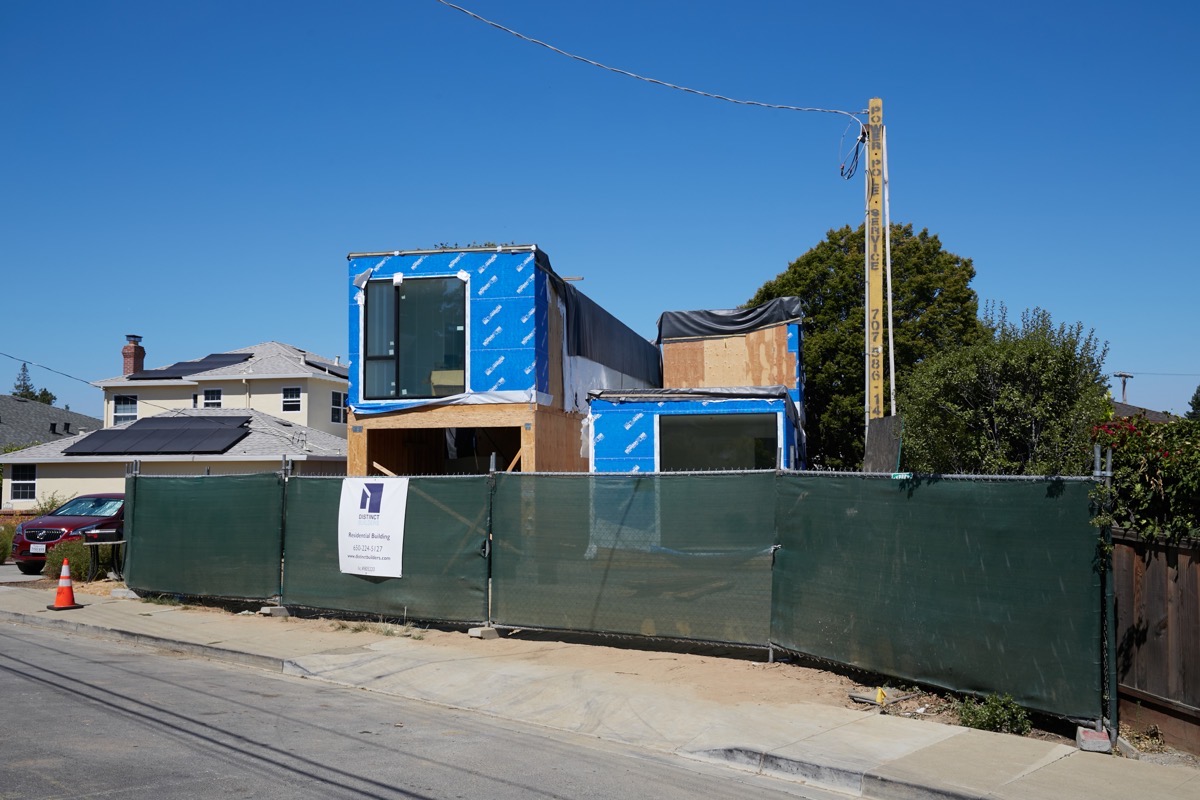
As you might be able to tell from the above photo, the two stacks are not connected, and in fact are separated by a gap of six or eight feet or so. My understanding is that the main stairway, plus, I believe, the house’s main entryway will be constructed in that gap using conventional means. I also presume that something will go atop that nearest module on the right; perhaps there will be a deck there. In any case, we should find out relatively soon, since the house is now ready to get its exterior finishes, along with other items like that main stairway.
Modular construction is not often used in our area, except perhaps when adding an ADU (Accessory Dwelling Unit) to one’s property: a variety of companies, such as Redwood City’s Abodu, offer pre-built ADUs that can simply be craned into position. The company behind this particular home — Seattle-based Method Homes — doesn’t appear to do ADUs, but they do make an interesting variety of homes that can be shipped all throughout the western United States. In addition to their standard designs, they also do custom ones, so if you explore their website and don’t see one that appeals directly to you, know that Method Homes might still be an option.
According to Method Homes, fabrication takes about four months, during which the site is prepped, the foundation is built, and utilities are put in place. After fabrication, the modules are delivered and placed on-site in a process that usually takes a single day (as was the case here). Finally, what they call “home stitching” (the work that then needs to happen to turn the modules into a finished home) takes another two to four months.
Because the modules come already wired and pre-plumbed, in many cases the stitching process can be relatively simple. HVAC and mechanical systems are pre-installed in the modules, as are floors, tile, lighting, cabinets, countertops, sinks, toilets, showers and baths, and in many cases, siding. Not included are appliances, but with cabinets and hookups already in place, installation of those should be relatively quick and simple.
Method Homes, at least, does not seem to focus on costs as a reason to go with modular construction, although in many cases the costs can be somewhat less than a traditionally built house. Instead, they focus on speed, quality, and a lack of cost overruns. From their website:
“Method can build a custom home 60 percent faster than the traditional site-built construction cycle, which means you get into a new home on a fixed budget within a predictable timeline.”
As for actual costs, Method Homes says that the all-in price (but not including the land) for their typical project runs between $550 and $750 per square foot. While in many areas that doesn’t make their homes cheaper than traditional construction, in areas that are remote, or that have high real-estate costs (like ours; construction costs have gone through the roof in the last couple of years), you may well be able to save money going modular.
Their quoted all-in cost breaks down as follows:
- Soft costs (studies, fees, design, engineering): $40,000 or more.
- Modular costs — that is, the cost of building the finished modules themselves in Method Homes’ factory: $300-$400, or more, per square foot.
- Site costs (prep, utilities, foundation, shipping & installation, finish work, utility connections, decks, stairs, paint): typically, 70%-120% of the modular costs.
I have no idea whether the homeowners of 183 Ruby Avenue are saving any money over what it would have cost them to build a comparable home on this site, but I do have to imagine that their neighbors may well prefer the inconvenience of a one-day street closure, plus 2-4 months of construction and finish work, over the typical process, with its many months of noise, dust, and construction vehicles cluttering up the street. Certainly the homeowners will be getting into their new home much quicker than they otherwise would.
I’m seeing more and more factory-built ADUs being craned into backyards throughout our area, and the county’s recent Navigation Center project shows the other extreme of what one can do with modular construction these days. I wouldn’t have thought to build an entire home using modular components, but it’s an interesting idea whose time may have come. If so, I expect I’ll be chasing a lot more houses up and down the streets of Redwood City (and San Carlos, and Menlo Park…) in the next couple of years.
 Walking Redwood City
Pingback: Out and About | Walking Redwood City
Pingback: Looping Large | Walking Redwood City
Pingback: Sheer Madness | Walking Redwood City
Pingback: Loop the Loop | Walking Redwood City
That’s so funny! I live nearby and happened to go by when out on a regular walk and saw the crane. Said hi to you as I passed — didn’t realize it was THE Greg.
Well, the guy with the pole missed, wires down on my block (St Francis x Elm) took ATT several hours to correct. Bet they’d like to know who caused the damage.
PS, Thanks for the story!
Ugh. That’s unfortunate. Glad they got it fixed. And you are of course very welcome. Glad you enjoyed it.
Hi Greg,
We saw the Method trucks heading down Farm Hill Blvd. Thank you for sharing the rest of the story about the destination.