
I posted this article on Friday afternoon as usual, but due to a technical glitch my site was unavailable until a short while ago. But it is up again, now, so enjoy!
Even as a kid I was into computers and electronics. I spent a lot of time at my local Radio Shack (which actually was a good place for electronic parts back then) and, later, at my local computer store. I also spent a ton of time poring through technical magazines and catalogs. Back then one of my favorites was the Heathkit catalog.
Heathkit was a Michigan-based company that designed and sold kits for a wide variety of electronic devices: everything from simple radios up through color televisions, shortwave transceivers, electronic test equipment, and, starting in the late 1970s, computers. I built a handful of Heathkits, including a shortwave radio receiver (with vacuum tubes!), a pocket calculator, a computer terminal, and, finally, a 16-bit computer with two 8-inch floppy drives.
Heathkit had a few retail stores, the nearest to me being in downtown Los Angeles, far from my home. When I moved to the Bay Area I was delighted to discover that they had a couple of stores here, one of which was at the corner of Middlefield Road and Woodside Road in Redwood City—in this building:
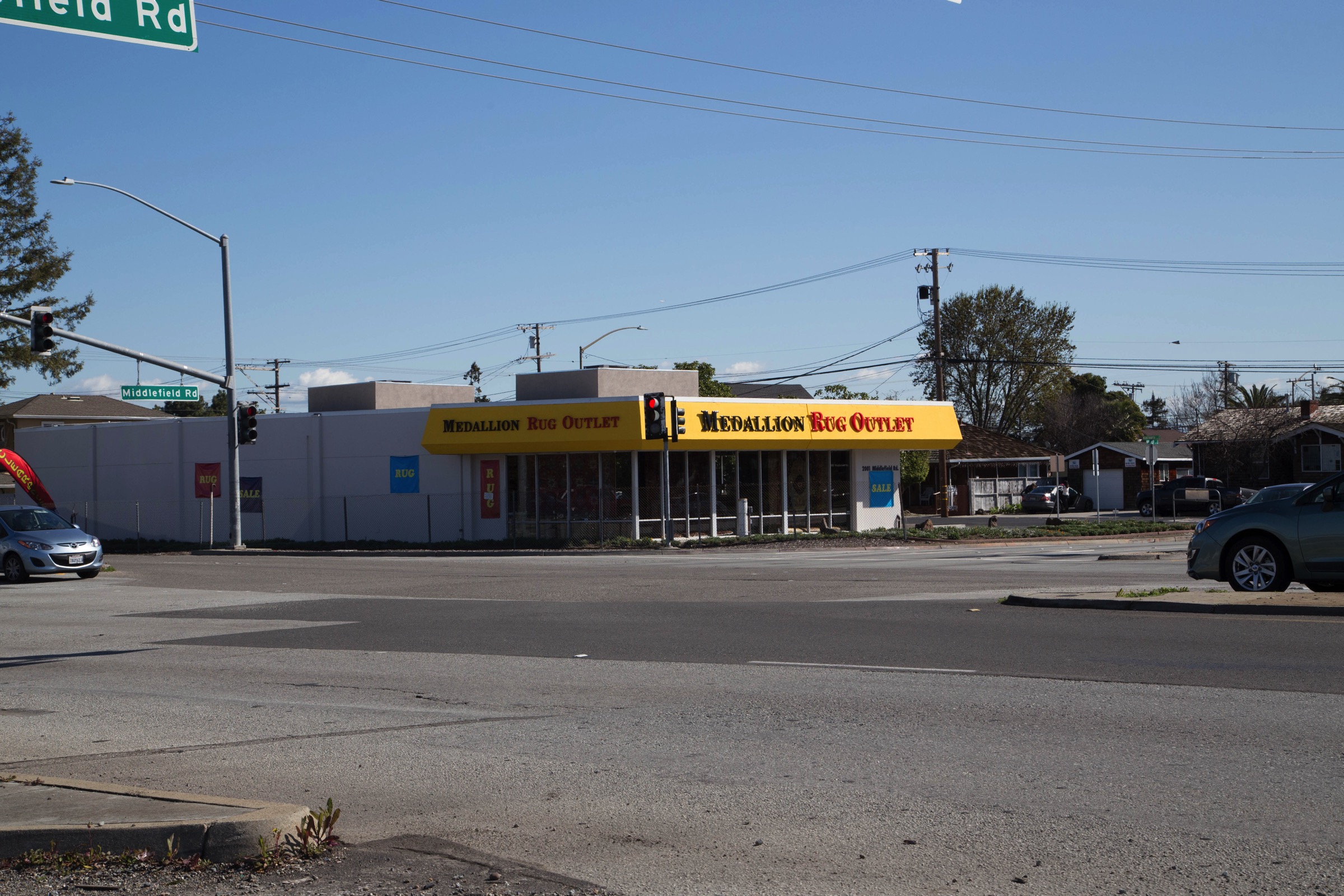
Heathkit got out of the kit business in 1992, having closed their Redwood City store (I believe) sometime before. That particular building has had a few different tenants over the years, the latest appearing just recently when Medallion Rug Outlet—whom I presume is connected to Medallion Rug Gallery—moved in.
Although I understand the economics behind Heathkit getting out of the kit business, I was nevertheless depressed when they did: I whiled away a great many happy hours building and then using my Heathkit projects. But this part of my story has a happy ending: Heathkit has been resurrected! They only have a tiny number of kits at the moment, but their current incarnation possesses the original designs and instruction manuals and they plan to reintroduce updated kits to the kit-building public. I am most of the way through building their electronic digital clock, and the experience is just as I remembered it. If you or someone you know is interested in building electronic kits, do check out their website. And note that they plan to introduce more kits over time, so check back periodically if you don’t see anything that appeals to you right now.
While watching the February 13 City Council meeting it occurred to me that constructing a building here in Redwood City is a little bit (OK, a very little bit) like constructing a Heathkit. While developers probably wish they had one of Heathkit’s famous assembly manuals, they do have Redwood City’s Downtown Precise Plan (DTPP), which is kind-of a manual for developers wanting to build in our 183-acre downtown area. As long as the developer follows the more than 1,000 regulations, standards, and guidelines that make up the DTPP, the process of working with the city is greatly streamlined. That was the reason for the plan, and based on what’s going on in Redwood City’s downtown today, well, it worked.
Back in 1998, recognizing the dearth of economic, residential, and entertainment activity downtown, our City Council formed a task force to bring what was derisively termed “Deadwood City” back to life. Between 1998 and 2007 the city held numerous community meetings, the result of which was the construction of Theatre Way and the On Broadway building (where the Century Theaters are), the removal of the Courthouse Annex and the subsequent restoration of Courthouse Square, various infrastructure improvements, and, finally, the drafting of the DTPP.
Although the DTPP was originally completed in 2007, due to a lawsuit it wasn’t until 2011 that the plan was put into effect (it has been amended three times since then, most recently in May 2016). The DTPP, which can be found here, is a lengthy document full of regulations, standards, and guidelines that control both what can be built and how. Prior to the DTPP, for each proposed project the developer had to complete a complex and expensive Environmental Impact Report (EIR) detailing how the proposed project would impact the environment (including traffic) and proposing alternatives and ways to mitigate those impacts. For many downtown projects, though, the DTPP eliminated the need for individual EIRs. It grouped projects into categories, and projected future development in each category. Based on those projections, the city then did a single EIR for everything. Then, under the DTPP any proposed project that fits within the corresponding category limit is covered by that overarching EIR, meaning that it doesn’t have to do a project-specific one. Of course, once the limits are hit for any given category the DTPP’s overall EIR no longer applies and the developer would once again have to create a project-specific EIR.
The categories, and the DTPP limit for each, are listed in section 2.0.4 of the plan. I’ve included the numbers here:
- Residential: 2,500 new “dwelling units” (apartments or condos, typically). 375 of these must be affordable housing.
- Office: 500,000 square feet.
- Retail space: 100,000 square feet.
- Hotel: 200 guest rooms.
These numbers are known as “Maximum Allowable Development” (or M.A.D.) limits (or caps), and each is a “net new” value. So, for instance, if you tear down a 1,000 square foot office building and construct a 5,000 square foot one in its place, you are only adding 4,000 net new square feet of office space.
Since the plan was put into place, the residential and office space caps have just about been reached. As for retail, overall development thus far has actually removed about 4,000 square feet of retail space, so 104,000 square feet can still be built. And no hotel rooms have yet been built under the plan.
The DTPP had a number of goals, one of which was “revive our downtown.” But there are a set of others that particularly interest me:
- Make pedestrians the priority
- Integrate transit and bicycle use
- Provide “just enough” parking and create a “park once and walk” district
- Create a network of open spaces
So far there has been little progress on any of these goals, other than the experimental closing of Theatre Way to cars and trucks. That prioritized pedestrians for that one block, at least.
The bulk of the February 13 Council meeting was a “study session” on the development that has been done under the DTPP and what changes to the plan, if any, might be worthy of consideration. During Council discussion it became clear that various Council members are interested in creating more open spaces and making pedestrians more of a priority. I just about jumped out of my seat when Mayor Seybert stated that he thought that the closure of Theatre Way should be made permanent—a sentiment that was echoed by Vice-Mayor Bain. Other Council members not only seemed to agree, but one even suggested that the Council consider closing other streets, noting that the city often closes streets around Courthouse Square, for instance, with relatively few issues. I’m excited to see them thinking this way: closing part of Broadway is something I suggested two years ago in my post A Modest Proposal (I also suggested closing Theatre Way to vehicles last June in my post Street Walking, something that actually happened not long afterwards).

Closing streets is one way to help achieve the goal of creating a network of open spaces. Multiple Council members also mused about how to create actual park space, noting that concrete and asphalt open spaces are not always the most comfortable. If the city could identify a suitable parcel upon which a park could be built, I think that most would agree that some sort of park, with grass and trees and benches and perhaps some play equipment, would be a great addition to our downtown. While city staff and our Parks Director are looking at options, I just happen to have an idea.
First off, based on the public comments and the subsequent Council discussion it became clear that many people feel (as I do) that more attention needs to be paid on revitalizing Main Street. Next, the Mayor remarked upon the small plant-and rock bioswale that a City intern had constructed between the Jefferson Post Office and the (currently closed) Howie’s Artisan Pizza restaurant:

Finally, add in the fact that several of the recent development projects have included less parking than was required, instead opting to contribute “in lieu” fees to a city-managed parking fund—a fund that now contains a couple of million dollars, I believe, and that has not yet been tapped for any purpose that I know of. Put all these together, and I’d like to propose that we convert the city-owned Main Street parking lot—the surface lot in the center of the block bounded by Broadway, Main, Middlefield, and Jefferson—into a park, and that we use the parking fund to construct parking either there or elsewhere to make up for the lost parking spaces. I say “there or elsewhere” because theoretically a multi-level underground garage could be built beneath the park—although Redwood Creek currently runs beneath that lot, so an underground garage there might not really be feasible.
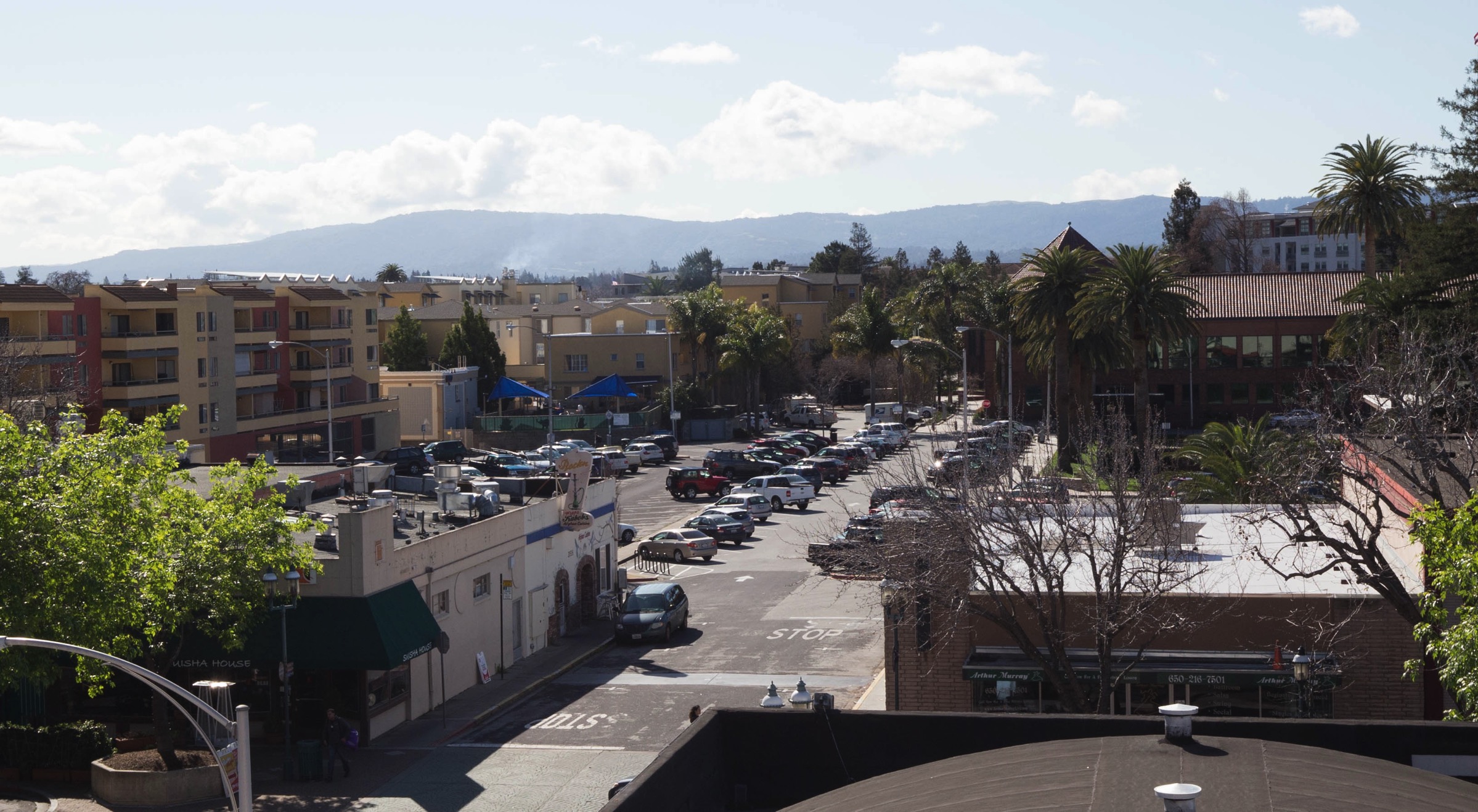
The lot already has access to the four major surrounding streets, so easy access to the park would be ensured, and it would provide some nice walking paths between those four streets (which should bring more people over to Main Street). If I were designing it I probably would leave the small part of the parking lot directly behind City Hall as parking, as well as to leave some or all of the street that is used to access the back of the Post Office intact. And the small section behind the current Powerhouse Gym is actually private property that will be consumed by the soon-to-break-ground 2075 Broadway project, so that wouldn’t be included. But the remainder would make for a nice-sized chunk of green in the middle of our downtown, right behind a great deal of existing housing.
Just as the DTPP can, from a certain angle, be viewed as instructions for assembling a building “kit” in our downtown, so, too, could one view the job of a City Council member as putting together a kit that is a city. Encouraging the right mix of office, residential, retail, and recreation areas is an important part of what our Council does, and the DTPP is one tool that they are using to assemble this giant kit. Having enabled a great deal of development, I’m curious to see just what they do next to encourage residents and visitors to spend even more time and money in our thriving downtown. And I’m hoping, somehow, that in the process we gain a new downtown park.
 Walking Redwood City