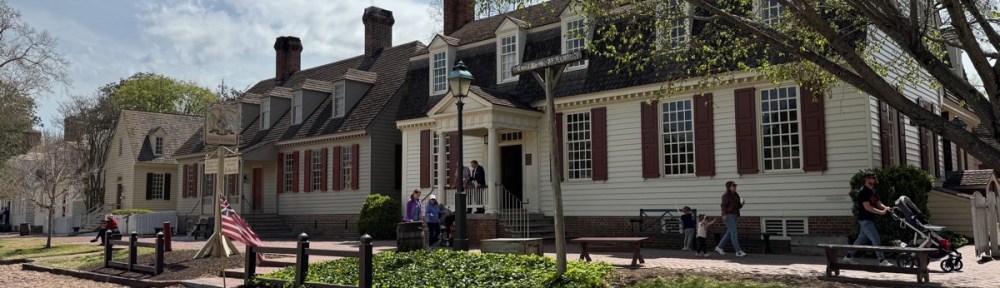
This week, something completely different. I’ve been out of town since the start of the month, which is why there was no blog post last week. I’ve been in Colonial Williamsburg for a couple of different events, one of which is their annual Garden Symposium (that my wife is attending; she’s the gardener in our family). This symposium has become an annual event in our household; she attends the lectures and goes on the various garden walks, while I wander the historic area, admiring the buildings, visiting the many tradespeople, exploring the shops, and chatting with the various reenactors who dress and act as some of the key historic figures who were actually here in the mid-to-late 1700s (and yes, I enjoy looking at the gardens, too).

For years I’ve had various people suggest that, when I go on a trip like this, I do a post from wherever I am at. This year, primarily because of the length of this particular trip, I decided to give it a try. So…enjoy!

In case you aren’t aware, Colonial Williamsburg is a restored and recreated portion of the city of Williamsburg, Virginia. From Colonial Williamsburg’s website:
Williamsburg was the thriving capital of Virginia when the dream of American freedom and independence was taking shape. From 1699 to 1780, Williamsburg was the political, cultural and educational center of what was then the largest, most populous, and most influential of the American colonies.
In 1780, Virginia’s capital was moved to Richmond, and the city of Williamsburg began a slow decline. It wasn’t until the 1920s that someone — in this case, the Rev. Dr. W.A.R. Goodwin, who was then the rector of the local Episcopal church — realized that if an effort wasn’t made to preserve the remaining historic houses and buildings, they would soon be gone. And with them, we would lose a truly important part of this country’s history. Goodwin managed to catch the interest of John D. Rockefeller Jr., and together they began the process of acquiring and restoring the historic heart of the city.
It was in Williamsburg that many of the discussions around independence took place. And it was Williamsburg’s leaders who initially voted to propose independence for all 13 colonies. That action led to the Second Continental Congress (in Philadelphia) and the drafting of the Declaration of Independence.
Today, Colonial Williamsburg is the largest U.S. history museum in the world. Its 301 acres contain 89 original buildings (plus many recreations), more than 20 historic trades, and a number of historic persons who roam the streets and with whom visitors can engage in conversation. Colonial Williamsburg is run by a non-profit foundation that employs an army of researchers, conservators, and archaeologists, all of whom are working to better understand and communicate what actually went on in Williamsburg, particularly in that critical year of 1775.
Colonial Williamsburg is unusual in that it isn’t fenced off and run like an amusement park: it is just another part of what today is a normal, healthy American city. The historic area’s streets are public streets that, during the day (and evening), are largely closed to traffic so that people can be free to explore the area on foot (or in a horse-drawn carriage). Although the Foundation sells tickets that get you in to see the craftspeople and allow you to tour some of the historic buildings, it costs nothing to roam the streets, explore the gardens, talk to the reenactors, and even watch some of the street theater that allows you to feel as if you were there amid some of the key events that led up to that historic vote.
Prior to independence, of course, we were subject to British rule. In Williamsburg, that rule came in the form of the British governor, who lived in the Governor’s Palace, which you’ll find at one end of the Palace Green:

Along the green — which is a long, linear park where, I was surprised to learn, native American tribes used to camp when they were in town to negotiate or trade with the governor — are a number of beautiful Colonial houses. For instance, the Robert Carter house, which is one of the original structures that, in this case, has only been partially restored so that visitors touring the house can see how it was constructed:

On the other side of the green is an open-air theater where short plays are put on for the enjoyment of Colonial Williamsburg’s guests:

This theatre, although by no means original, is located on the actual site of the first theater in English America, which had been built in 1716.
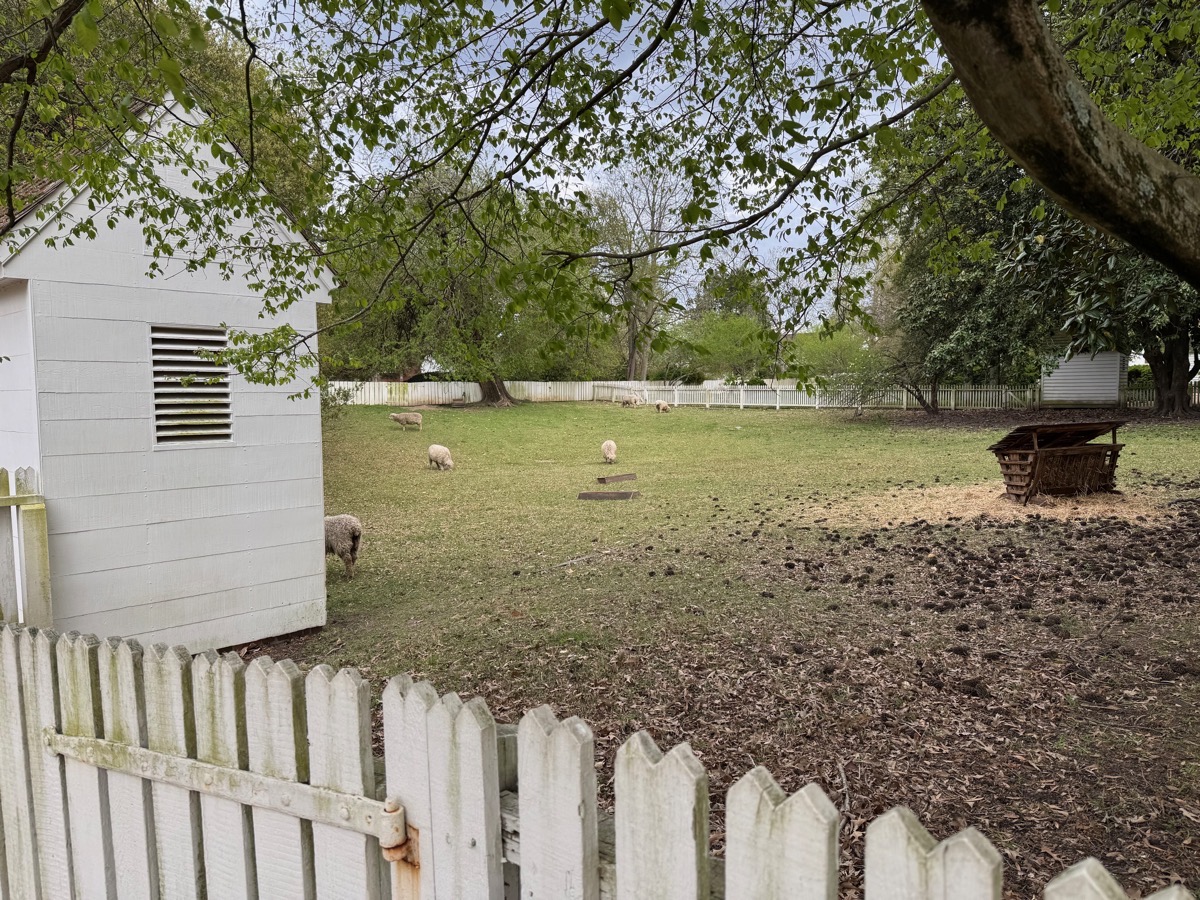
Folks living and building homes and buildings in Colonial Williamsburg back in the day clearly didn’t have to deal with zoning laws. Not only is that theater flanked on both sides by houses, the corner nearest the Governor’s Palace consists largely of a fenced field where sheep are being kept:
Elsewhere, homes, stores, workshops, and taverns stand cheek-by-jowl. There was no division between residential and commercial areas, like we have today in places like Redwood City. And most of the stores, workshops and taverns look much like houses; only the presence of a sign outside gives them away. For instance, here is the grocer:

And here is the King’s Arms Tavern:

This tavern — which is a working restaurant that serves dishes made from recipes of the Colonial period — has a particularly nice sign:

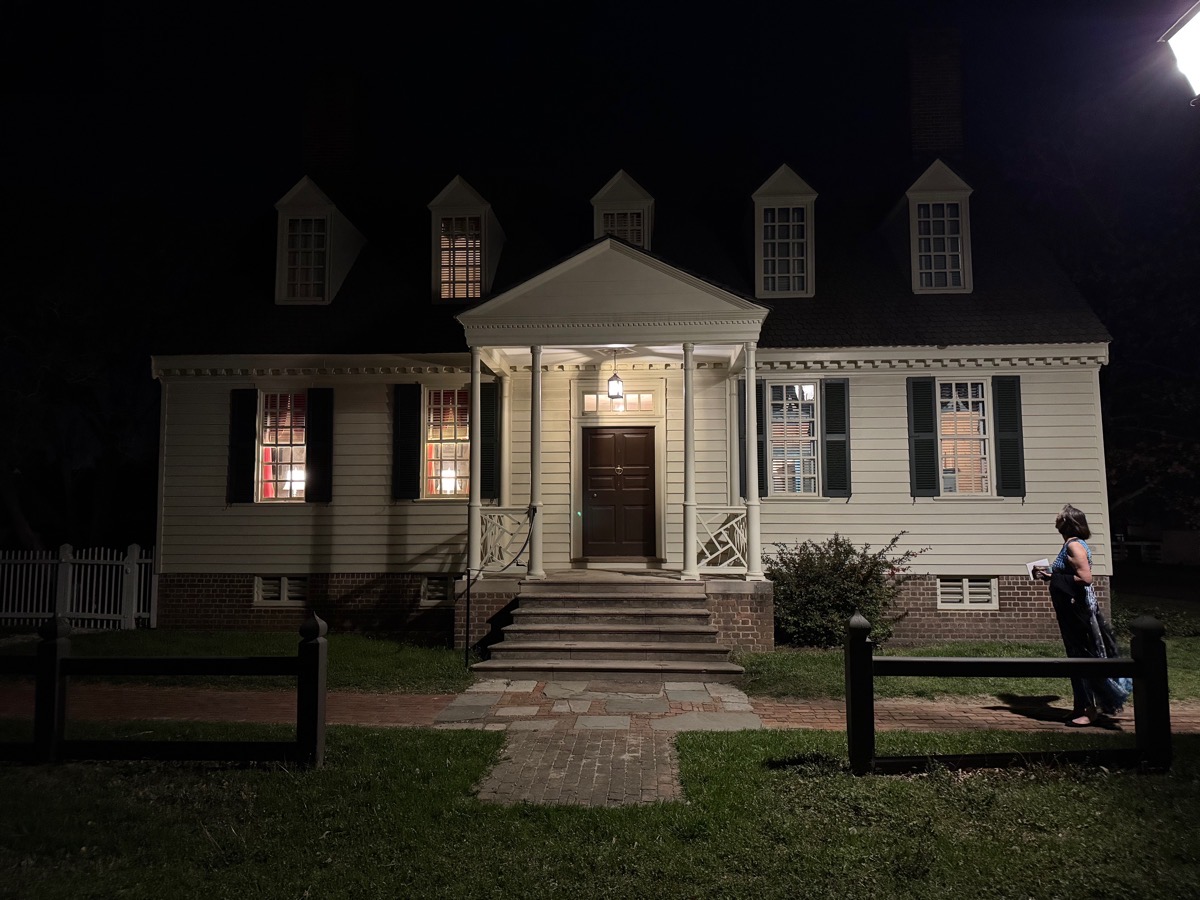
I should note that a number of the historic homes are available to stay in: their interiors have been kept as authentic-looking as possible, but they’ve been updated with decent beds, proper bathrooms, and, of course, electricity and HVAC systems. For part of this trip we shared this one with my brother and sister-in-law:
Of course, there are hotels just outside the historic area as well, some run by the Foundation and many that are not.
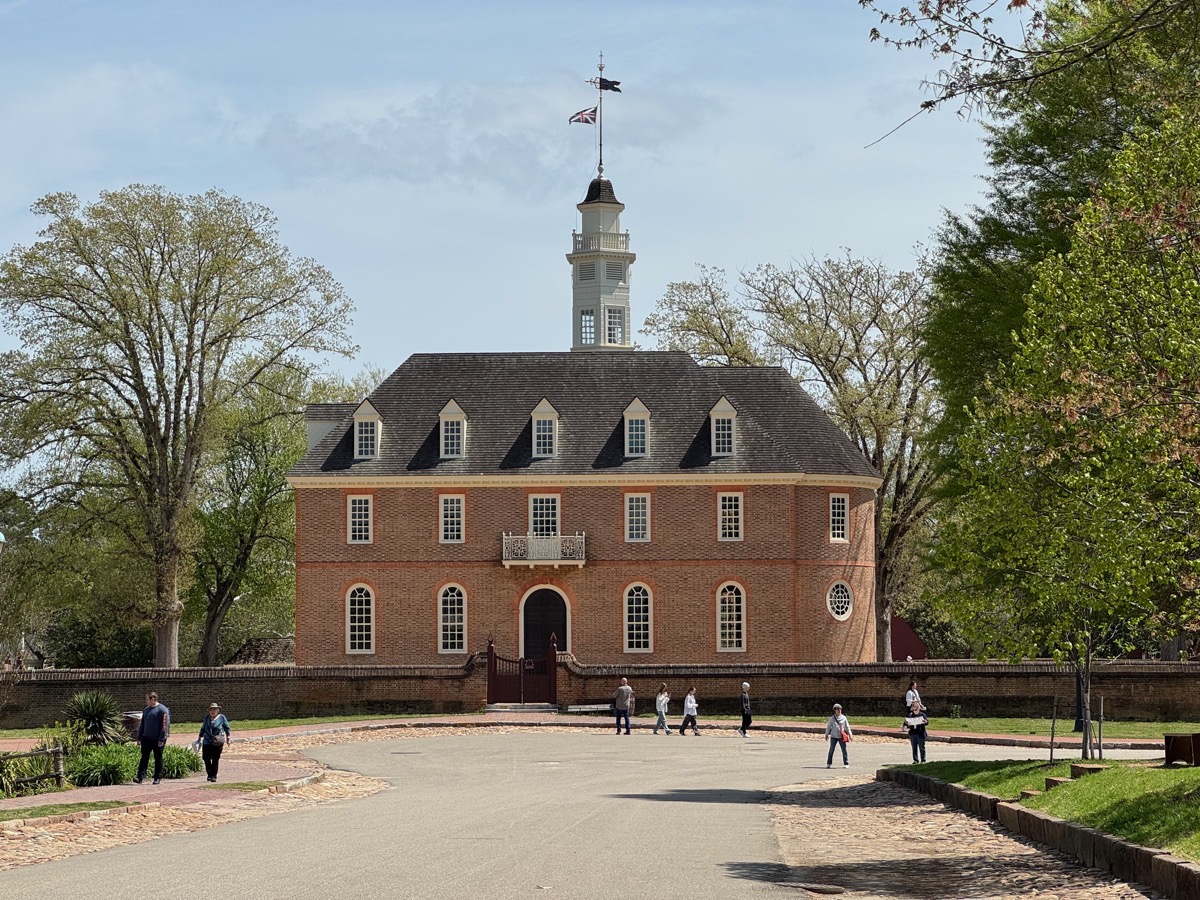
At the end of the historic area’s “main drag” — Duke of Gloucester Street — stands the Capitol building, where the Burgesses (the leaders of Colonial Virginia) met, and where many of the proclamations that led up to independence were made:
The historic buildings are great, but what really makes Colonial Williamsburg special are the people who “inhabit” it. The tradespeople, for instance, with trades ranging from apothecary to wigmaker, and include silversmith, brickmaker, cabinetmaker (and harpsichord maker), printer, gardener, gunsmith… nearly every trade you can think of that was necessary for a functioning city in the 1700s. And yes, there are enslaved peoples. In fact, these are some of the most interesting people to talk to. What better way to get an understanding of such an archaic, vile institution?
Not everyone is in costume: the archaeologists, for instance, can often be found hard at work, but willing to explain what they are doing and what they are finding. Currently, there is a dig going on right along Duke of Gloucester Street, at the site of what was Peter Scott’s cabinet shop:
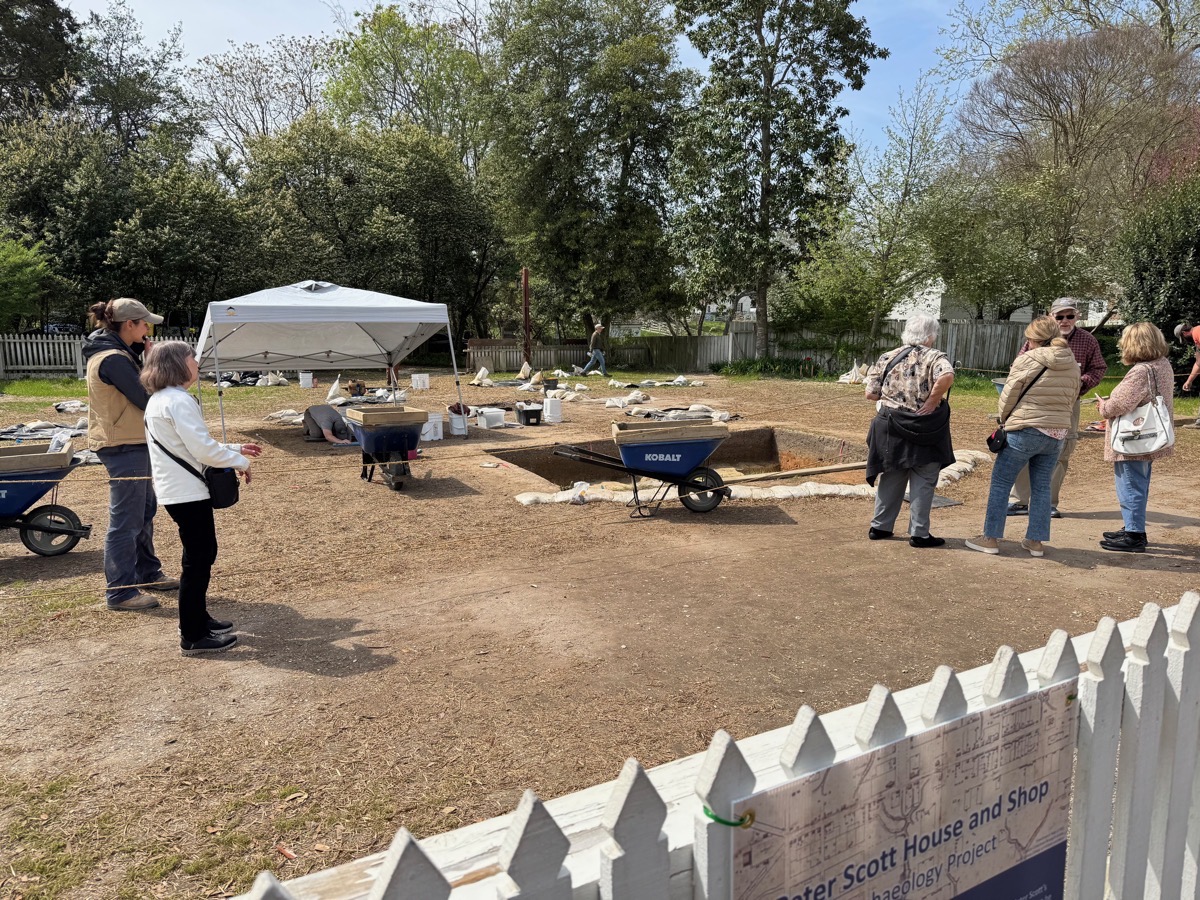
Peter Scott made fine furniture in a building on this site for 42 years. The building had originally been a rental house, constructed on this site by Martha Washington’s father-in-law from her first marriage. By the time Peter Scott passed away, in 1775, the building was being managed by Martha’s second husband, George Washington (Martha’s first husband having died in 1757). Needing a place to house some of his Continental troops, Washington put them up in the Scott house. Shortly thereafter, though, oops! The troops accidentally started a fire that completely destroyed the building. Today, the archaeologists are excavating the building’s cellar and foundations, after which they hope the Colonial Williamsburg Foundation can recreate the building that once stood on this site.
Speaking of George and Martha Washington, they are two of the “Nation Builders” who are represented among the historic area’s residents. Colonial Williamsburg employs a number of actors who have done and continue to do extensive research on the particular character they’ve been hired to play. Their full-time job, then, is to “be” that character. They give talks, and walk the streets. And they respond to questions as if they are their character, living back in the 1700s. For instance, I was delighted to be able to hear a young pre-revolution Martha Washington (from 1775) talk about her upbringing and her two husbands, after which she answered a number of questions from the watching crowd:

The depth of their research really shows; it is amazing what questions they can answer.
Other characters you may recognize include George Washington, Thomas Jefferson, Patrick Henry, James Madison, and the Marquis De Lafayette. But there are some others who you likely don’t know, but are no less fascinating: George Wythe (a lawyer, politician, and mentor to Thomas Jefferson), Jane Vobe (a local tavern keeper), George Mason (author of the Virginia Declaration of Rights), Gowan Pamphlet (enslaved property of Jane Vobe, he became an ordained Baptist preacher and founded Williamsburg’s First Baptist Church), and Ann Wager (for each of several years she taught between twenty and thirty Black children, ages 3-10, most enslaved, some free, at the Williamsburg Bray School). Finally, there is James Armistead Lafayette, an enslaved Virginian who at the behest of the Marquis De Lafayette became a double spy during the Revolutionary War, providing intelligence on Cornwallis’ activities that proved key to Washington’s winning the Battle of Yorktown — the key turning point of the war. His is an incredible story, and one that he tells extremely well.
Colonial Williamsburg does an incredible job of combining the historic buildings with some of the people who inhabited them. A couple of years ago, the building housing the Bray School, long thought to have been lost to time, was discovered, much altered, on the nearby campus of the College of William and Mary. The Colonial Williamsburg Foundation stripped the more modern additions from the building, and then last year moved it to a site within the historic area. For some time now they have been restoring the building to its original form, and readying it to be opened to the public:
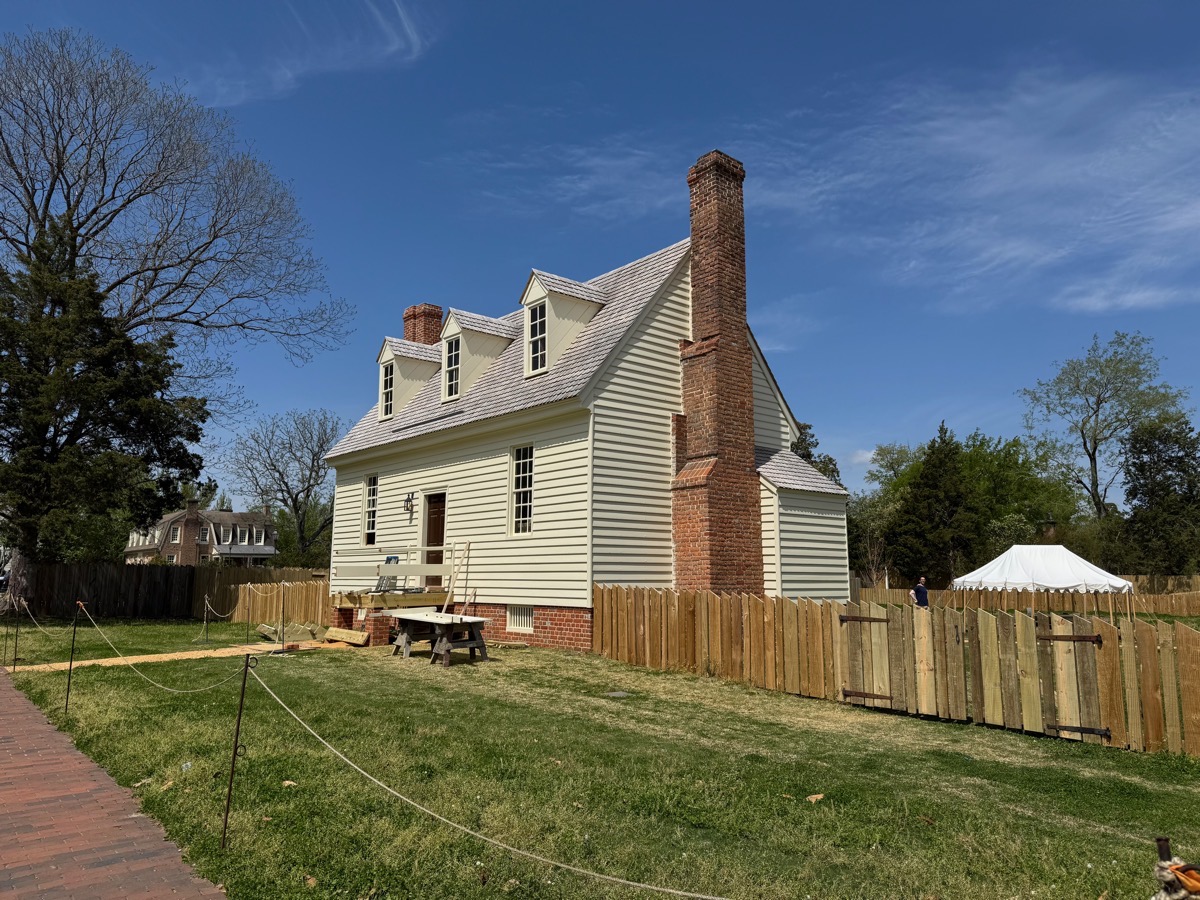
This tiny building served as both a schoolhouse (just one half of the ground floor) and a place where Ann Wager, the teacher, lived (upstairs, plus the other half of the ground floor). How they managed to squeeze up to thirty kids plus the teacher into the one small single classroom is hard to fathom. The historians suspect that much of the learning took place outside, on the grounds of the building. In any case, in a very short time the public will be able to not only tour what is the oldest existing schoolhouse for Black children, they’ll be able to speak to the teacher, in the form of a well-educated actor playing the part of Ann Wager.
Right next door to where the schoolhouse was placed (its original location — quite nearby — having not been available, unfortunately), another recent archaeological effort revealed the site of the African Baptist Meeting House: the first church building specifically for the Reverend Gowan Pamphlet’s Baptist congregation. Both the building’s original foundation and the foundation of a later, larger version were discovered — along with the buried remains of 63 members of the congregation. Each of the graves has been carefully marked, and soon a recreation of the meeting house will be constructed on the original site. Visitors will then be able to experience this building for themselves, and perhaps even listen to a sermon from the Reverent Gowan Pamphlet (well, from the man who plays him).
Finally, Martha Washington’s original father-in-law, John Custis IV, had a home in Williamsburg. The house, which is long-gone, was, I’m told, not much to look at — but the gardens were spectacular. Over the past year or two archaeologists have been working the site — “Custis Square” — identifying the place where the house stood, excavating the well (into which people used to throw their trash after the well was no longer of use, making it a goldmine for the historians), and mapping out the gardens. This last I find particularly fascinating; they’ve been able to identify where some of the plants were located based on seeds and other organic material found in the ground. Here, too, the Colonial Williamsburg Foundation aims to recreate Custis’s garden, and, just possibly, his house.
Colonial Williamsburg is a fascinating place, and I highly recommend a visit. Especially now, with all of the craziness going on with our federal government, it seems a good time to get reacquainted with this country’s origins. Those origins were full of conflict, not only between us and the British, but between the very men (and, somewhat indirectly, women) who ultimately came together to agree on the path to independence. I suspect we can learn a lot from those conflicts, and I can think of no better place to learn all about how independence truly came about than the place where it actually happened. One can learn a lot from books, and there are some great ones out there, but there is nothing like walking the streets of the city, standing in the Capitol building, or even speaking directly with Thomas Jefferson to really understand our American history.

 Walking Redwood City
Great post Greg, you really covered it well!
Thanks for the reminder of what I saw in 1976 with my mother and myself!
Love history and this kind of learning brings it to life!
Merrily
Thank you for sharing your adventure. Brought back memories I had forgotten about from a midd
What a cool trip! I really enjoyed reading about your experience in Colonial Williamsburg. Thank you for sharing.
I will probably never get there, so thanks for taking me there!
Great review 👏
A big insight from our trip there last year was the map of Virginia on the wall In the Capitol Building. The guide/character explained that in the colonial era Virginia stretched all the way to Minnesota and included modern day Michigan. It helps explain why it carried such influence during the Continental Congress.