
As a bit of follow-up to last week’s post, in it I had mentioned that the new office building at 1390 Woodside Rd. still had construction fencing around it, even though the building looked completely done. Well, that was based on a visit I paid to the site a week ago Tuesday (the 25th). On the following Saturday, I had occasion to stop in at Ace Hardware (in Woodside Plaza) and I noted that the construction fencing had been removed. I went by again earlier today just to get one final picture without that fencing:

So although I’ll still keep an eye out to see if I can tell who the new tenant is (or will be), the project itself is, at long last, well and truly done.
Next, in that previous post I also wrote about the small eight-unit townhouse development at 955 Woodside Rd., which also was still surrounded by construction fencing. I went by the site earlier today, however, and noticed that that fencing, too, has been taken down. The development doesn’t appear to be on Intero’s website as yet (Intero is handling the sales of these new townhouse-style condominiums), so I’m not sure whether prospective buyers are currently being welcomed to tour the units. I’ll check back on that project again next week.
Finally, all of the plastic has been removed from inside the windows at Ocean Oyster Bar & Grill, at the corner of Broadway and Jefferson Avenue in downtown Redwood City. Their website does not yet indicate that the restaurant is actually open, but I wouldn’t be surprised if they open their doors as soon as this weekend. Again, I’ll be keeping an eye on this place:

This week I spent some time prowling around Sequoia Station. I didn’t really expect to find much — and I didn’t, really — but I wanted to take a closer look at what Hunter Properties — who currently owns the lion’s share of the center — has been doing to spruce up the place and make it more attractive to prospective tenants. So far, as many of you have probably noticed, the changes have been limited to a new paint job, primarily using mint-green and a grayish-white paint:

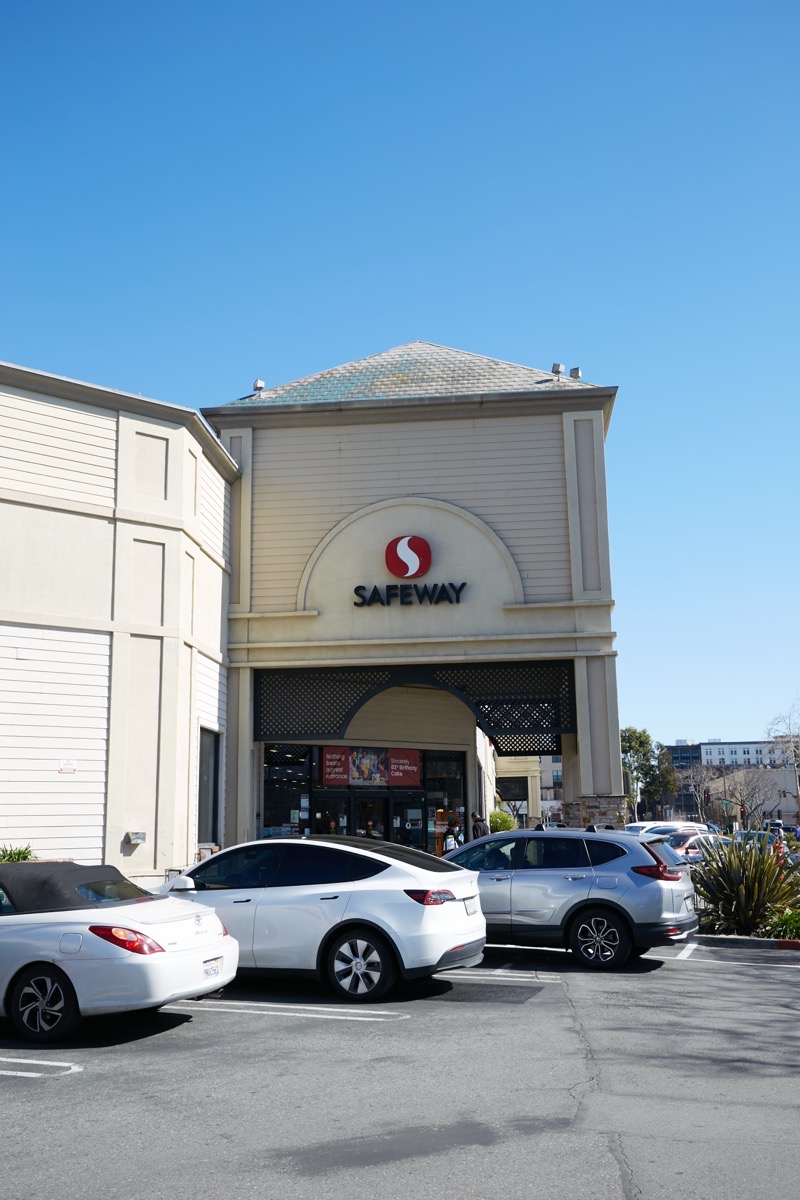
As you can see in the above photo, though, one of the buildings has yet to be painted. Namely, the building containing Safeway plus a handful of small retailers and service businesses, including Noah’s New York Bagels, Mathnasium, Citibank, and others. Given that there are no signs that any further painting will be done, at least at the moment, I have to wonder if the Safeway building ever will be. As I understand it, Safeway owns their space — and possibly the entire building within which they are the major tenant. That makes them responsible for the care and maintenance of their space (or building), meaning that it is up to them whether Safeway (and, likely, the rest of the building) will get painted to match Hunter’s portion of the center. If Safeway isn’t interested in spending the money to do so — or if they want to repaint, but want to use a different set of colors altogether — that’ll be their choice. So your guess is as good as mine as to what will happen there. Surely Hunter Properties told the Safeway folks what they were planning to do, so perhaps Safeway had just been waiting to see what the updated center looked like before they decided whether or not to take action of their own. In any case, I do hope that they do something: the faded, dirty paint on their building really stands out in contrast to the crisp new paint on the remainder of the center. When I was there this week, I noticed some rather visible graffiti on the walls between the bagel shop and Safeway:

As well, I noticed how shabby the shingles on Safeway’s northern entrance “tower” are looking:
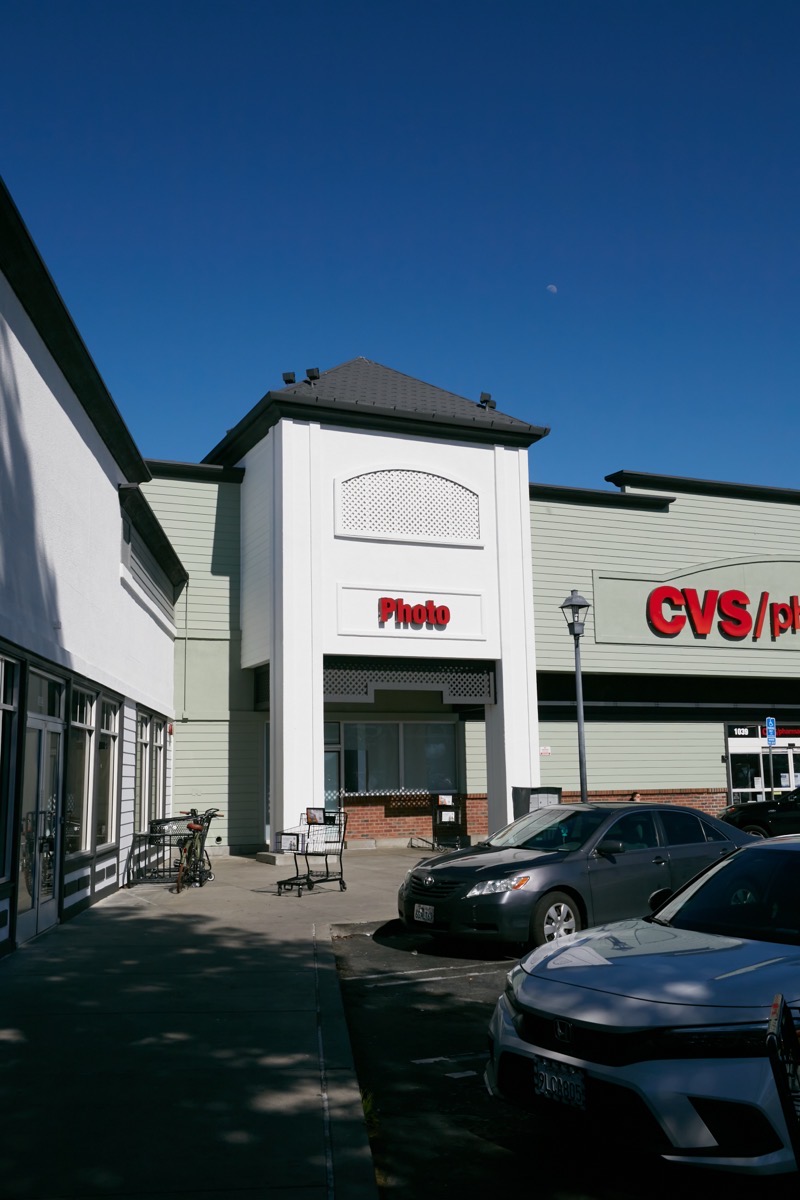
Contrast the above with the tower near the entrance to the CVS Pharmacy in the same center:
On the vacancy front, I noticed one or two new ones. On the positive side, the empty space that used to house Mattress Firm (to the left of the CVS Pharmacy) has recently been divided into two: one small space on the corner where the driveway enters the center from James Avenue, and a larger one comprising the rest of what used to be Mattress Firm:
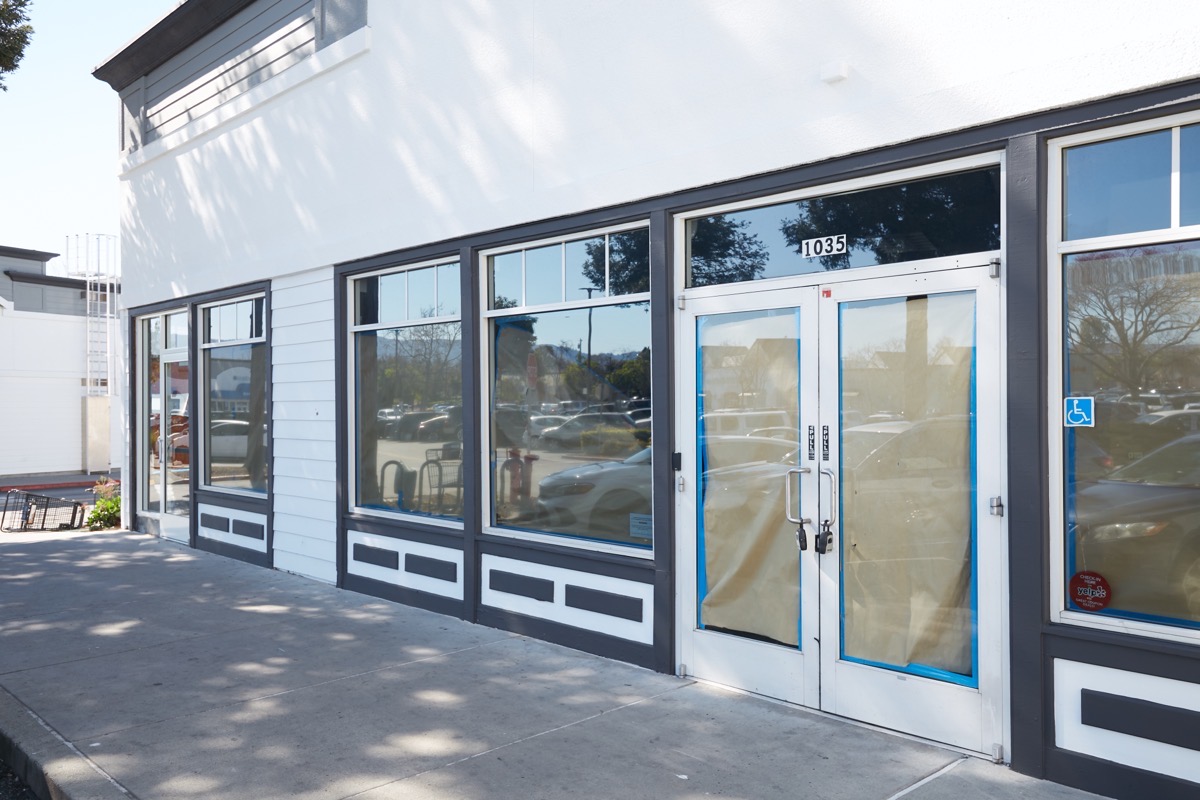
The windows fronting both spaces are largely papered over, so while the smaller space was likely created for a specific tenant and thus is likely to soon be occupied, the other space might also see a new tenant soon. I’ll note that other currently empty spaces — such as the large one that used to house Old Navy — don’t have their windows papered over.
If you are wondering why all the sudden interest on my part in the Sequoia Station shopping center, its because a week ago Wednesday I was privileged to be able to attend a regional competition in which teams from five of our area’s universities presented their own designs on how they would redevelop the center if given the chance. The competition was put on by NAIOP Silicon Valley, the local chapter of the Commercial Real Estate Development Association. The headline sponsor was NOVO Construction, while the “site sponsor” was Hunter Properties, the majority owner of the Sequoia Station shopping center. As for the teams, there was one each from Menlo College, Stanford University, UC Berkeley, San Jose State University, and Santa Clara University. Finally, the presentations and final judging took place in Redwood City’s Fox Theatre.
As you may recall, before Hunter Properties acquired the center (for $53 million), the previous owner, Lowe, had proposed a six-building development for the 12-acre site. Their idea was to extend Franklin Street — which today is about four blocks long and runs from Maple Street to Jefferson Avenue — through the middle of the property, extending it to James Avenue. Then, on the half between the new Franklin Street and the Caltrain tracks, from north to south, Lowe was hoping to construct three buildings:
- a 12-story building with 397 housing units (20 affordable) plus a large “family entertainment retail” establishment on the ground floor. This building would have partially wrapped around a 31,000-square-foot outdoor plaza.
- a 9-story, 336,500-square-foot office building with 13,300 square feet of retail on the ground floor. This building would have had outdoor and rooftop dining, plus an underground parking garage that would have included approximately 150 transit parking spots.
- a 9-story, 344,700-square-foot office building over an underground parking garage. The ground floor of this building would have had 3,900 square feet of retail space and a childcare center.
On the half of the parcel between Franklin Street and El Camino Real, the intent was to construct another three buildings (again, from north to south):
- a 7-story residential building containing 234 affordable homes, half of which would have had either two or three bedrooms. On the ground floor there would have been at least one retail space with outdoor dining, plus five startup business/retail incubator spaces.
- an 8-story building with 262,600 square feet of office space over 28,800 square feet of ground-floor retail (most of which would be occupied by a new CVS Pharmacy). An underground parking garage would have sat beneath the building.
- another 8-story building with 286,200 square feet of office space atop a new “state-of-the-art” Safeway store, plus underground parking.
As proposed, this new development would have made far more efficient use of what today is a traditional single-story residential shopping center with the majority of the property taken up by a large surface parking lot (Sequoia Station is somewhat unusual in that it also has an underground parking garage beneath a portion of the center). The redeveloped center would have looked something like this, from the air:

The five teams that developed proposals for last week’s competition undoubtedly looked over what Lowe had been proposing for the site. For one thing, they all included the extension of Franklin Street through the property (although this may have been a requirement imposed from the outset). But they all did their own evaluation of what the city needs on this site, and all came to somewhat different conclusions.
Menlo College proposed five “thoughtfully designed apartment buildings, offering a diverse mix of studio, one-bedroom, and two-bedroom units, with select floor plans featuring dens for added flexibility.” A sixth building would have held the new Safeway (all five designs incorporated a new Safeway supermarket, and none explicitly included a new CVS Pharmacy), but their Safeway would be a two-story design in order to leave space in front for a surface parking lot (parking for the residential buildings would be accommodated in three structured garages). Menlo’s design also included 20 smaller retail suites scattered throughout the ground floors of the residential buildings to “accommodate essential services and everyday conveniences.” Finally, their design included a fair amount of landscaped outdoor space. It did not, however, contain any office space.
Stanford’s design —which turned out to be the competition winner — was in some ways the most unconventional of the five. Titled “La Hacienda,” it aimed to be a “simple luxury Spanish revival multi-family residential and retail development in the heart of downtown Redwood City, CA.” It, too, contained no office space: Stanford’s team had concluded that downtown Redwood City (including ELCO Yards) already had plenty of office space, and that residences — particularly for “Get Z, non-luxury young professionals” are what the city’s downtown needs. Thus, Stanford’s design included 796 residential units built to condominium specifications, plus 138,400 square feet of prime retail space (which would include the new Safeway). Unlike the others, Stanford’s team located their Safeway towards the rear of the property, away from El Camino Real (roughly, where the CVS Pharmacy is located today). That Safeway would be partly (but not entirely) blocked from view by El Camino Real by other buildings in the development, and much of its roof would be constructed as an outdoor terrace to be used by the residents of the adjacent building. That residential building, which would contain over 400 of the development’s housing units, would be buffered from the nearby Caltrain tracks by a long, narrow, multi-story parking garage built against the tracks. Parking for the Safeway (and, possibly, for the other retail buildings) would be accommodated by a 300-space parking garage beneath that store.
In Stanford’s design, all of the retail other than the Safeway would be located in buildings surrounding two open-air courtyards. Together these buildings could support 30+ retail units, and would be perfect for restaurants wanting at least some outside seating.
Moving on to UC Berkeley’s entry, it consisted of a mix of residential, office, retail, and open space, as follows:
- 620 residential units, 95 of which would be workforce housing (for teachers, nurses, firefighters, etc.), 115 of which would be for seniors, and 410 that would be “upscale multifamily units.”
- 350,000 square feet of office space for law firms, VC firms, and mid-size corporate tenants. The project’s single office building would be nine stories tall and would have a central atrium to maximize natural light.
- Retail: 109,000 total square feet with a “mix of daily-needs tenants and experiential retail to ensure continuous foot traffic.”
Cal’s project would consist of five buildings: one office building, one parking garage, and three residential buildings (one each for the various housing types) all with retail occupying all or part of their ground floors. The Workforce Housing building would have the Safeway on its ground floor. The Senior Living building would include some retail plus a ground-floor outdoor space. And the upscale residential building would have garden and dog park on its roof, a parking garage as its central core, and some amount of retail on its ground floor. The five buildings would be arranged with the Safeway/Workforce Housing building, the stand-alone parking garage, and the office building up against the Caltrain tracks; and the Senior Living and Upscale Housing buildings out along El Camino Real.
Moving on to San Jose State University’s “Spartan Station,” their design consisted of six buildings: a ten-story luxury apartment building, two ten-story affordable/mid-range apartment buildings (with ground-floor retail), two ten-story office buildings (also with ground-floor retail), and a three-story “retail square” with retail on floors one and two and a co-working space on the third floor. Their design included 860 apartments (350 luxury, 380 mid-range, and 130 affordable). The office space totaled to 558,00 square feet, in two buildings that would wrap around internal parking garages. The full complement of retail added up to 226,000 square feet, with 51,000 of that being the new Safeway. As for the rest of the retail space, the team from SJSU envisioned 10 restaurants, 44 small retail spaces, one 30,000-square-foot “sub-anchor” (perhaps a drugstore, but a specific tenant was not identified) and 10,000 square feet of space for one or more entertainment tenants. They also envisioned pedestrian walkways (“inspired by Santana Row,” a community garden, seating areas and dog parks.
In total, SJSU’s design included 3,250 parking spaces, some wrapped within the office buildings and the rest in underground garages. Layout-wise, the plan showed two rows of three buildings (with Franklin Street dividing the rows). The two office buildings and the three-story “retail square” were located along the Caltrain tracks, while the three residential buildings were out along El Camino Real.
Finally, Santa Clara University showed its individuality by including housing, retail, and, instead of offices, a hotel. And not just any hotel, but a high-end luxury hotel. Their needs analysis noted that downtown Redwood City has no hotels of that caliber, and that there is strong business demand — such as from the major law firms that already have and continue to move into downtown Redwood City — for just such a place. They picture 166 large (650 square feet) hotel rooms spread across four stories in a building along James Avenue back by the Caltrain tracks.
In addition to that hotel building, SCU’s design included three others that would contain a whopping 1,362 units of housing (70% of which would be 850-square-foot one-bedroom units, 30% of which would be 1,200-square-foot two-bedroom, two-bath units) with rooftop and courtyard green spaces, plus triple-pane windows for noise insulation. The design’s 164,652-square-feet of retail space would be spread across the various buildings’ ground floors, and would include Safeway, the “most visited grocery store in a 15 mile radius.” Half of the retail space would be given over to restaurants, with 500-square-foot open patios for outdoor seating.
As for layout, Santa Clara University’s team showed four buildings: two against the tracks and two out along El Camino Real. The three residential buildings would be 10-12 stories in height, whereas the hotel would be noticeably shorter.
Based on a number of criteria that included not just the actual design but the business plan, the presentation we witnessed, a financial analysis, and oral responses to questions from the judges — both in closed session and at the conclusion of each presentation — the three judges tallied the scores and proclaimed Stanford University to be the overall competition winner (Stanford received the “Sliver Sledgehammer”). In addition, we in the audience were given the opportunity to vote for our favorite based solely on their presentations: Santa Clara won that “Audience Choice” award. But all of the entries had a lot to recommend them, and all will presumably serve as fodder for the folks from Hunter Properties that, presumably, will one day come up with their own proposal for redeveloping Redwood City’s Sequoia Station shopping center. Personally, I’m really curious to see what Hunter proposes. However, we’ll all have to be patient: Hunter Properties has stated that they do not intend to redevelop the center for a few years, if ever. So enjoy today’s center for what it is…
 Walking Redwood City
What is the ugly white part on the building on Woodside? I’m hoping that’s not a permanent portion.
That is permanent, as far as I can tell. FYI there is another one on the Woodside Road side of the building. Both enclose the building’s stairwells. They sure stand out in the bright sunlight, don’t they? On the Woodside Road face it appears that there are plants that may eventually soften that white block; I’m not sure if the same applies on the Virginia Street side of the building (there are low plants in front of the one on Virginia; I need to take a closer look to see if there are any plants or vines that will grow to some height).
Greg, you neglected to mention whether any of the design teams provided adequate right of way (as Lowe very proudly made a point of including) to accommodate a track “fan-out” for Caltrain’s plans for a new 4-track mid-line station (likely elevated as part of a city-wide grade separation) to accommodate overtakes and potential transfers between their and future HSR’s express and slower all-stop local trains, possibly also future Dumbarton corridor trains connecting to/from the East Bay & BART.
You are correct – I did neglect to mention that, but then again I’m not sure it was specified as something that teams needed to take into consideration. In any case, I seem to recall that only one team (SJSU, I think, but I don’t have that in my notes so don’t quote me on it) even mentioned Caltrain’s future plans, and as I recall it was just a throwaway line. All of the plans as presented seemed to show the transit center as it is today, and only two sets of tracks. Then again, we were shown rough plans only, with very little detail especially outside of the subject property.
Greg, you neglected to mention whether any of the design teams provided adequate right of way (as Lowe very proudly made a point of including) to accommodate a track “fan-out” for Caltrain’s plans for a new 4-track mid-line station (likely elevated as part of a city-wide grade separation) to accommodate overtakes and potential transfers between their and future HSR’s express and slower all-stop local trains, possibly also future Dumbarton corridor trains connecting to/from the East Bay & BART.
Glad to know the designs for Sequoia Station do not include any new office buildings. Maybe they realized the Box Building adjacent to the property has been over 50% vacant since it was built? I was overjoyed when I heard the news that Lowe sold the property and Hunter and was in no hurry to develop it. I live four blocks away it the area is congested enough as it is. My idea would be to put Caltrain underground instead of constructing a series of underpasses for vehicular traffic.
Yes, well, they are just student designs — and some of them did include office space. So who knows what Hunter will come up with. In any case, Sequoia Station as it is won’t be going anywhere for at least a couple of years.
Ocean opened Thursday March 6, I walked into it to verify last night.
Good to know, thanks! I went by around 1:30 today and they were closed, but maybe they are only serving dinner right now? And their website isn’t updated to reflect that they are open. But that’s great. I’ll have to give them a try. I certainly want to step inside; the decor looks fascinating.
yeah dinner-only is certainly possible. I walked in late — 945? — just as it was closing last night and someone who seemed manager-ish said yesterday was first day. There are 2 bars, and it’s huuuuuuuge.
walked in on March 6 and had dinner