
Most of the time, when a new development project is proposed for some part of Redwood City, my first reaction is not one of surprise. Mostly, I look at what is being proposed, and where, and think, “Huh. That’s interesting.” But every once in a while, something comes along that seems truly out of left field, something that really surprises me. Like the first (and so far, only) new project proposed this year.
I’ve been watching the site at 112 Vera Ave. for a very long time now. I first took pictures of the five side-by-side duplexes that stood on the site in December of 2017, after I’d become aware of the somewhat controversial nature of the place. (things had been deteriorating for many years before). As I recall, things had been deteriorating for years, and at some point the duplexes became uninhabitable. Then, squatters moved in.
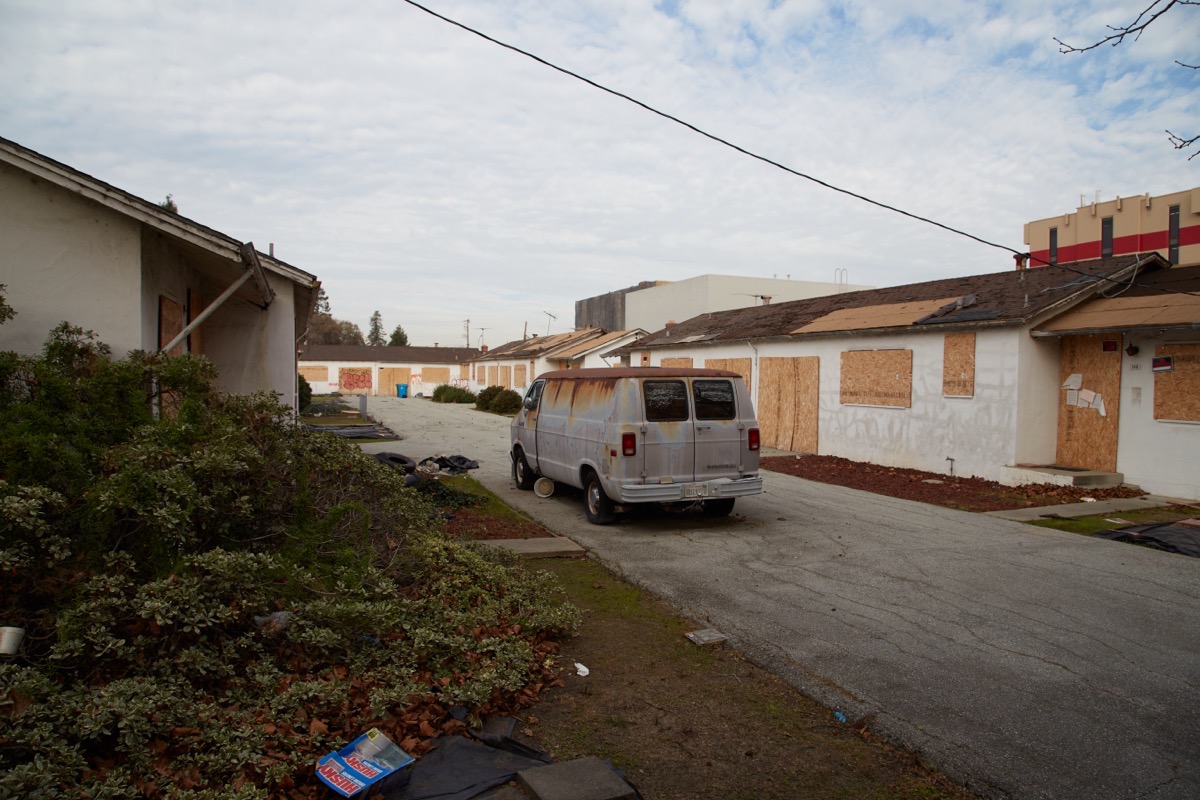
Neighbors complained about the place for years, and finally the city took action. I saw pictures from when the city went in and cleared the place out, and they were disgusting: it was clear that the units had become a serious health hazard.
Ownership of the property was a bit murky, as I recall: either the owner had died, or was seriously ill, or something. Whatever it was, the owner was unable to do anything with the place. Eventually, I believe it passed to a relative, and work finally began to rehabilitate the ten housing units in the summer of 2019.
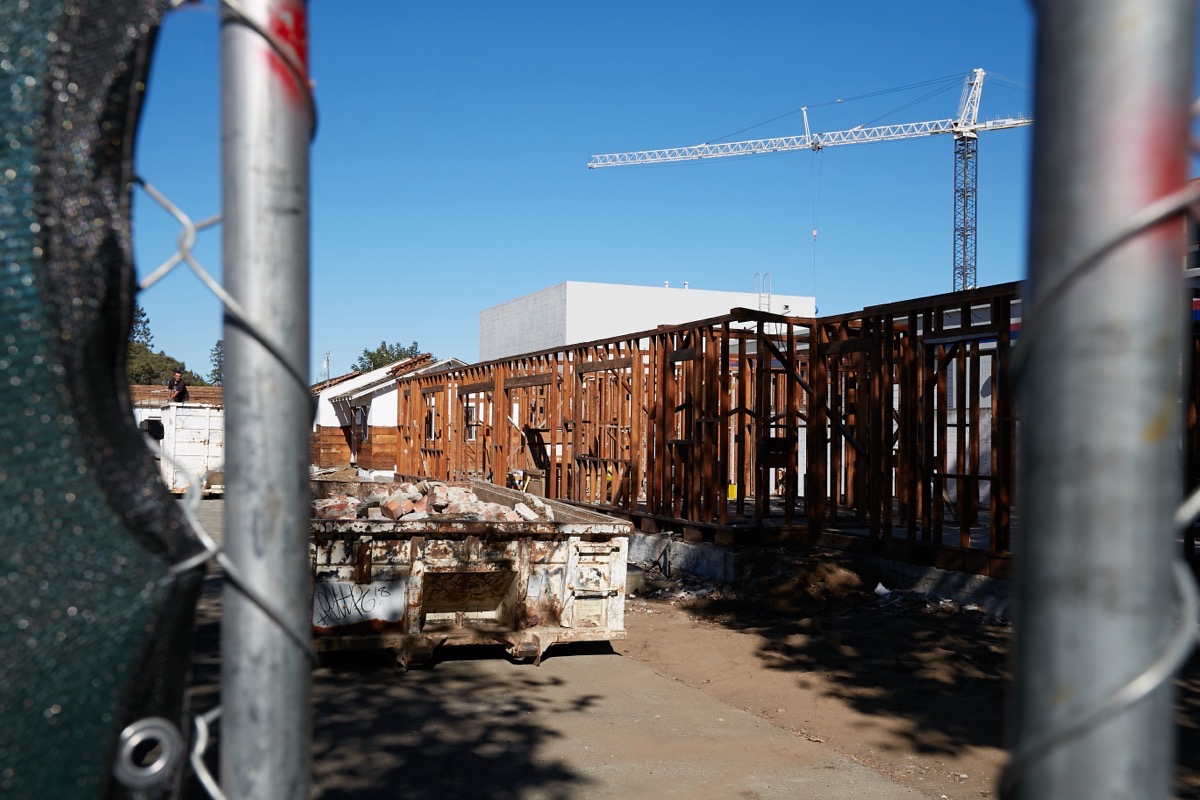
What started as a relatively simple cleanup of the existing buildings quickly became something else when it was determined that the buildings themselves were too far gone to be salvaged. Thus, the buildings were torn down to their foundations, and work began to build new units, with essentially the same design and layout as the old, on those foundations.

By now, it was 2020. And soon someone — a city inspector, I suspect — determined that the foundations themselves were badly in need of being rebuilt. So the basic floor framing that had been added to those old foundations was torn off, and by the summer of 2021 work was underway to repair the concrete foundations themselves.

The work proceeded at a snail’s pace. It wasn’t until February of 2022 that floor joists once again stood atop the five duplex foundations.

I figured things would move smoothly from there, and it did, for a short while, with framing starting to go up in March.

By May, all five units had plywood exteriors and roofs, and I was starting to relax.

By August of 2022, however, little progress had been made.

Then, another spurt: tar paper and stucco mesh (but not the stucco itself) were applied to the walls, windows were installed, the roofs were shingled, and gutters were installed.
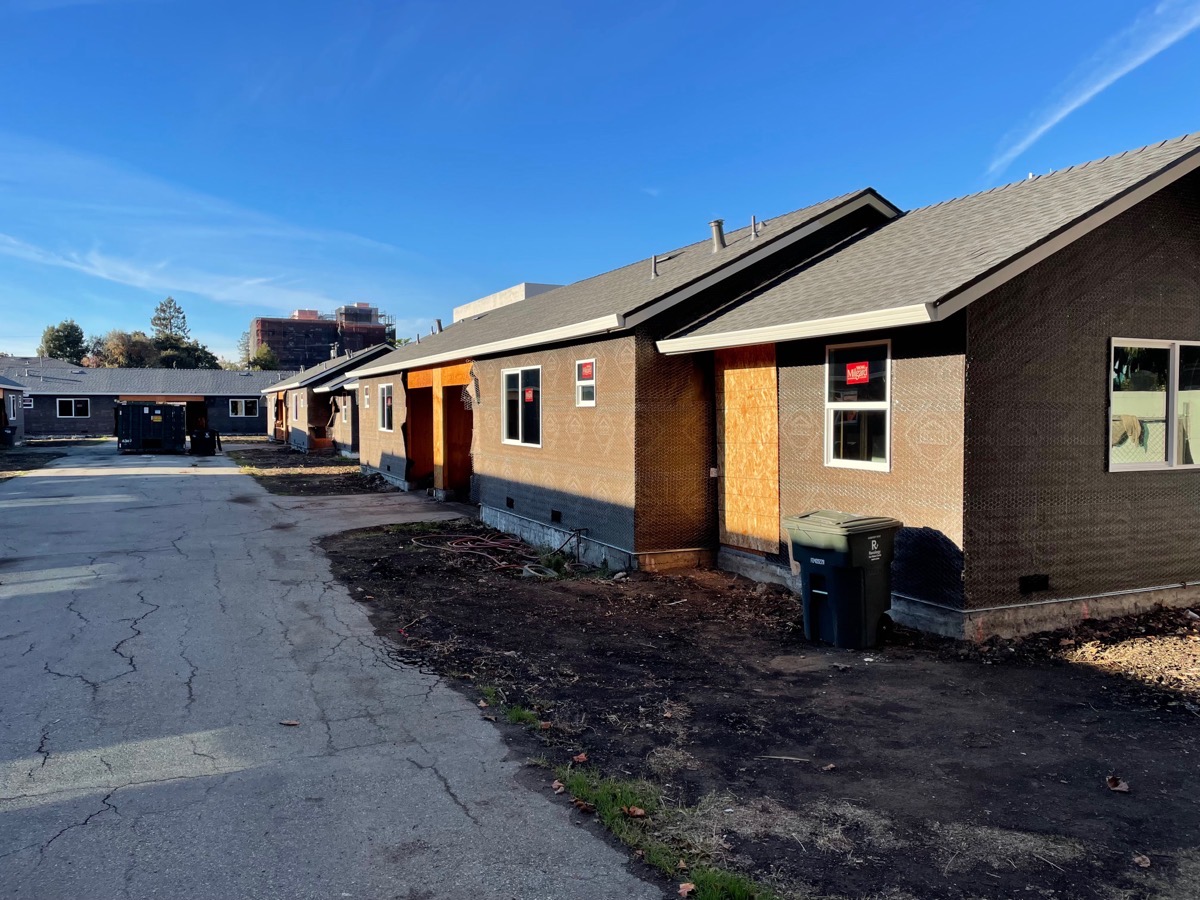
Surely we were in the home stretch, right? But no. That was November of 2022. And since then, the place has sat, essentially untouched. Here is one final photograph, from early in 2024:
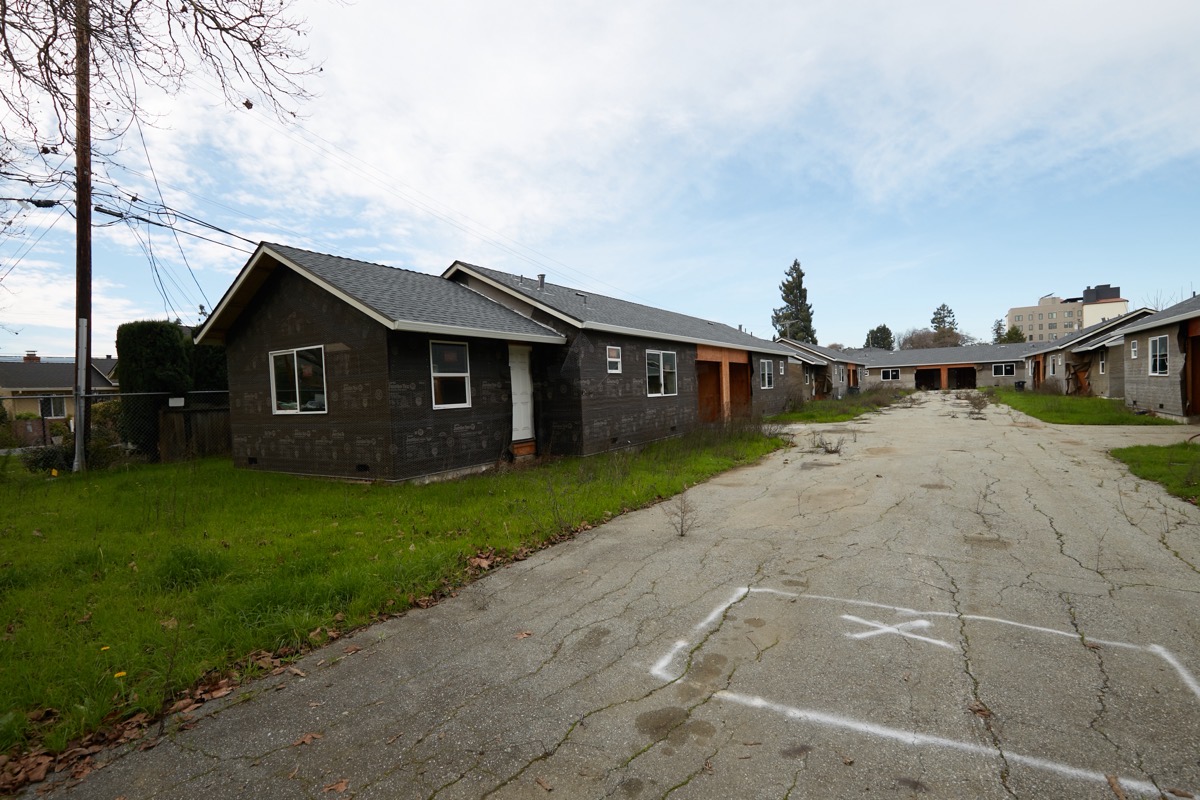
As you can see, nothing really changed between August of 2022 and today. I just couldn’t figure out what the holdup was. The developer seemed to be so close! And they’d invested a fair amount of money so far, money that they weren’t just going to throw away, right? Wrong. Just this week a formal proposal was made for a development on the site, and its a doozy:

This rendering shows what the proposed building would look like from Vera Avenue. But the site is narrow and deep; here is a side view:

This is unexpected. And quite a surprise.
112 Vera Avenue is just one parcel off of El Camino Real; it sits right behind a tire and auto repair shop. Across Vera Avenue is Villa Montgomery, a 58-unit income-restricted (that is, affordable) apartment building:

Across El Camino Real from the tire and auto repair shop is the Franklin Street Apartment Homes building:

[image courtesy of Google Street View]
Finally, immediately next door to 112 Vera Ave. is a small development that seems pretty much identical to what had been at 112 Vera Ave. before (and is pretty much identical to what was being rebuilt at 112 Vera Ave.):

The proposed building, at seven stories and 77’ 7” tall (to the roofline), is clearly going to loom over its immediate neighbors. It probably won’t look too out of place relative to Villa Montgomery and Franklin Street Apartments, but note that both of those developments are really only five stories tall (Villa Montgomery’s tower, at the corner of El Camino Real and Vera Avenue, extends to six stories, but the rest of the building is only five). As for the folks occupying the next-door single-story duplexes, well, it will definitely loom over them.
As for the building’s proposed residents, those seven stories gets you an apartment building with a whopping 178 units: 25 studios and 153 one-bedroom units. Parking? There is none. Well, technically, there are six parking spaces, but I’m guessing that those are for staff and not for the residents. All but two of the building’s apartments will be designated for those qualifying at the Low income level (those earning more than 50% of San Mateo County’s median income, but less than 80%; currently, that translates to more than $65,250 but less than $104,400). Those final two will be for the building’s managers, and will be leased at market-rate.
The fact that this is affordable housing has led the developer to rely on California SB 330, a housing bill that not only limits the ways that cities can deny such projects, but also streamlines the approval process. While a full Environmental Impact Report (EIR) still needs to be produced, unless it reveals some serious roadblocks, this project has a good chance of going ahead, resident parking or no. At least the project sits close to El Camino Real (and thus frequent bus service) and isn’t that far from Redwood City’s Transit Center. And shopping is fairly close by: it’s an easy walk to the Sequoia Station shopping center, and downtown Redwood City and its many restaurants is not much farther. So living at 112 Vera Ave. without owning a car would seem doable. Then again, residents can’t be prohibited from owning cars; those that do will presumably be parking them in the nearby residential areas, areas that already see a lot of cars parked on their streets (I walk the area a lot, and even during the middle of the day parking seems somewhat scarce). So there’s that.
Although there are one or two other proposed affordable housing projects in Redwood City that are relying on the state’s new housing laws, this project just may be the poster child for those laws, which not only streamline the approval of affordable housing projects but also forbid cities from requiring any amount of parking. I predict a lot of pushback from neighboring residents, and I’ll be watching with interest to see if those existing residents have any luck. If not, I’ll then be watching to see how these 178 new households integrate into the neighborhood.

Mazra, the Mediterranean restaurant that will be occupying the former Courthouse 2021 space at 2021 Broadway, will apparently be opening on April 2, just a couple of weeks from now (their website says “March ‘ish’ 2024”, but according to Palo Alto Online, April 2 is the new target date). This will be the second location for Mazra, who has been garnering rave reviews in San Bruno since 2020. Their popularity there has been so great, in fact, that even before they open their Redwood City location they’ll be closing their San Bruno one for a time in order to expand their building there. I have yet to try their food, but they’ve “made Yelp’s Top 100 Places to Eat twice in four years” so I’m really looking forward to doing so once their new location in the middle of Redwood City’s bustling “restaurant row” opens.
Redwood City’s “State of the City” address will be held on March 18 beginning at 6 p.m. (there will be a reception beforehand, with coffee and light refreshments, starting at 5 p.m. for those wanting to attend in person). It will be held, as usual, in the City Hall Council Chambers, at 1017 Middlefield Rd. Residents wanting to watch from the comfort of their homes or offices can do so via Zoom (redwoodcity.zoom.us, Meeting ID 994 8182 5639). It will also be recorded, of course, so it should be possible to watch after the fact as well.
 Walking Redwood City
In theory a high a density apartment building without parking seems great but in practice I question its viability. Surely there will be at least some residents with cars. Seems the developer should have to show data from similar nearby projects what percentage of residents have no vehicles. That neighborhood seems to be already slammed with tons of vehicles.
A couple of years ago they’d have to show such data — and provide parking. But with the spate of new California laws, projects like these with essentially no parking can’t be blocked for that reason alone. But I’m sure if/when it comes before the Planning Commission and/or the City Council, there will be oodles of public comment on that very fact, whether or not it can affect the outcome.