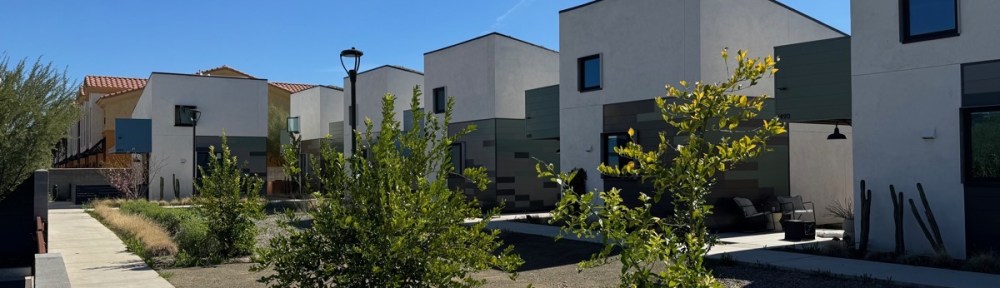
This week I’ve been in Arizona, attending a family reunion of sorts with members of my wife’s family. She has a sister who lives in Tempe, and a brother who lives part-time in Mesa, so the reunion took place in that general area, just east of Phoenix. While there, I took the opportunity to check up on two residential projects I’ve been long interested in that show some real out-of-the-box thinking on the part of the developers. Both developments seem to have gained traction, and hopefully can serve as models for projects in our own part of the country.
Tiny homes have a mixed reputation. While they can be a challenge to live in for some, for those who are comfortable with a simpler, more minimalist lifestyle, their small size can translate to small costs. As well, their small footprint means that more of them can be built in a given area, increasing density. Since higher density and lower costs are both something we desperately need in the Bay Area, as long as the tiny homes aren’t too tiny, and employ quality construction, I’d expect them to attract a lot of interest.
Tempe Micro Estates is a small single-family home development specifically targeted at low- and moderate-income home buyers. The development consists of 13 mostly identical, 600-square-foot units plus a 900-square-foot community center, all arranged around a central courtyard. The one-bedroom, one-bath homes may be modestly sized, but they have full kitchens, sleeping lofts (there is an accessible model that instead sports a “semi-separate bedroom” on the ground floor) and individual patios. These units are designed to be energy efficient, nearly all sporting rooftop solar panels. Instead of individual garages or carports, the development includes a common parking area near the street, roofed over with solar panels and equipped with EV charging stations.
Here is a picture of a handful of the homes, fronting onto the central courtyard:
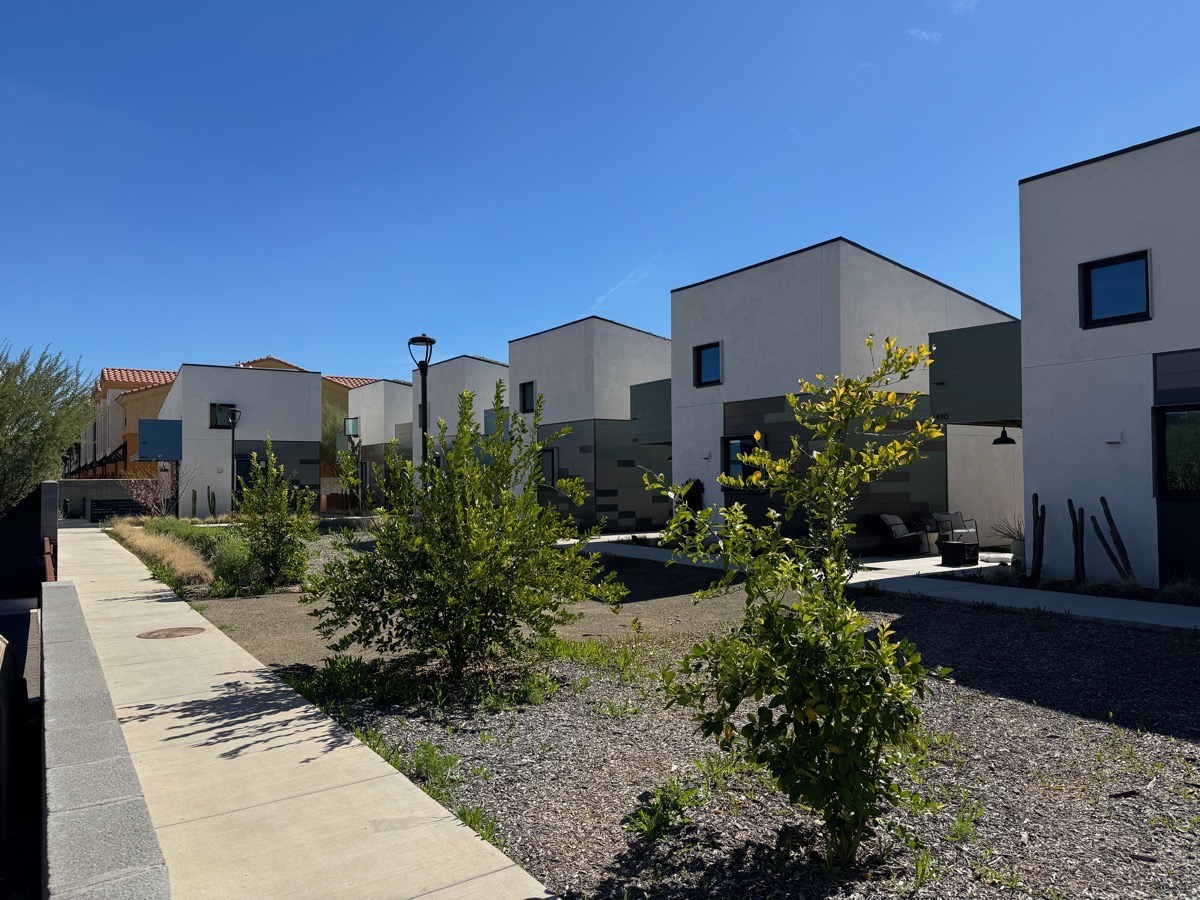
As you can see, they are pretty much identical. The basic unit design is simple, and employs standard window sizes to help cut down on costs (at Tempe Micro Estates the windows are small, primarily to help the homes stay cooler in the desert heat; if something similar was built in our area they could perhaps be larger).
Here is a closer look at just one of the units, showing its entrance and its small patio (that partially shaded bit of concrete in front of the entry door):
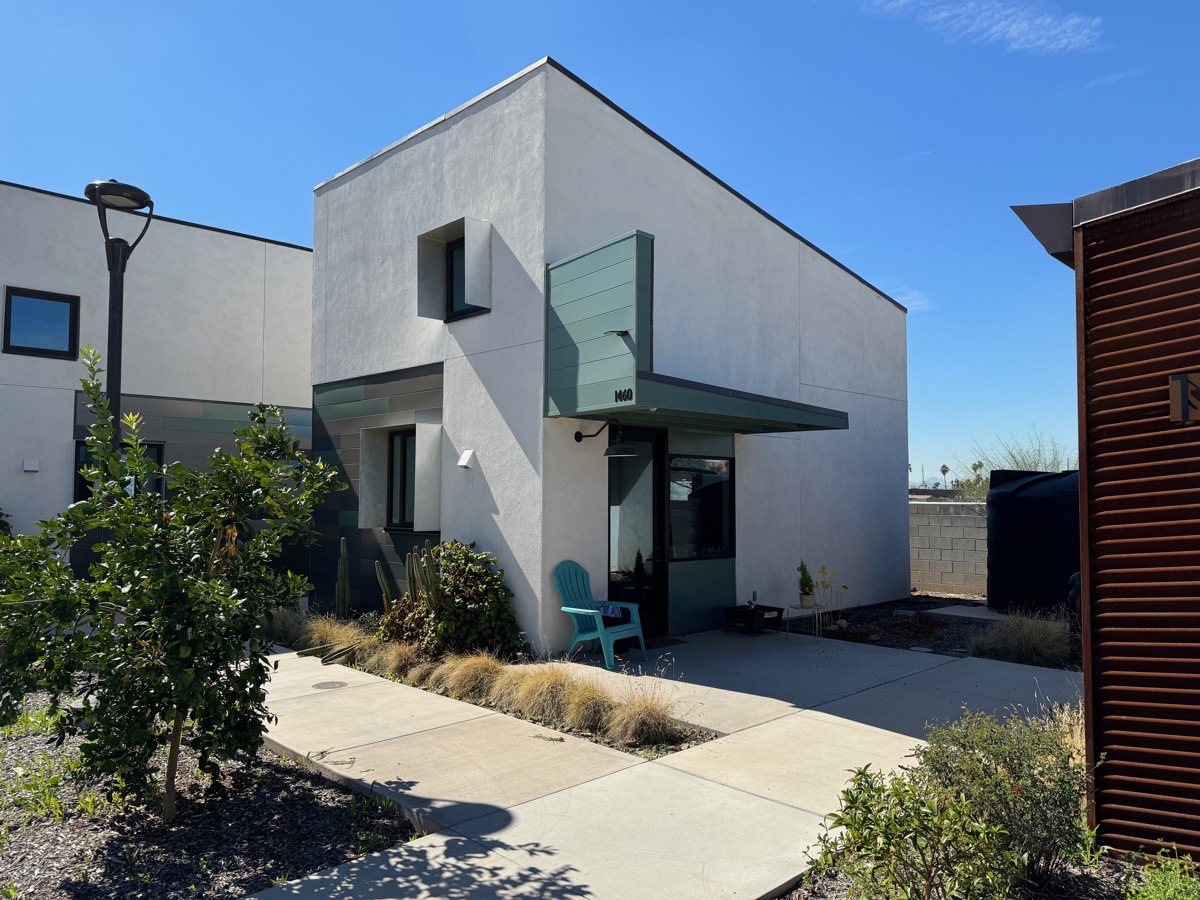
High land costs are drastically reduced in a development such as this, based on the fact that each unit has such a small footprint. In addition, the development relies on a community land trust: the residents own their homes, but lease the land upon which their homes are located via a low-cost, renewable 99-year lease.
Before leaving this particular development, I want to share a photo of a fascinating little development I was previously unaware of, adjacent to Tempe Micro Estates:
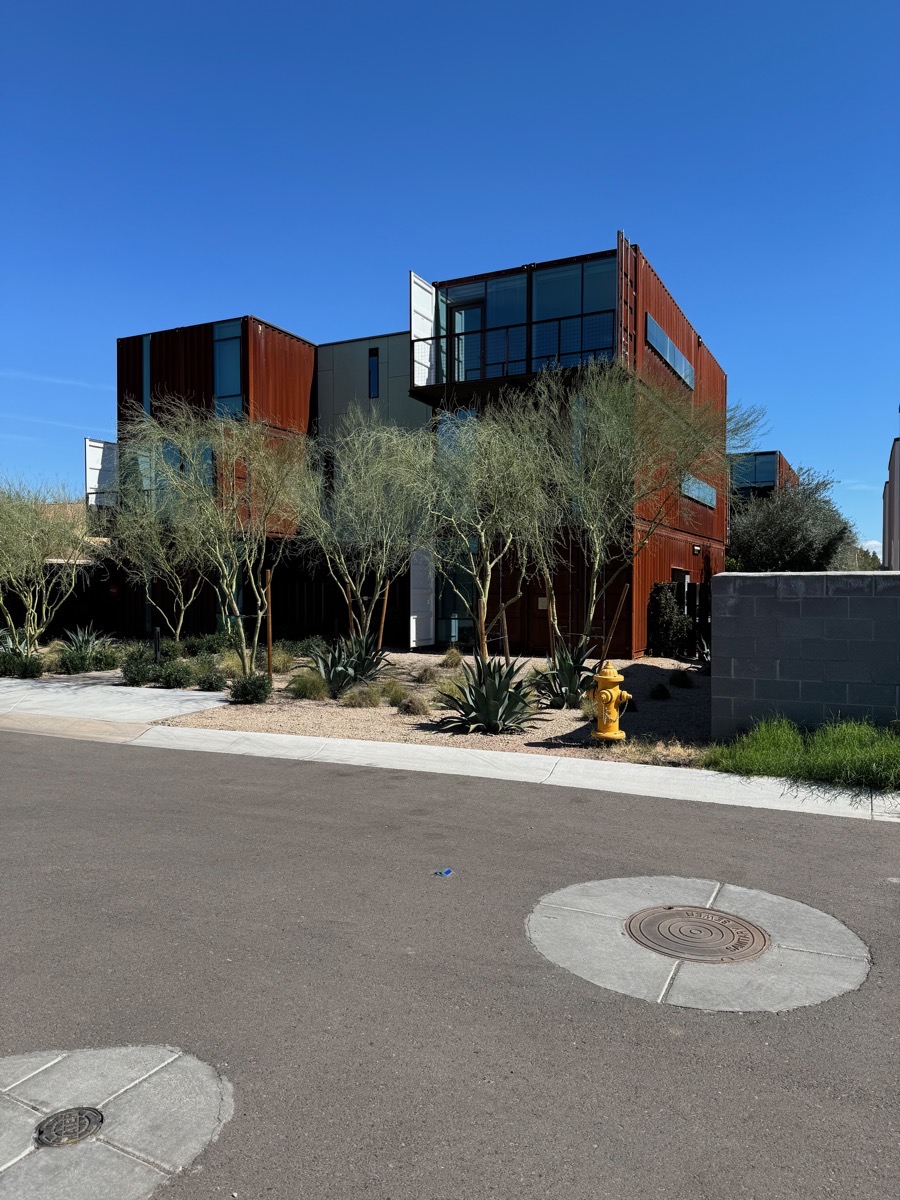
It isn’t clear to me just how many living units there are here, but the two H-shaped buildings contain at least four and perhaps more. As you can see, they are constructed from shipping containers (the sides of those balconies are formed from the open doors of the containers; look closely and you’ll see that the latching mechanisms are still attached). The rusted exterior is quite lovely, and fits in well with the desert landscape. I definitely need to see if I can find out more about this particular housing project.
Elsewhere in Tempe is an altogether different type of development, one that bills itself as an entirely car-free neighborhood. It ultimately will have 700 or more apartments, along with a grocery store, a restaurant, a yoga studio and a bicycle shop. Called Culdesac, this development is located directly in front of a light-rail stop, making car-free living a real possibility.

When I visited this week, some number of the apartments were occupied, and a great deal more were at various stages of construction (the apartments are grouped into small buildings that are then arranged in clusters around common areas). Not only were the grocery store, restaurant, yoga studio and bicycle shop open for business (all of which are open to the public), so, too, were a number of small shops on the ground floor of some of the residential buildings:

Nowhere in the entire 17-acre development will you find any asphalt. Even the pavers you see in the photo above are used relatively sparingly; most of the walkways to and between the residential buildings are made from fine-ground gravel and rock (“fines”):

Culdesac has plenty of bicycle and Bird scooter parking, but only a single lot with a relatively small amount of parking for cars. Staying true to Culdesac’s mission, the parking in that lot is not for vehicles owned by residents, but is instead for visitors, for Waymo pickups and drop-offs, and for a handful of cars available for residents to rent. Instead, residents are encouraged to take alternative forms of transport: they receive passes that enable unlimited free rides on Phoenix’s light rail, streetcars and buses, plus they get 15% discounts on all Lyft rides and 15% off Bird scooter rides. Finally, for those rare times when only a private car will do, on-site electric cars can be rented for as little as $5/hour.
From the look of things, Culdesac is doing well: the stores are up and running, and a number of the residential units clearly seem to be occupied. Plus, the developer is building a number of additional residential units, indicating that there probably was more than enough demand for the first batch. Some of the under-construction units were still in the early framing stage, but others were nearly complete:

Lest you get the wrong impression of this place from the above photograph (which shows the backsides of these new buildings), it really is a charming place. It actually reminded me of some European towns, with their narrow, winding streets:
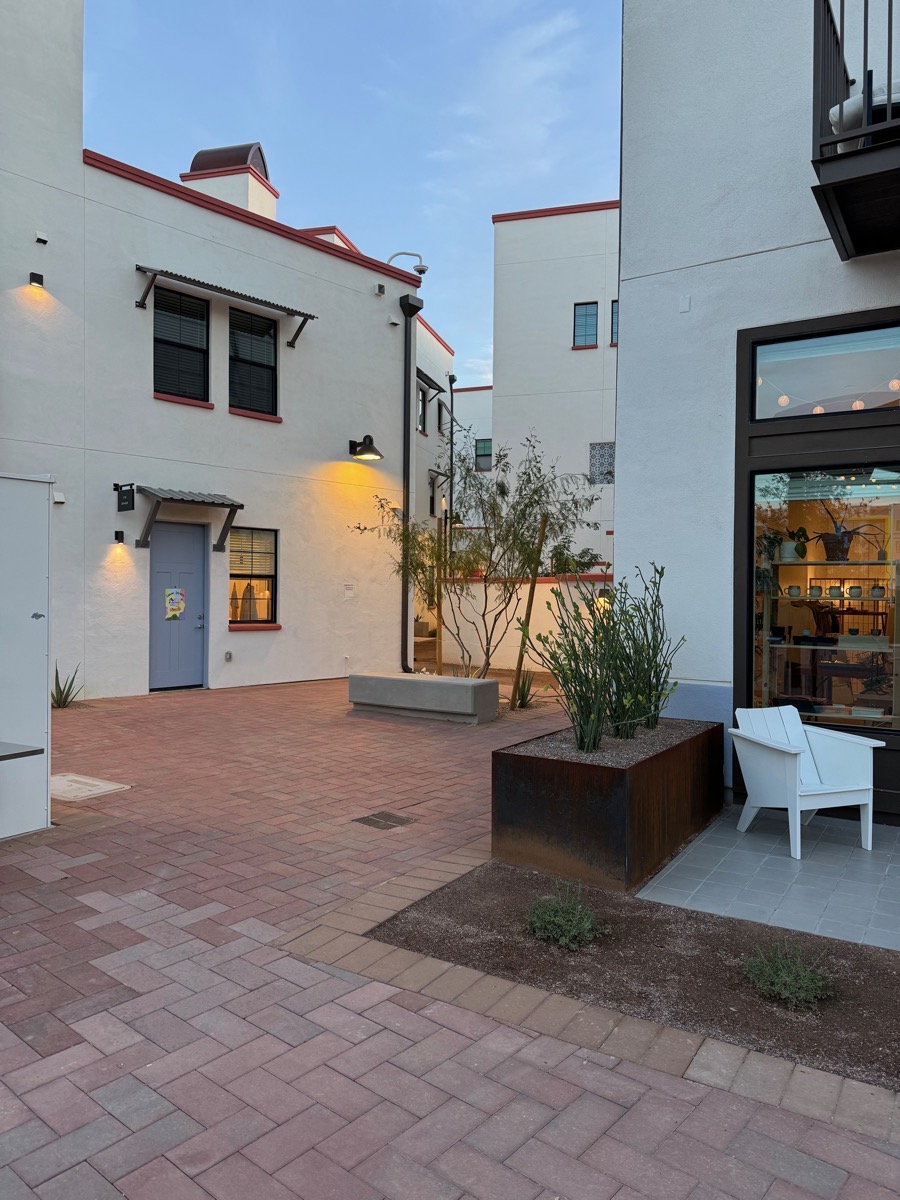
Culdesac’s primary aim is to develop a car-free, walkable community, and I truly hope they succeed. Primarily because it doesn’t need to provide enough parking lots or garages to satisfy the needs of 1,000 or so residents, the land that otherwise would have gone towards those facilities can be used for more housing units instead. Which not only makes far better use of the land on which the project stands, but actually saves quite a bit of money — money that I hope is being passed onto the residents in the form of reduced rent.
I truly hope that these two developments succeed and spawn imitators. If so, I really hope that some of those imitators are in the Bay Area; we would definitely benefit from projects like these that not only provide quality, high-density housing in a non-traditional form, but do it in a way that should result in cheaper apartments and for-sale homes.
If you are ever in the area and want to see either of these for yourself, Culdesac is located at 2025 E. Apache Blvd., in Tempe, AZ. As for Tempe Micro Estates, you’ll find it at 1499 S. Rita Lane, just off of E. Spence Avenue, also in Tempe, AZ.
 Walking Redwood City