
Very possibly because I was born and raised in California, I’ve always had a bit of a thing for cars. Unlike many of my friends, however, my tastes ran towards the practical: my first car was a Chevy Vega wagon (stick shift!), and when I eventually had to move on from that car, I briefly considered getting a full-sized station wagon — before I saw sense and instead went with a Ford Fiesta (a two-door hatchback with a surprising amount of cargo space) instead. That car got me through college and well into my first couple of years of married life; I still miss it.
One of the things I really appreciated about my Fiesta was that it was quite economical for its day. When driving back and forth between our home in Los Angeles and my university in Flagstaff, Arizona, I would top off the ten-gallon tank before setting out. Then, I’d see just how far I could get before I had to fill up again. Because of the elevation change — Flagstaff is at 7,000 feet, and LA is, of course, essentially at sea level — there was no way I could make it all the way to school on one tank. Truthfully, even with all of the downhill driving I couldn’t make it quite all the way home on a single tank either, but that elevation drop helped a lot, and I could get close.
These days, the world of cars has changed. In my household, we now have both a fully electric car — a Chevy Bolt — and a Volvo plug-in hybrid. The Volvo is relatively new, but we’ve had the Bolt for over four years now, and before that we had an all-electric Honda Fit. So we’ve had plenty of time to learn about living with electric vehicles. Although I do enjoy seeing what kind of range my cars seem to have, and I do like to experiment with different driving techniques in an attempt to maximize range, I don’t do what I did with my Ford Fiesta back in my college days: I don’t take long distance trips in which I try to see just how far I can get. With my Fiesta, when I chickened out and decided that it was time to fill up, there was always a gas station within easy reach, so I rarely worried about running out. With our electric cars, though, I quickly learned all about “range anxiety.” Public chargers seem to be getting better, and our Bolt can use the new DC Fast chargers (which allow you to “fill up” your EV much quicker than a standard charger), but because we’ve always had at least one car powered at least partly by gasoline, we never push it. We use our EV for pretty much all of our local driving, and use the Volvo (which can go about 35 miles purely on electric power, after which it reverts to gasoline power) for all of our long-distance driving trips.
Doing things that way, we never have need for public chargers. Instead, we charge up at home, using the 220-volt Tier 2 EV charger installed in our garage. Because in our household we actually use our two-car garage to park our two cars, when I had the charger installed I had it placed in the center of the garage’s back wall, where the charging cable would be able to reach either car.
I am extremely lucky to have a single-family home and a charger in my garage. I’m well aware that a great many of our area’s residents are not so fortunate, and thus have to rely on public chargers, or on very slow Level 1 (110v) home chargers, or have to sit out the EV revolution, at least for now. Particularly hard hit are those living in apartments and condominiums, most of which have neither the necessary wiring nor even enough power coming in from the power company to support a slew of Tier 2 EV chargers. Although some of the newer multi-family residential buildings have at least a few chargers, soon, if not already, there will be more electric vehicles among the residents than there are chargers, meaning that everyone will have to take turns.
But then, there is this project:
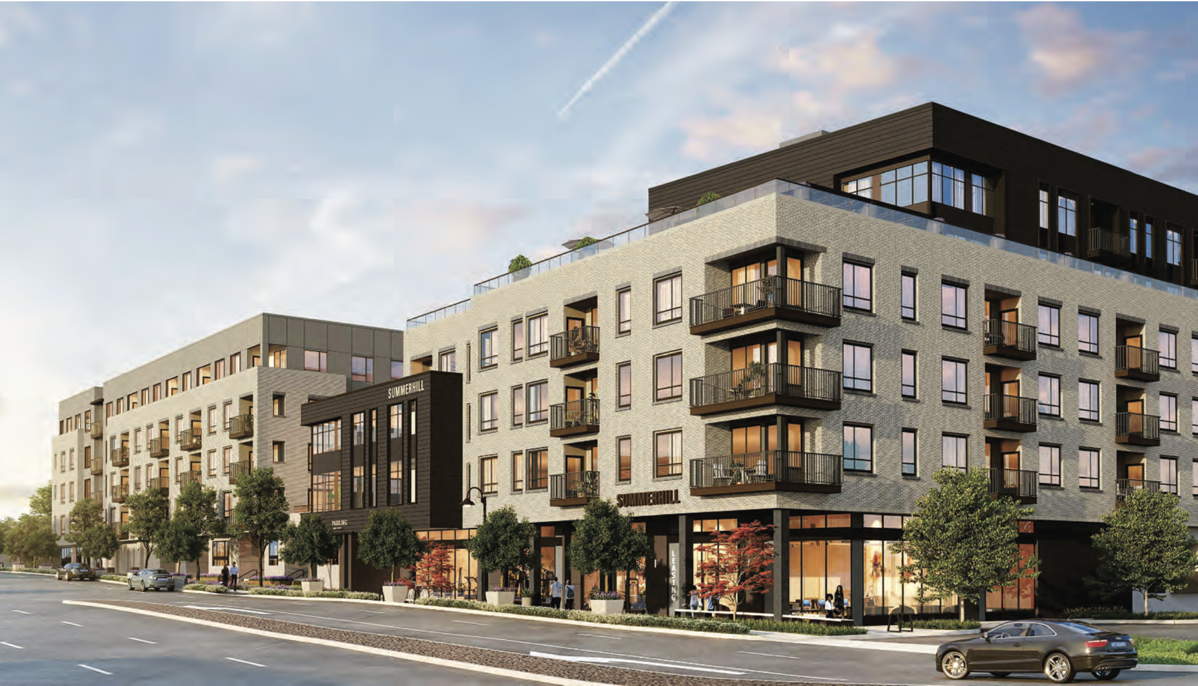
I don’t expect you to recognize it: this project was approved by the San Carlos Planning Commission less than two weeks ago, for a parcel on El Camino Real right up against that city’s border with Belmont. Today (and, for at least a bit longer: the builder hopes to get underway next May, and complete the building by July 2026) the parcel is home to a CVS Pharmacy, but eventually it may well be occupied by the six story (a new high for San Carlos!), 242-unit residential project you see above.
This is the CVS Pharmacy that would be replaced:

Only the CVS and the parking lot directly in front of it are part of the project: the southern part of the center, with Kabul Afghan Cuisine, Jersey Joes, and such, would remain untouched, as would the portion of the parking lot in front of those stores.
I have to give credit to San Carlos: they’ve enabled the creation of a great many housing units on what would seem to be tough-to-develop lots sandwiched between El Camino and the Caltrain tracks. Fortunately for this project’s developer, Summerhill Apartment Communities, El Camino Real diverges from the tracks somewhat in this part of town, making this site deeper and thus somewhat easier to develop. This building would still sit up against the Caltrain tracks, however, and therefore would still require extra soundproofing on parts — such as the side directly facing the tracks — to compensate.
In many ways, this project looks much like many of the recently constructed multi-family housing projects in Redwood City and San Carlos, and in many ways it is. It has a variety of unit sizes, from studios up to three-bedroom units (more than half of the total are one-bedroom apartments). Of the project’s 242 units, 15%, or 36, of them would be deed-restricted as below-market-rate units, with 24 of the BMR units going to very low-income households (those making at or below 50% of the median income in San Mateo County), and 12 going to households qualifying as low-income (those making more than 50%, but less than 80%, of the median income).
All of the units appear to have small private decks or access to private terraces. On the second floor there would be two internal (that is, open to the sky but surrounded by apartments) courtyards, one containing a pool and spa and an adjoining “clubroom.” The ground floor is where residents would find the building’s fitness center (facing El Camino Real) and its fully fenced dog area.
Parking is to be in a two-level internal parking garage, accessible directly from El Camino Real, with one of the levels being below grade and one being hidden on the first floor behind the buildings’s lobby, fitness center, and ground-floor units. The trend these days — including in Redwood City — is to provide fewer parking spaces than there are living units, with the aim of discouraging car ownership. This particular development, though, bucks that trend. San Carlos normally requires that a development of this size — 242 units, and considering that larger units imply multiple vehicles — have 281 parking spaces. Because this project would have a Transportation Demand Management program associated with it (which encourages residents to use mass transit and other alternative strategies to get to and from work; this building is a half-mile from both the San Carlos and the Belmont Caltrain stations), it qualifies for a 20% reduction, bringing the required number of parking spaces down to 225. So just how many parking spaces does the 11 El Camino Real project propose supplying? Would you believe 297? Granted, 14 of them would be designated for visitors, and three more are labeled “on-site,” which I take to mean reserved for the building’s employees. But that still leaves 280 parking spaces reserved for residents. I should note that 17 of them are tandem (where the cars are parked nose-to-tail, and the rearmost car has to be moved in order to get access to the frontmost car), but I’m sure that those would be assigned to some of the multi-bedroom units, so any needed car shuffling would take place within a single household.
What I find really interesting, though — and the reason for the seemingly unrelated introduction to this post — is the fact that of the 297 parking spaces, 242 of them would either be equipped with EV chargers or would be “EV ready.” That is, it appears that every household in this new development would have the capability to charge an electric vehicle in their own reserved space, unlike in other developments where a relatively small number are to be shared among the building’s residents.
To be fair, “EV Ready” just means that there are wires and a dedicated circuit for those particular parking spaces, meaning that not everyone would have a charger right away. But it appears that of the 242 spaces with some sort of EV capability, fully 97 of them would have Tier 2 chargers on day one, with 220v, 40-amp service running to each. The remaining 145 spaces would apparently each have a dedicated 110v, 20-amp circuit, possibly serving a conventional outlet. While those spaces wouldn’t have a dedicated charger, such an outlet would be able to accommodate the Tier 1 charger that comes with pretty much every EV sold in the U.S. these days. Of course, a Tier 1 charger isn’t capable of fully charging a completely depleted Tesla — or my Chevy Bolt, for that matter — overnight. However, it could be enough if your regular commute is short, or if you don’t need to drive your car long distances every day, or if you can charge your car at work. Because I no longer commute to an office, for instance, it would be enough for me: we only recharge our Bolt (which can go up to 250 miles on a single charge) ever other week or so. So Tier 1, although not ideal, is far better than nothing.
SummerHill — and the City of San Carlos, who appears to be requiring all of this charging capability — is really being forward-thinking here. Like them or not, electric vehicles seem to be the future of personal transportation, and although the transition to a fully electric fleet will take decades, retrofitting a multi-family building for multiple EV chargers can be a difficult and costly effort. Putting the necessary infrastructure in place when the building is built makes a great deal of sense, and this building’s residents will surely be grateful if and when they get an EV. Indeed, until other projects like this start springing up, these chargers are going to make this building really stand out, and likely would attract people away from other buildings that don’t have equivalent infrastructure.
Finally, projects like these are going to put a lot of pressure on PG&E to upgrade its infrastructure so as to bring more power to buildings like these. A lot of the charging would likely be taking place at night, when solar-generated electricity (either from this building’s rooftop, which may or may not be equipped with solar panels, or from elsewhere) is not directly available. Hopefully many residents with EVs will either charge at their offices, or will charge at home during the day. I myself make an effort to charge our cars during the daytime, when our own solar panels are providing more than enough power to supply the charger. But again, because I no longer commute, I have the luxury of being able to do that: many cannot. PG&E (and other electric utilities throughout the country) are going to have to come up with a way to store power produced in the daytime, for use at night. But I’ll leave that to them, and continue to focus on local projects like this one — which looks to be a winner.
 Walking Redwood City
Don’t you have pickup truck as well as those two cars? I seem to remember you referring to it in a discussion about recycled water. Thanks!
I do indeed. A 2005 Ford Ranger, that I bought used many years ago. When we got it we were doing a lot of projects on and around the house, and thus it was quite useful, but nowadays it sits in our side yard for months at a time, most often going out because we’ve loaned it to a friend. I’m thinking about selling it because we otherwise just don’t really use it anymore. I could certainly use it to transport water, but I’m trying to work out a way to transport it using my plug-in hybrid SUV, giving me one less reason to keep the truck.
I couldn’t find whether these are to be for-sale or for-rent. And it appears that San Carlos may be requiring this level of service; if so, they are the first that I’ve heard of — but they shouldn’t be the last. I hope that Redwood City follows suit.
Unless I missed something, I don’t think you were specific about whether these are rental or condo units. Was that left undeclared from the San Carlos Planning Commission?
If they are condos, that might explain the higher density of parking space availability for marketing purposes, and specific spaces might be powered from specific units.
Alternatively, I could see this as a new rental venture, where each charger is metered and the landlord sells the electricity at a markup, much as many complexes charge for parking spaces these days.
Not saying either option is inherently good or bad, just speculating on why a developer might choose to invest in the additional infrastructure required, and where their financial return would come from.
There is also a trend to decouple the parking from the units for those who don’t need parking (especially if the building is close to public transportation). The spaces can then be sold or rented to commuters, etc. I don’t particularly love this model but it seems to be happening more frequently.
Very true. It’s called “unbundled parking” and it works to the advantage of people who don’t have cars, since they then don’t have to pay for parking.