
Late last summer the Redwood City Council held two study sessions to review a set of nine development project proposals under a so-called “Gatekeeper process.” (See my post Gatekeeping for some background on the nine projects.) In October the council then discussed all nine, and “initiated” six of them: it directed city staff to begin working on how the city’s General Plan and Downtown Precise Plan should be amended to accommodate those six projects. Of the remaining three, it only rejected one outright. The other two were sent back to the drawing board, to see if the respective developers could tweak them to better address the city’s strategic priorities.
This week, those two projects returned to the City Council. Both had been slightly adjusted in ways that apparently were enough to satisfy the current City Council. At Monday’s meeting the council added them to the list of projects to be initiated. While initiation is only the first of a long series of steps that could lead towards project approval, it is a significant step down that road. Note that each project will still have to go through the standard review and approval processes, which will provide a number of opportunities for members of the public to comment.
The largest, and most impactful, of the two projects initiated on Monday is the one proposed for 1900 Broadway. I’ve written about it before, but as a reminder this is a large mixed-use project proposed for the site at the corner of Broadway and Main Street, where Wells Fargo Bank is today:

As you can see from the picture, this parcel is underutilized; most of the property consists of surface parking for the two-story bank building. As you can also tell, a taller building wouldn’t be out of place on this site: the eight-story Marston apartment building is just across Marshall Street, for instance.
What Lane Partners, the project’s developer, proposes for this site is a seven story, 92-foot-high building that would sit above two levels of subterranean parking. The majority of the building would be office space, although there would be some amount of retail on the ground floor, and the top two floors would consist entirely of affordable housing. The current proposal calls for 225,000 square feet of office space in total (down slightly from the original proposal’s 234,000 square feet), at least 10,000 square feet of retail space, and between 70 and 80 units of housing (up from the original proposal’s 54). This housing, which would be affordable at the Low and Very Low levels, would be built by Lane Partners, after which ownership would be transferred to Eden Housing, who would manage it. The precise mix of unit sizes has yet to be settled on, but there would be one, two, three, and four bedroom units (Lane Partners anticipates that at least half of the units would have more than one bedroom).
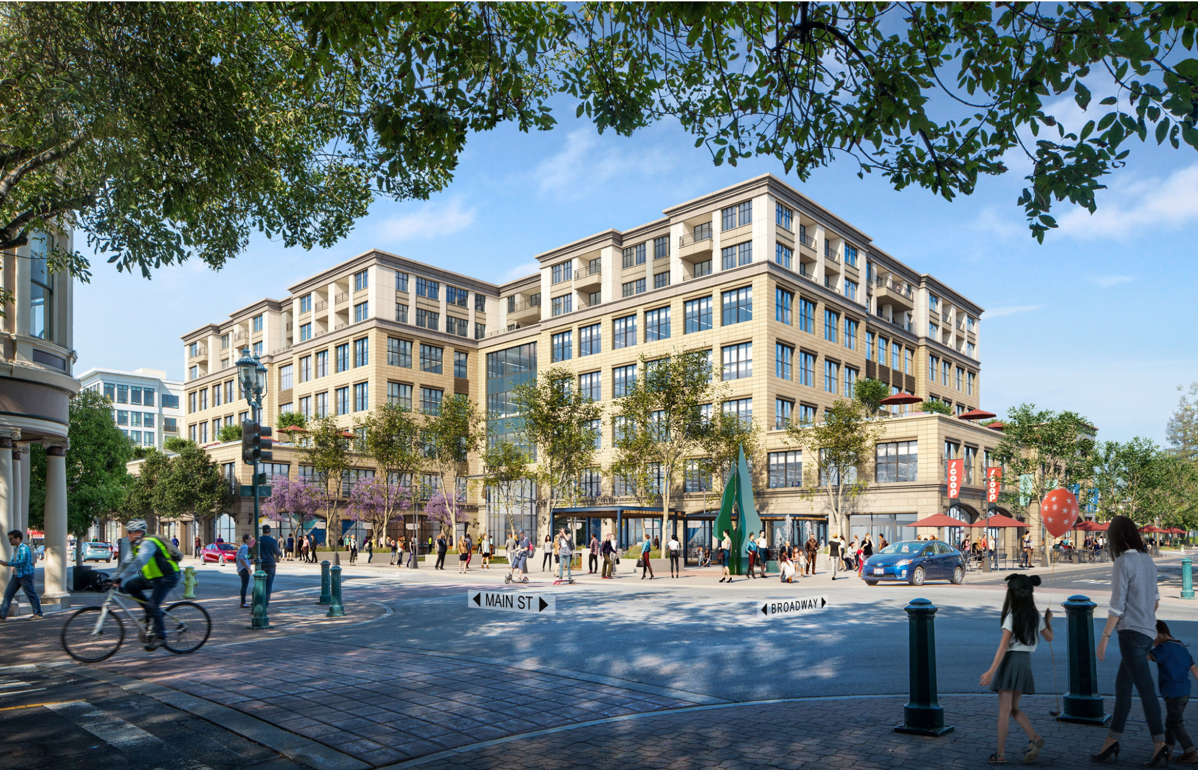
Other nice touches include setting aside 25 of the parking garage’s spaces for exclusive use of the Sequoia Hotel (assuming their project gets built; if not, the 25 spaces would be for public use); a 1,000 square foot “community art space” and an additional 840 square foot storage space for use by the city within the building; a commitment to use all union labor during construction; and a promise to prioritize family entertainment ventures for the retail space. Finally, and perhaps most importantly for those of us who aren’t likely to be either living or working within the building, the design calls for an 11,000 square foot public plaza at the corner of Broadway and Main Street:
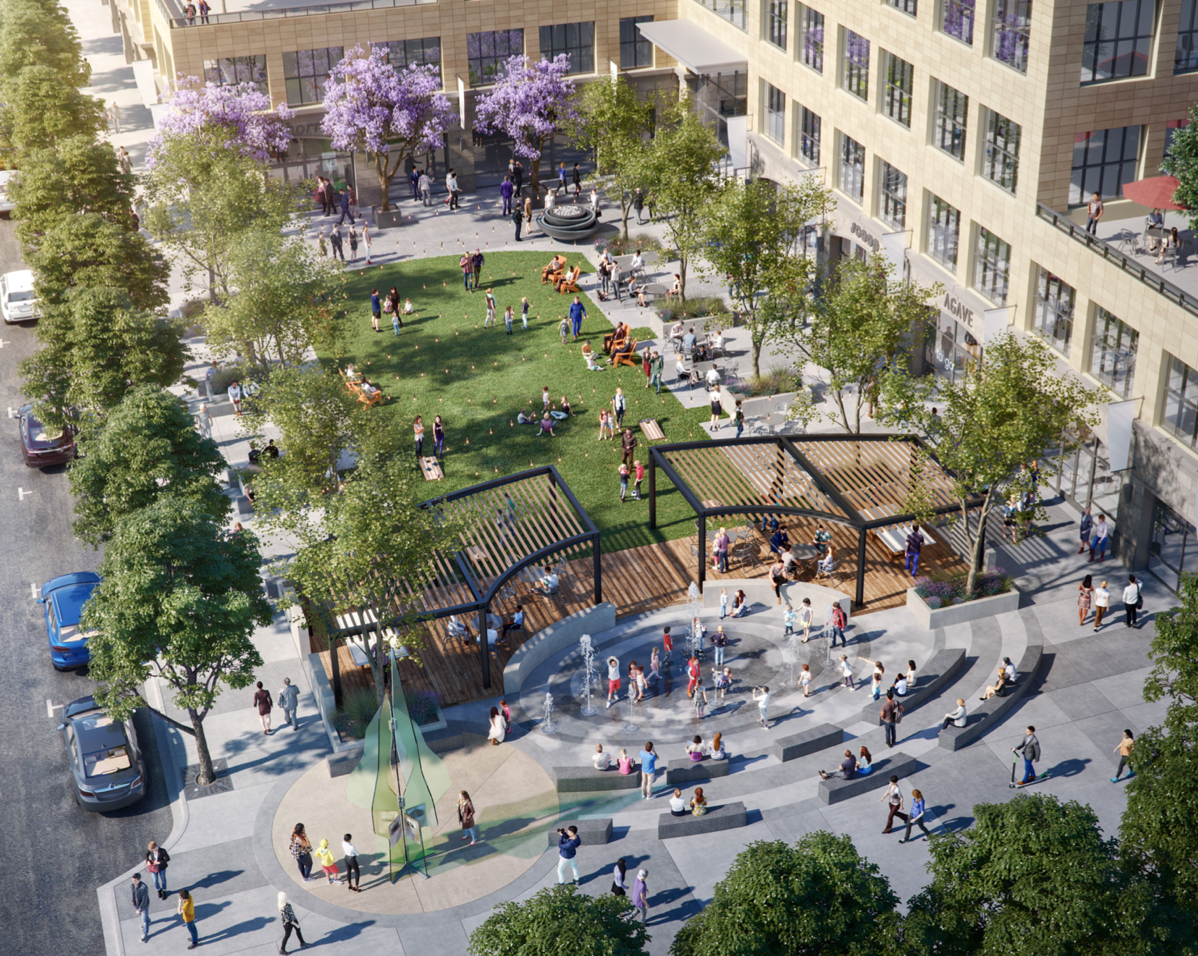
(The previous two renderings are among a handful that Lane Partners included as part of their presentation material for Monday’s meeting.)
As you can see, this could be a very attractive public plaza, not only for casual day use but as a place that could host many of the same kinds of functions that currently occur in Courthouse Square. Indeed, this plaza is roughly the same size as the open space in the center of Courthouse Square (between the kiosks and fountains). And if this new plaza truly is mostly lawn, rather than concrete, it will be a lot more comfortable than Courthouse Square is during the warm summer months.
As I mentioned in my previous, brief write-up on this project (in Gatekeeping), one tricky aspect of this project is the fact that, as currently designed, this project would require the abandoning of a one-block section of Spring Street, and the acquisition of the small triangular parklet on the other side of that street. Together these two additions would turn the oddly-shaped parcel into a rectangle, as I’ve indicated with a dashed outline in the following map:

The loss of the parklet would likely be a minor one: it is small and has no amenities, such as benches, and I pretty much never see anyone there whenever I walk by (although surely some nearby residents use it as a place to walk their dogs). The removal of that one block of Spring Street from our roadway system, on the other hand, will not be so easy to absorb. That section of Spring Street connects Marshall Street to Broadway in a rather seamless manner, making for the most direct path between the neighborhoods west of El Camino Real and the Woodside Road/Broadway intersection. Without the Spring Street connection, the route would be less smooth, requiring both an extra left and right turn. The effect that this project would have on traffic — both from the loss of that section of Spring Street and from the additional commute traffic that this building would bring — is one of the things that will be carefully studied by traffic professionals now that this project has been initiated. As someone who drives along this section of Spring Street quite frequently, I for one will be reading the results of that traffic analysis with great interest.
The 1900 Broadway project has its pluses and minuses. As does the other project that the council initiated on Monday, although with that project the balance seems more clearly tipped in the positive direction. This second project is proposed for 601 Allerton St., on the corner of Allerton and Fuller Streets. Today the site contains a rather nondescript two-story building where, among other things, the Social Security Administration has its local offices:

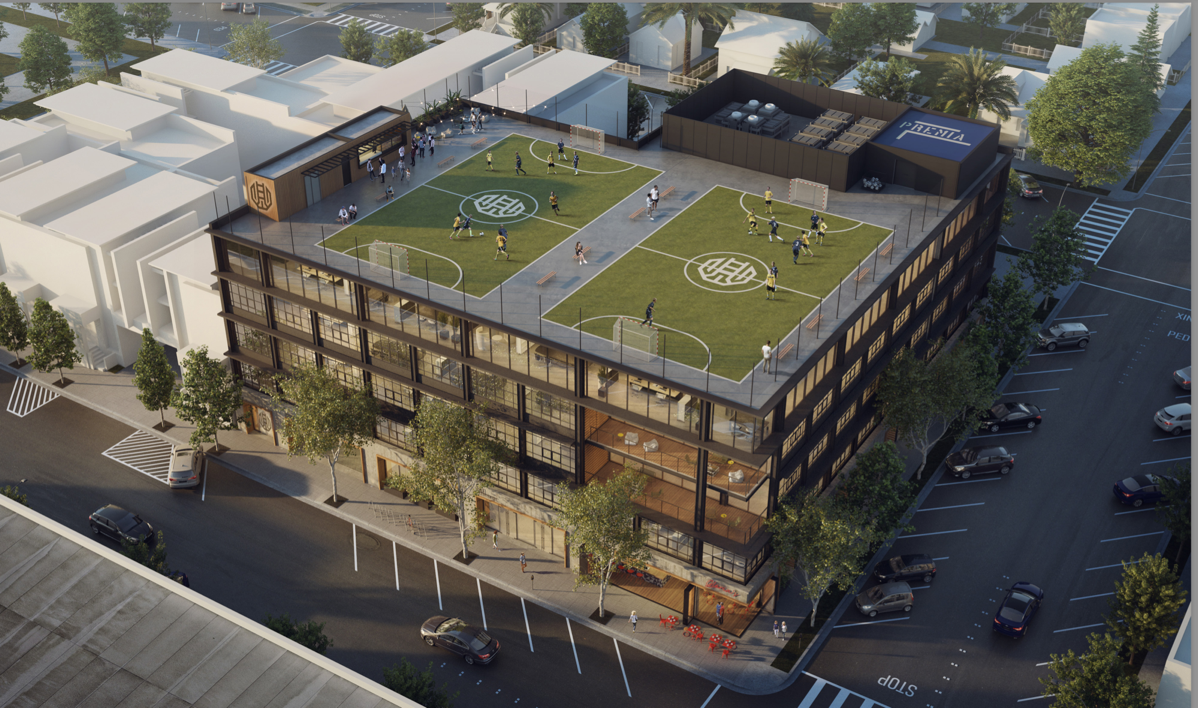
Here, the developer, Premia Capital, hopes to replace the existing building with a five story, 59-foot-tall office building with a small (540 square foot) cafe on the ground floor and two community futsal courts, plus a clubhouse, on the roof (I don’t know about you, but I had never heard of futsal before watching this presentation). Those rooftop courts, which would be open to the public (and apparently would be programmed in a manner similar to how the city’s public sports fields are, although not necessarily through the city), would be accessible through a dedicated entrance on the building’s ground floor. As for parking, that would be accommodated by an underground garage with room for 220 cars.
Here is a rendering from Premia’s presentation, showing an aerial view of the proposed building:
Here is another, showing the building from the ground level and emphasizing the building’s “community cafe” (which of course would be open to the public):

No discussion of this project would be complete without mention of its affordable housing component. In its previous incarnation, the building included eight small units of affordable housing, all on the ground floor and located just behind the cafe. Now, that space has been given over to offices, and the affordable housing is off-site. Instead of building new affordable housing, though, Premia is proposing that they instead purchase the existing apartment building at 450 Redwood Avenue and renovate and then deed-restrict the apartments as Very Low Income units. This building:

(I have yet to walk over and take my own photo of this building; the above image is from Apple Maps.)
As it exists today the apartment complex has 27 units, but all are either studios or one-bedroom units. Premia proposes combining a yet-to-be-determined number of units so that some of the apartments would be larger and thus more suitable for families. The resulting complex would likely contain between 18 and 26 apartments, rather than the current 27. Although this would very slightly reduce the overall number of housing units in Redwood City, the loss is more than made up for by the fact that all of the complex’s units would be affordable for some length of time (the term is often set to 55 years, although that hasn’t yet been determined here).
The affordable housing, the public futsal courts, and the cafe are all nice amenities to accompany a relatively small office project that would fit right in with its immediate neighborhood. Although it would certainly bring additional traffic, the site is not that far from Redwood City’s Caltrain station, meaning that there may not be all that much additional traffic. Here, too, the results of a required traffic study will make for interesting reading. Otherwise, I see very few downsides to this particular project.
In addition to the discussion around, and eventual initiation of, these two development projects, I was thrilled to watch the final significant item on the council’s agenda: the hearty agreement by the council to issue bonds for the construction of the first phase of the Veterans Memorial Building/Senior Center project. This project, which has been in the works for a very long time, seemed all set to go when the pandemic hit. Because of that, out of an abundance of financial caution the council put this project on hold until they had a better feel for both the financial markets and the city’s financial picture. Not only is Monday’s approval a sign of the council’s confidence in the city’s future, it also signals the imminent start of construction on this project.
I did a fairly lengthy write-up of this project back in December of 2019, in my post It’s Fun to Stay at the…; check it out if you want to know what is being affected and what the new building being constructed during this first phase would look like (the second phase would see the construction of the new YMCA next door). With the imminent issuance of the bonds that will finance this project, the city now anticipates that construction will begin in July, and that the new, fancy Veterans Memorial Building/Senior Center will be ready for occupancy in about two years: by July 2023.
 Walking Redwood City