
I’ve been watching the various development projects in Menlo Park for some time now. Some of the larger ones aren’t having much of a negative impact, given that they are being built on sites that had been essentially empty for years: they were once home to large automobile dealerships, dealerships that had closed a number of years ago. Given the choice of an empty, slowly deteriorating automobile dealership and a new mixed-use development, most would probably vote for the mixed-use development. But every once in a while a development comes along that replaces a beloved part of the city, and it isn’t so clear whether the project will end up being a net positive or a net negative for the city. Not too long ago one such project got underway. This one:
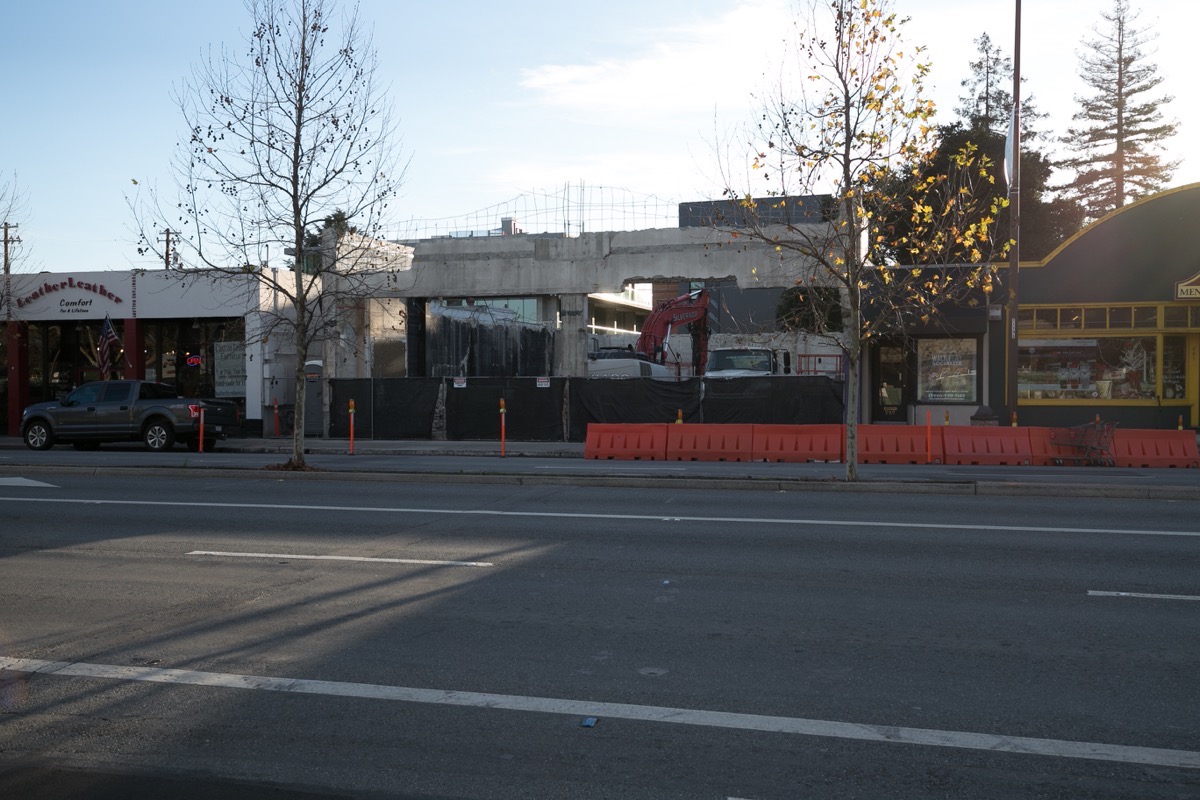
(For the record, I took this picture on December 27. Today, as I write this, it appears that almost all of the remaining concrete you can see in the above picture has been torn down, leaving a mostly empty lot. Apparently the plan is to keep two of the building’s walls so that this project can be classified as a substantial renovation rather than as all-new construction.)
If you don’t recognize this spot, I don’t blame you: the structure you can see in the above photo doesn’t really give a hint as to what was once there. But this was, until not too long ago, the Guild Theatre.
The Guild Theatre originally opened in 1926 as the Menlo Theatre. It had been operating for the past 93 years, making it not only the first movie theater on the Peninsula, but the longest lasting: according to the San Francisco Chronicle the Guild was the “last of the single-screen movie theaters that once marked each Peninsula commuter town along El Camino Real.” Thus, it seems to have both ushered in an era, and seen it out. The Guild was a special place, not only because it frequently had midnight showings of The Rocky Horror Picture Show but because it often showed smaller independent films in addition to more mainstream ones. I have a number of happy memories of going to movies at the Guild (not Rocky Horror, though), and I will truly miss its unique style and its eclectic selection of films.
The three investors who bought and have subsequently demolished the Guild Theatre plan to build a new misc hall in its place, one that will host live concerts. So at least we aren’t losing a classic — and historic — theater to yet another restaurant or office complex. But the curtain has been brought down on the last of the great independents along the Peninsula, it seems…
I’ll get to the bigger Menlo Park projects in a minute — I’ve covered them before, but they are worthy of an update — but there is another interesting project that I was curious about, and thought that others might be, too. For quite some time now I’ve been driving by this place, wondering what work was being done:
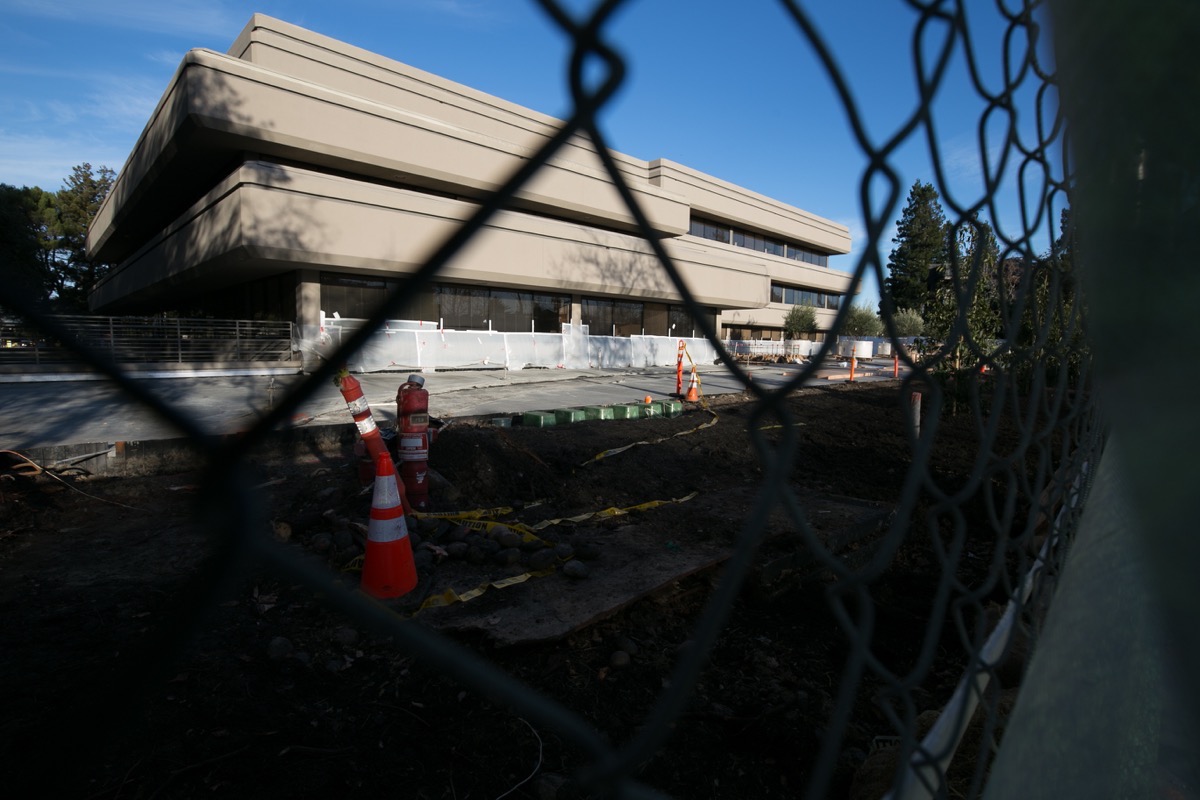
In case you don’t recognize it from the photo, this building is on the corner of El Camino Real and Ravenswood Avenue. Its on your right as you are heading north on El Camino Real, and is just south of the Ravenswood Avenue intersection. You may not recognize it from this view — which is from the sidewalk in front of the building along El Camino Real — because there used to be seven 85-foot-tall coast redwood trees that helped screen the building from the street. Today those trees are gone, though, and at the moment there is a green cloth-covered construction fence obscuring much of the view.
The building itself isn’t that old — it was built in 1983 — so when I noticed a lot of digging going on in front of the building I wondered what was up. It appeared to be some sort of landscaping project on steroids, but that didn’t make much sense. I go by this building once or twice a week, but because I am usually driving I never made a note to remind myself to check into it. It was only after I walked along the sidewalk in front of the building and took the above photo that I finally did the necessary research.
Beneath this building (and beneath some of the front landscaping) is an underground parking garage. Apparently, water damage and erosion have caused some of the steel “tendons” in the garage’s ceiling to break. The repairs would have entailed cutting some of the roots of the seven now-missing redwood trees, which would have damaged them severely and made them prone to toppling. Thus, the trees were entirely removed.
The garage repairs appear to be largely complete, and so the landscaping is now being put back together. To make up for the loss of the seven trees (which were planted back when the building was built) 14 new heritage trees will be planted on the property. As well, an additional 62 trees will be planted elsewhere in Menlo Park. The trees being planted on property won’t be redwoods, however: their need for large quantities of water and their invasive root systems make them impractical for the site. Instead, the building’s owner plans to plant Brisbane box, London plane trees, and coast live oaks.
The loss of the redwoods is a bit sad, but the sheer number and variety of trees that are being planted in their stead is a net positive for the City of Menlo Park. I’m looking forward to seeing the final result, and I’m looking forward to the appearance of 62 new trees throughout the city.
Now, allow me to review the progress of the several other major projects that are currently underway in Menlo Park’s downtown. If you drive through the city along El Camino Real you’ll quickly realize that proportionally, development in Menlo Park seems about on par with Redwood City. (Menlo Park is just about half the size of Redwood City in terms of land area, and in terms of population Redwood City has about 2-1/2 times as many people.) Unlike in Redwood City, however, many of downtown Menlo Park’s largest projects are being built on long-disused parcels.
Starting near the southeastern border of the city we find the large Middle Plaza project, which is being constructed by Stanford University. Three automobile dealerships once stood side-by-side on the land that is being consumed by this project: Stanford Lincoln Mercury, University Ford, and Anderson Chevrolet (this last became for a time Tesla’s second-ever showroom).
Combined the properties total some 8.4 acres in size. Stanford will be building a complex that is a mix of housing and office space, plus a small amount of retail. There will be four residential buildings (two of which will be connected) ranging from three to five stories in height. Altogether they will contain a total of 215 apartments, eight or ten of which will be made affordable to those who qualify at the Low income level. Middle Plaza will also include three “non-medical” office buildings, for about 143,000 square feet of space. On the ground floor of one of the office buildings there will be about 10,000 square feet of space for either retail or restaurants.
Beneath all of this will be a couple of large subterranean parking garages, and that is where the work has been focused so far: the holes that are being dug for these are positively enormous. This one is at the southern end of the property; you can just make out the neighboring Stanford Park Hotel in the distance, behind that blue crane near the right edge of the photo:

Here is another garage, this one towards the northern end of the property:
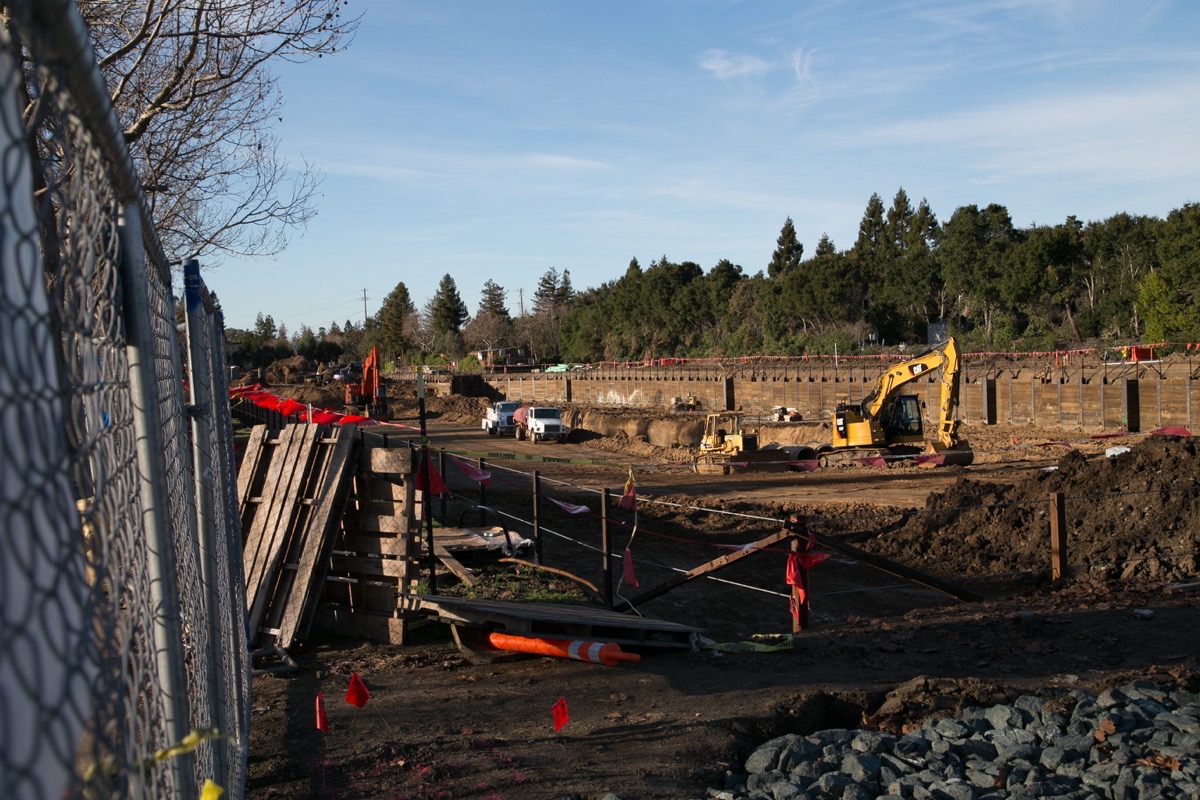
A somewhat narrow section of land will remain between these two garages: this will be a road that essentially extends Middle Avenue onto the property, and will serve as the main vehicular entrance to both the property and the garages. Cars will drive onto the property here and then enter the garages from the rear, by the Caltrain tracks (which run just in front of the trees in the above pictures). Thus, most of the traffic entering and exiting the property will funnel through the signalized intersection of Middle Avenue and El Camino Real.
Walking north on El Camino Real, the next project I came to is just off El Camino Real: this one is actually located on Live Oak Avenue:
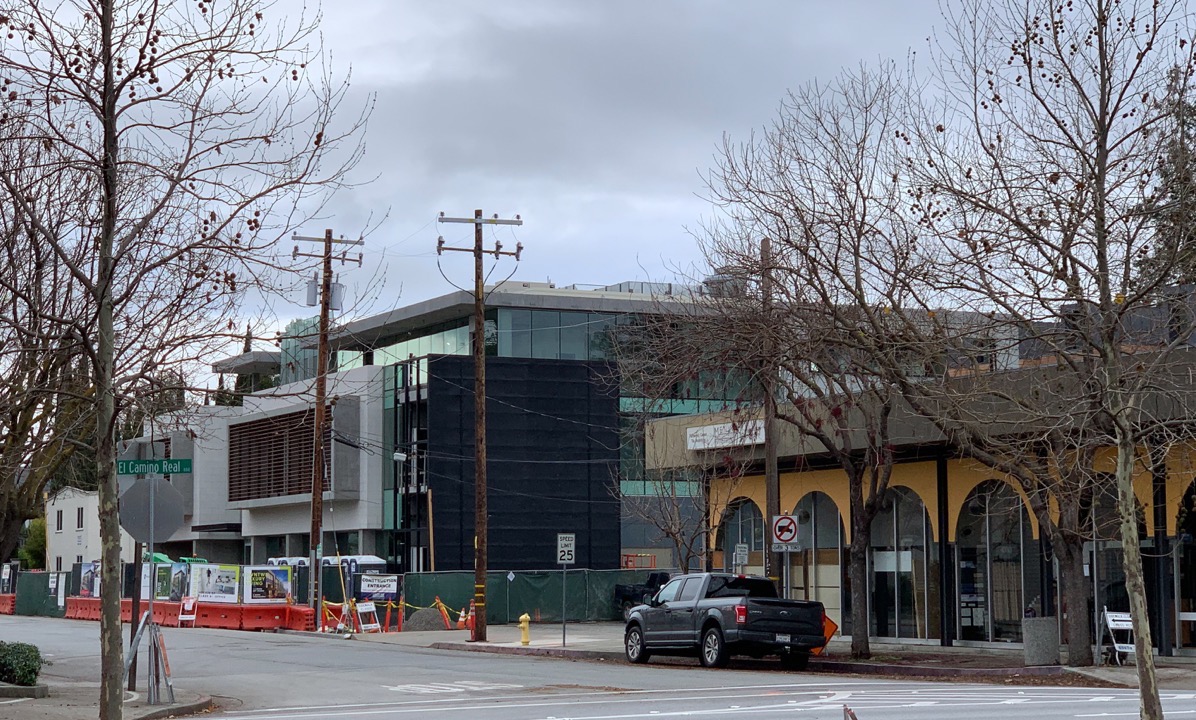
This project consists of four separate buildings, one three-story combination office/residential building (clearly visible above), one three-story apartment building (towards the right side of the picture), and a pair of two-story apartment buildings (located mostly behind the office buildings, and only barely visible in the above photo). Altogether they should supply some 17,000 square feet of office space and 17 for-rent housing units (two affordable), all above a two-story parking garage. From the outside, anyway, this project appears to be nearing its final stages, and hopefully will be wrapping up soon.
Continuing north on El Camino Real I passed the Guild Theatre site, which I’ve already covered. Next I came to the buildings at 505 and 556 Santa Cruz Ave., plus the building at 1125 Merrill St. (all just north of the building that houses Kepler’s books, and on the same side of El Camino Real):
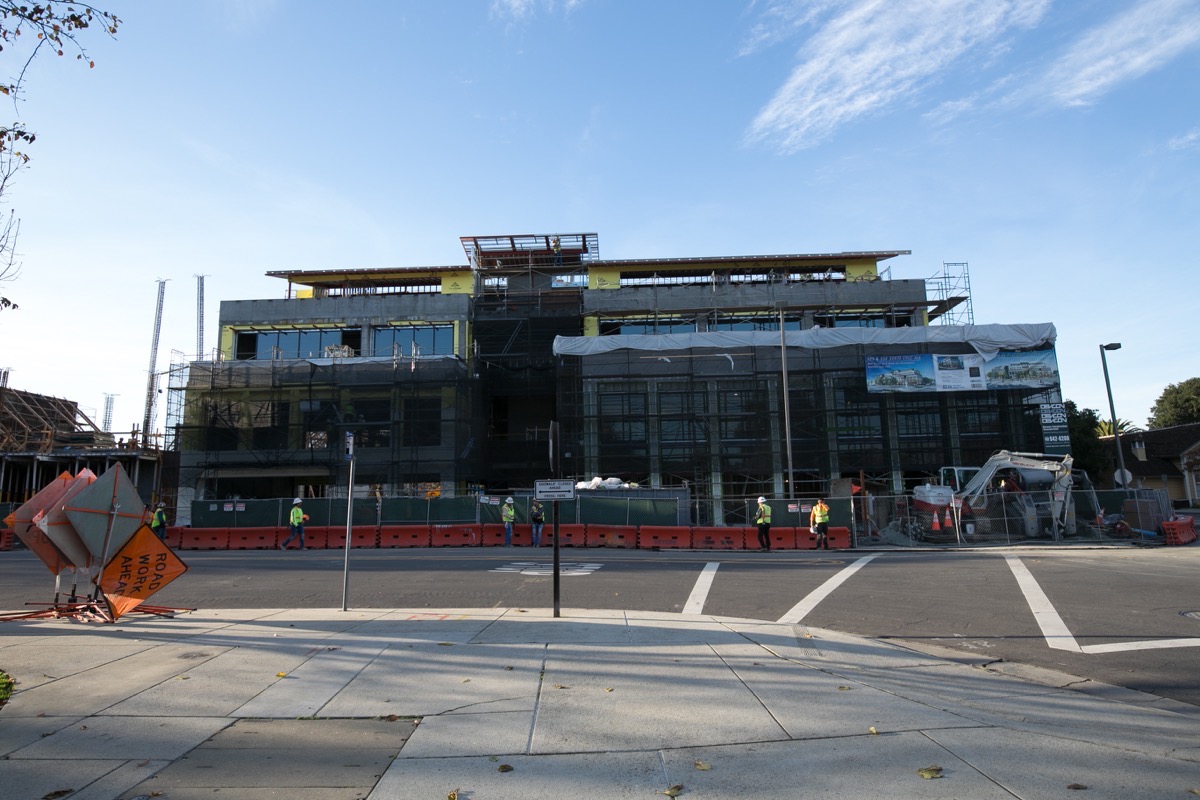
The above are the buildings along Santa Cruz Avenue. Here is the view from Merrill Street, showing 556 Santa Cruz Ave. (to the left) and 1125 Merrill St. (to the right, where the steel framing is still exposed):
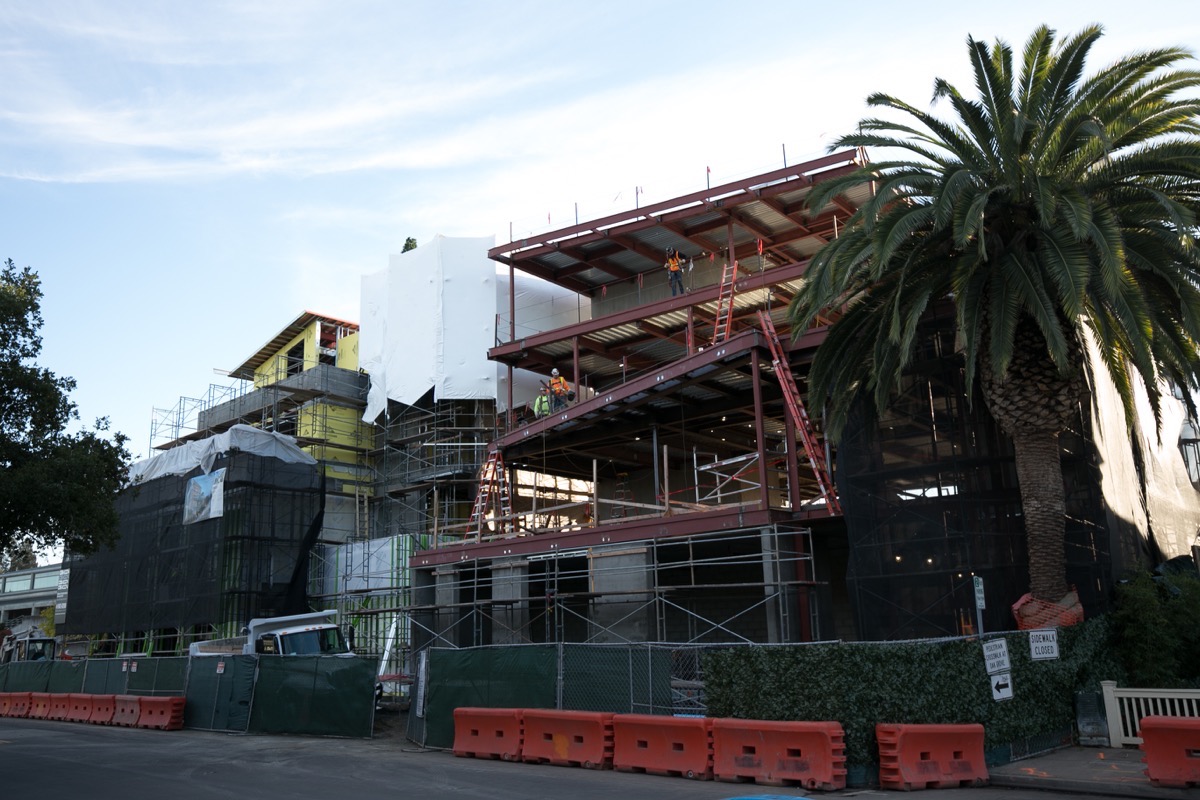
Each building will have housing on the upper one or two floors, for a total of nine units. The Merrill Street building will have non-medical offices on its first and second floors. One of the Santa Cruz Avenue buildings will have a café on the ground level and non-medical offices on the second and third floors. The other Santa Cruz Avenue building will have retail on the ground floor, and non-medical offices on the second floor. Parking will be located either on the ground floor (behind the retail or office space) or in an underground garage (beneath the café) using stackers in order to squeeze the required amount of parking into the rather limited available space.
One block further north along El Camino Real is the positively enormous Station 1300 project, which will contain 220,000 square feet of commercial space (office, retail, and restaurants) plus 183 apartments all in three buildings sitting atop a huge multi-level parking garage. The sheer size of this project makes it hard to photograph: I had to do it in pieces. One tip: the residential portion of the project is mostly built using wood framing, whereas the commercial portions use steel. Thus, when you drive by and see this:
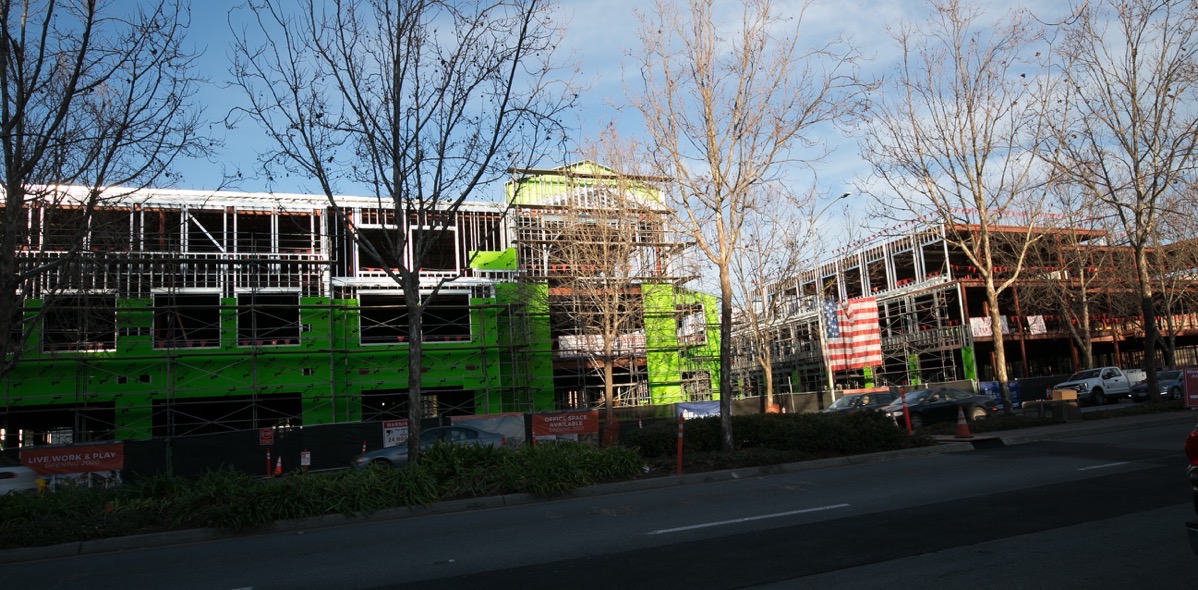
You know that these two buildings will contain offices, stores, and restaurants. (The main driveway onto the property will be between these two buildings, where the large American flag is flying.) The large residential portion of the development is located away from El Camino Real, towards where Oak Grove Avenue crosses the Caltrain tracks. Thus, although you can get a glimpse of it from El Camino Real, perhaps the best view of that part of the project is from Oak Grove Avenue:

As you can see, the framing for this project is largely complete. However, this project still has a long way to go. I expect it to wrap up sometime in the year 2021.
Directly across from Station 1300 on El Camino Real are two smaller projects, both of which appear to be nearly complete. The first is located at 1275 El Camino Real, and is where Menlo Park’s other single-screen movie theater along El Camino Real was once located: the Park Theatre stood here from 1947 until 2014. Very soon, however, the doors will open to a mixed-use three-story building with parking and a commercial space on the ground floor, office space on the second floor, and three residential units on the top floor. As you can see, the building is very modern in style; it is very different from the theater that once stood here:

Just a couple of doors farther along, to the north, is the other small project. This one is located at 1285 El Camino Real, and replaced two small buildings containing a few retail spaces and some private offices. Almost complete is a three-story building that will have a 15 apartments on the upper floors and small amount of retail and the building’s parking on the ground floor.

Lastly, back on the northeastern side of El Camino Real and a few blocks down, is the project that is finally well underway on the site where Beltramo’s Wines and Spirits once stood, at 1540 El Camino Real. This project will consist of two buildings — a two-story, “non-medical” office building along the front of the property and a three-story residential building sporting 27 units along the back — above a large underground parking garage. As you can see, work on the garage is moving right along now:
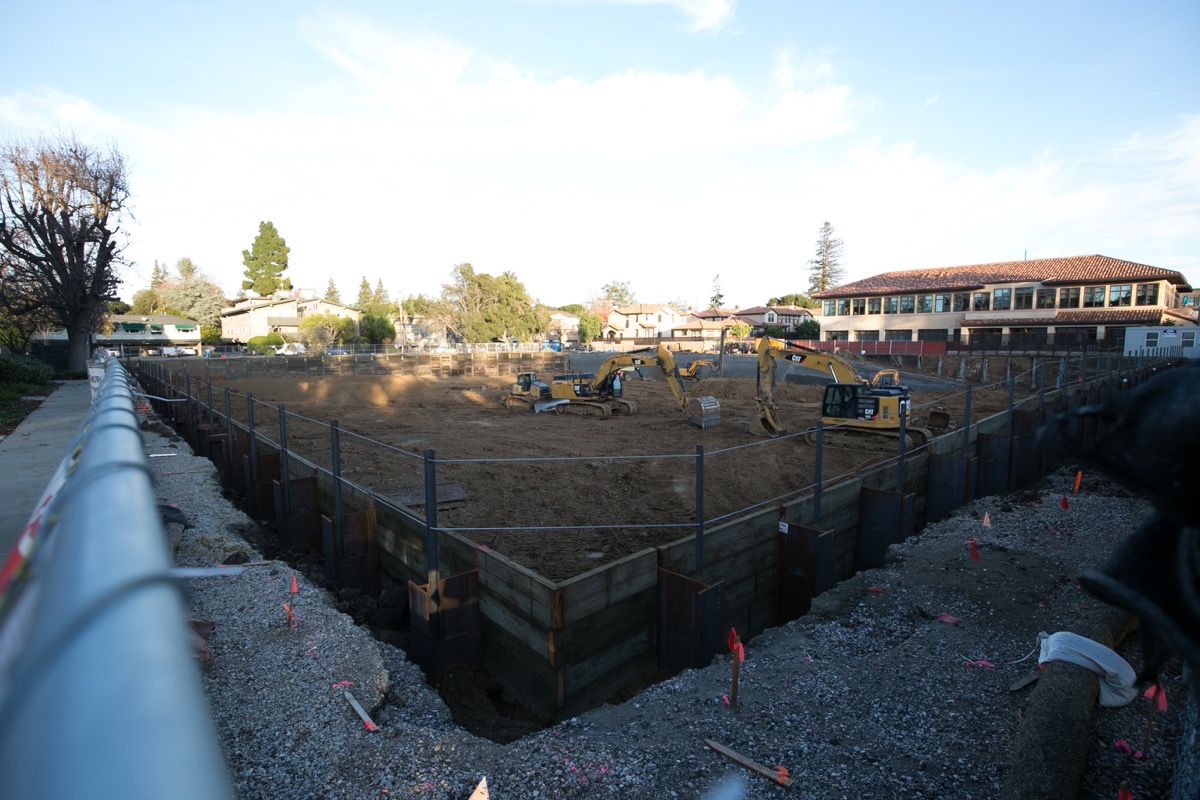
This project took a long time to get off the ground. For a while the old Beltramo’s building served as a temporary home to Treadmill Outlet while approvals were being obtained and the necessary arrangements were being made to enable this project to go forward. But Treadmill Outlet eventually moved back to Redwood City, the Beltramo’s building was torn down, and today someone walking along El Camino Real is presented with what you see above.
I could probably do a whole blog just about Menlo Park (or San Carlos, for that matter) given the number of projects going on there. But Walking Redwood City is just me, so I’ll continue to focus on the great many projects in Redwood City, with the occasional foray into our neighboring communities to the south and to the north. Incidentally, if you really want to get an idea of the magnitude of what is going on in Redwood City these days, check out my latest weekend column for the San Mateo Daily Journal (you’ll find it in the Opinion section of either the print or the online edition for Saturday, January 4). In it I put together a review of the major goings-on in Redwood City throughout 2019, and list of things I came up with to mention is, frankly, pretty overwhelming.
 Walking Redwood City