
Allow me to provide a brief apology for the length of this post: I simply had too much material to fit into a post of my usual length. But the projects I discuss are fascinating ones, so hopefully you’ll forgive my going beyond my usual standard.
Greystar Development is well-known to those of us in Redwood City who have been following the city’s transformation over the past several years. They are the folks who are responsible for:
- Franklin 299, the 305-unit apartment complex on Franklin Street (behind our main Public Library).
- Elan Redwood City (aka “103 Wilson”), the 175-unit apartment building under construction on Jefferson across from Sequoia Station.
- Huxley, which is under construction on El Camino Real on the site formerly occupied by Redwood Trading Post. This seven-story apartment building will contain 137 apartments.
- Greystar IV (not its final name), which will soon break ground on El Camino Real next to Huxley (where Treadmill Outlet and the veterinary clinic used to be). This project consists of a large 350-unit apartment building that will stretch from El Camino back to Franklin Street.
Greystar clearly knows a good thing when they see it, which is why they’re back with their newest project proposal: the Beech Street project (or, as it is referred to on the city’s Development Projects web page, “1601 El Camino Real”). Unlike their previous four projects, this one is not a single building, and it includes a significant office component. While the project they are proposing does include a residential building, Greystar has managed to cobble together several properties and is proposing to build one apartment building and four office buildings on what today is six blocks (totaling 8.3 acres). Whereas the apartment building would be on a scale with what Greystar is currently building on El Camino Real—seven stories, stretching just over 81 feet in height—the office buildings would be noticeably smaller. One would be four stories high (61 feet) while the others would be three (47 feet). All told the four office buildings would provide roughly 590,000 square feet of office space.
Replacing six existing blocks in Redwood City will undoubtedly have an impact. Just what is there today? Given some recent closures, and the way that the six adjacent properties are being used, it is a surprisingly short list:
- Towne Ford
- Hopkins Acura
- Main & Elm
- California Detail, Inc. (an automotive detailer)
- a 23-unit city-owned affordable apartment building
- Main Street Coin Op. Car Wash
Until recently the above list would have included the Redwood Roller Rink, but they recently closed. Also, West Coast Insulation and Fireplace used to occupy a large warehouse-style building on one of the properties, but they seem to have moved to Hayward, leaving their building empty. Other properties are being used for overflow vehicle storage by Towne Ford; until I got out and looked I hadn’t realized just how much land that one business was occupying.
Before I get on to the fates of the above-mentioned businesses, and a description of what Greystar hopes to build, here is a map of the project site that Greystar thoughtfully included as part of their project submittal to the city:

[click the above for a larger version]
In the above, Greystar has labeled the five proposed buildings A through E. Building A, which would consume nearly the entire block where Hopkins Acura is today (on El Camino Real between Beech and Maple Street), would be the apartment building. Building B would be the taller of the four office buildings; it would replace the Towne Ford showroom and service center. Today the site where Building C would sit is mostly used for vehicle storage, but it is also where you will find Towne Auto Body (Towne Ford’s body shop) and the small concrete-block affordable apartment building. Building D would replace both Main & Elm and California Detail, Inc., but curiously would work around this small one-story building at the corner of Main and Elm:
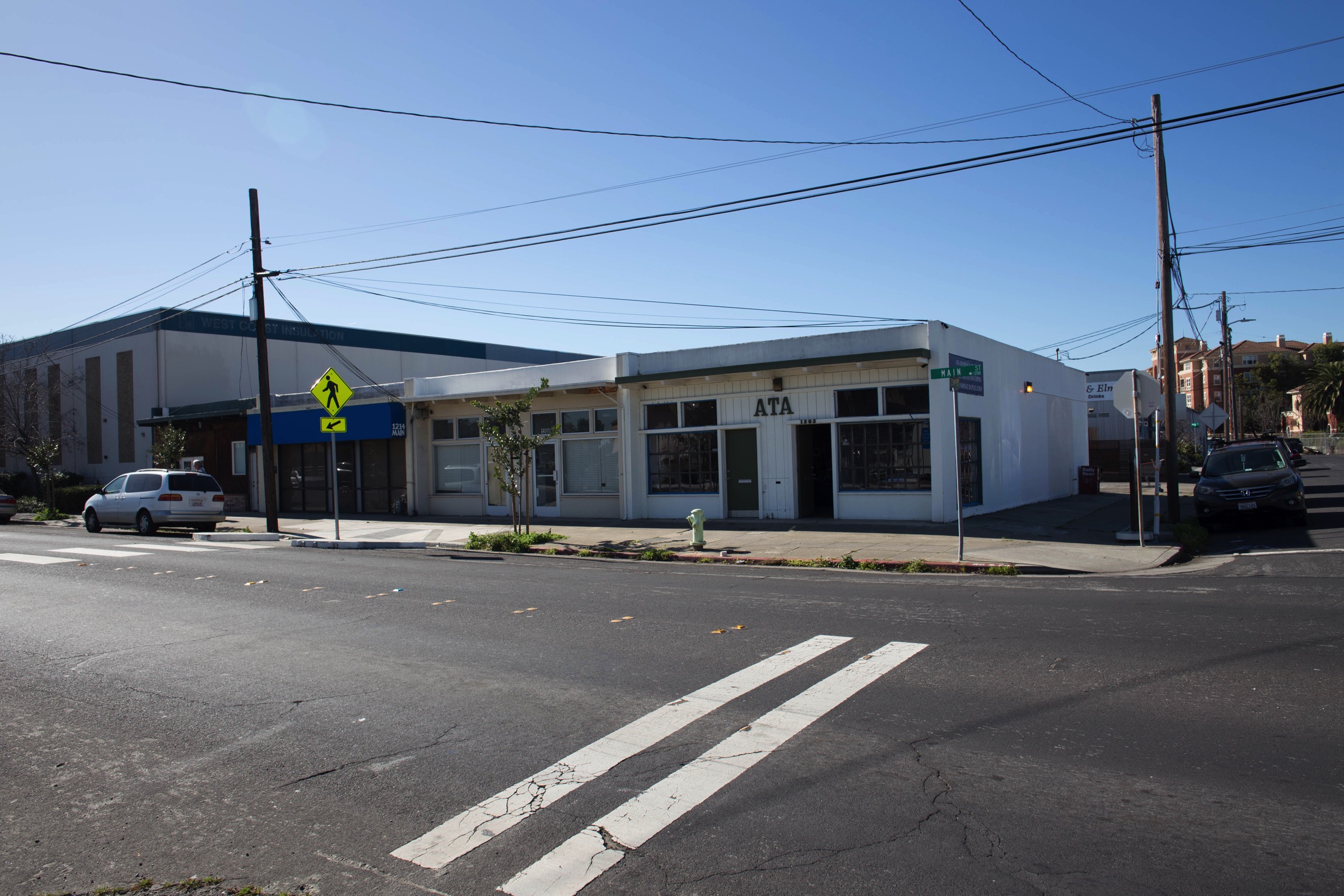
The preliminary plans note that the above-pictured parcel is “not currently controlled by Greystar,” but don’t be surprised if between now and project approval (assuming it gains approval) this part of the block is incorporated into the project.
Building E, the largest of the office buildings, would, as I had previously speculated, span two city blocks (after abandoning a short, dead-end section of Cedar Street, they would be combined into a single parcel). It would replace the now-shuttered roller rink, the car wash, and the long underutilized Perry Feed building (which appears to be largely used by Towne Ford for—surprise!—vehicle storage):

Hopefully you now have a good idea as to where this project would go, and what would be displaced. It’s too early to know for sure what would happen to the existing businesses, but, it tentatively appears that Towne Ford and Hopkins Acura would move out to join the Boardwalk auto dealerships and that Main & Elm would close. As for the city-owned low-income apartment building (“a majority of which are currently uninhabited,” according to the developer), the proposed project would include enough affordable apartments (60, in total) so as to make up for the loss of this building.
That is what we would lose. What would we gain? Here is a rendering that Greystar has supplied, showing what the new development will look like when viewed from El Camino:

On the left is “Building A”—a seven-story apartment building—which would contain a total of 272 apartments, 60 of which would be affordable. The building would have a rooftop pool, deck, and green space. At the ground level, the space between the building and Maple Street (beyond the left edge of the rendering, where Redwood Creek runs) would be landscaped as a “creek walk.”
On the right is “Building B,” a four-story office building (the three-story brick portion in the front is part of the one building). This building stands out in that it would contain, on the ground floor, a 10,000 square foot public childcare facility and, along its Beech Street frontage, “active” space to engage passersby: retail, perhaps, or a restaurant, a gym, or something along those lines.
Between the two, in the back, you can see part of Building C, and you may just be able to make out a green plaza (“Lathrop Park”) in front of it. Buildings D and E are not visible in this rendering.
All five buildings would have underground parking garages. I was a bit disappointed to learn that Greystar plans to valet park the majority of the cars: Buildings C, D, and E would be entirely valet parked, while Building B would use valet parking for the lower two levels of its garage (the topmost parking level includes 60 public parking spaces; that level would be entirely self-parked). The apartment building would also be entirely self-parked.
Between the buildings lies Beech Street, which begins at El Camino Real and runs through the complex towards the Caltrain tracks. This is what that section of Beech Street looks like today:

Because this section of Beech is only about 2-1/2 blocks long and terminates at the Caltrain tracks, it mainly exists to provide access to the two auto dealerships and as a place to park. It actually has some pretty decent sidewalks but they don’t go anywhere interesting, especially now that the roller rink has closed. Contrast today’s Beech Street with the vision presented in the previous rendering. Greystar’s plan is to make it much more pedestrian-focused—although automobile traffic would still be allowed.

The above rendering shows Beech Street as a meandering lane with no street parking. It also shows off some other interesting elements of the project:
- A small “corner plaza” in front of Building B at the corner of Beech and El Camino.
- “Lathrop Park,” at the corner of Beech and Lathrop. The developer says that this would be “similar in scale to Courthouse Square,” and the specs seem to indicate that it would be roughly 17,000 square feet in size.
- A “corner plaza” by Building E at the corner of Beech and Main. The developer is hoping to work with the city to do something more interesting with the adjacent small bit of Beech Street that dies into the Caltrain tracks. Today, it is closed off with bollards to make it an informal extension to the adjacent Main Street Dog Agility Park.
And then there is that small green triangular parcel at the corner of Lathrop and Maple: in the rendering it is located above Building A. This parcel:

Although owned by the city, the developer is proposing to turn it into a community garden. Given the number of apartments that are (and would be) in the immediate area, a community garden is a good idea. This particular parcel, however, is fairly small. On paper it is about one-third of an acre, but Redwood Creek, which runs right through this parcel, renders a good chunk of the property unusable. As best I can tell, the usable portion of this particular parcel is only about 8,600 square feet, or about one-fifth of an acre. Which to my mind makes the property somewhat small, especially given the number of apartments in the area.
The developer has also proposed working with the city to improve “Palm Island,” the tiny triangular parcel in the middle of the intersection where Main, Shasta, and Chestnut streets come together:

It isn’t clear exactly what they are thinking, but one of the renderings gives the impression that they might want to close that small bit of Shasta Street between Chestnut and Main (in the above photo, the bit between the park and the metal building), and thereby connecting the triangular parcel to the block that would contain Building E. This would enlarge the triangular parcel and make it much easier for people to access and enjoy.
One last thing about the rendering shown earlier: at first glance, there seems to be a lot of green space. But look closely, and you’ll realize that the buildings occupy a significant percentage of their parcels, and a lot of the green you are seeing is located on roof decks. I’m all for roof decks—although I’ll likely never see them in person—but don’t expect this neighborhood to be nearly as green as the above rendering makes it appear, at least from street level. There would be a fair number of trees, but other than “Lathrop Park” there would be little in the way of real public open space. Another of the developer’s renderings, which shows the development from an angle rather than from straight overhead, makes this more readily apparent:

In the above rendering the five buildings in the Greystar project are clearly visible. Appearing beyond Building A (the triangular apartment building) and Building D (which would replace Main & Elm and California Detail), almost as if it is part of the project, is a tall triangular building shown with little detail. This is actually a separate project, proposed by another developer, for the empty lot across from Main & Elm. But given its proximity to Greystar’s project, I think it makes some sense to look at both projects together.
On the city’s Development Projects web page this second project is known as the 1180 Main Street project:
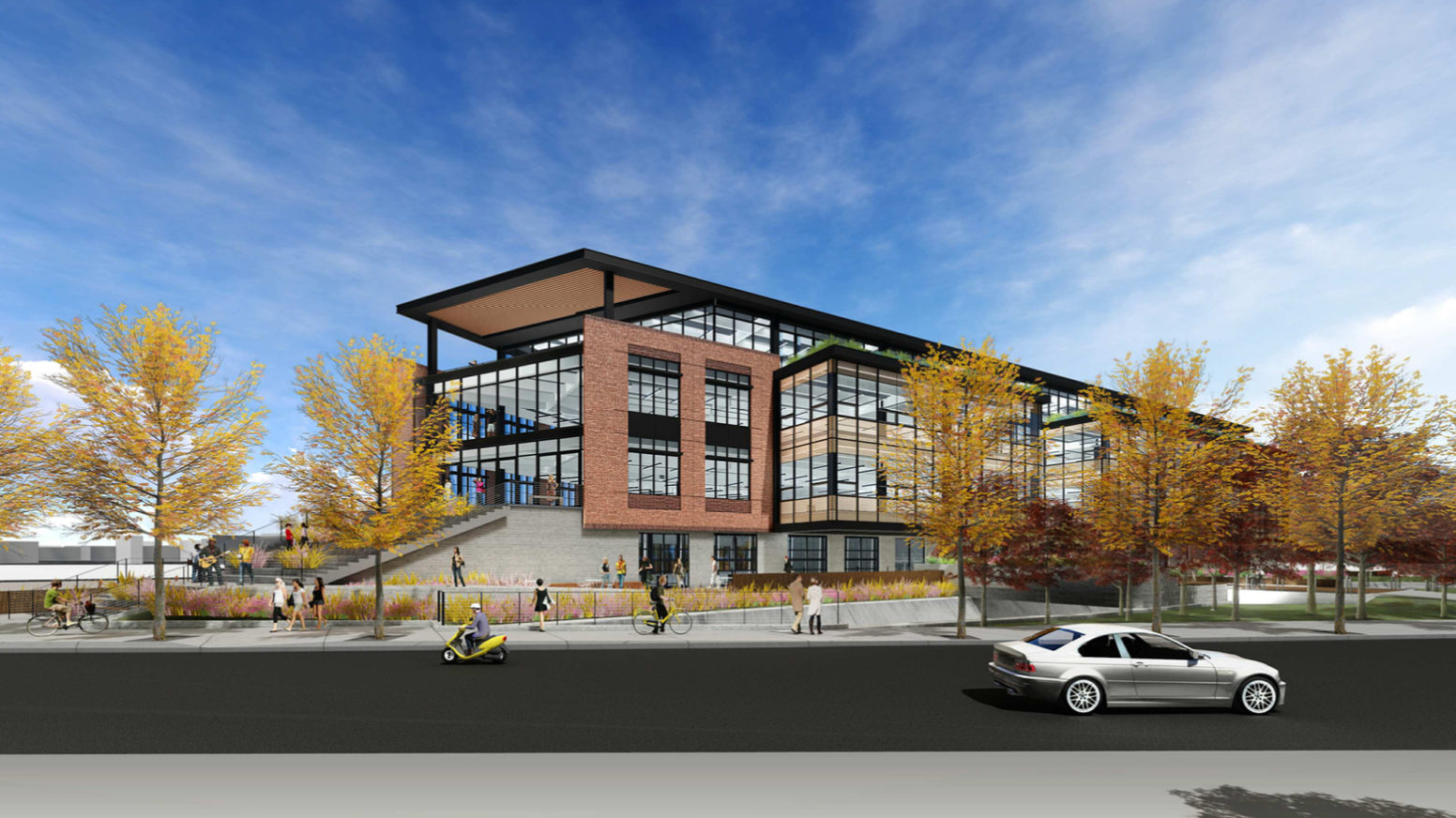
I should emphasize that this particular project is in no way connected to the Greystar proposal, and will be considered independently by the city. It is being brought to us by Premia Capital, who is just finishing up this “ship-shaped” office building at 550 Allerton:

Based on the renderings, I can see a lot of similarities between the above building and the office building proposed for 1180 Main Street. One significant difference would be the height: 550 Allerton is a six-story, 89-foot-high (not counting the air conditioners and that up-angled bit) building, whereas 1180 Main is to be a four-story, 56-foot-high building (also not counting a small enclosure that contains the elevator mechanicals).
550 Allerton shows that Premia can fit a building onto an unusually shaped lot, an ability that will come in handy on the 1180 Main Street project. The property is somewhat pentagonal (five-sided), but Redwood Creek, which cuts through one side of the property, complicates matters. What Premia has done is design a triangular building with a “bridge-top park” that spans the creek and funnels people into the entry plaza that fronts the building’s main lobby. To better understand just how this would work, look at this preliminary landscape plan that the developer provided:

[click it for a larger version]
The building would also have a second-level entrance on one of its corners, accessible via a grand staircase that rises near where Maple Street crosses the railroad tracks to the truncated corner at the left in the above drawing. Additional character would be provided by the two two-story sections of the building that would jut out over the “tenant terrace” that runs across the building’s front.
It comes as no surprise to learn that parking would be in a two-level underground garage that would require a valet in order to accommodate the required 425 cars. Entry to the garage would be from Elm Street, directly opposite today’s Main & Elm. Inside the building there would be accommodations for 72 bikes—for employees; there are also showers—while outside there would be racks that could hold up to 26 more, for visitors and/or for employees. As you can see on the landscape drawing, sidewalks would edge the property on three sides (Caltrain runs along the fourth, so a sidewalk there wouldn’t be prudent or necessary). And, of course, Redwood Creek would figure prominently in the building’s front entrance.
All in all, this could be a dramatic office building that would make maximal use of a parcel that for years now has been a fenced-off, empty lot. Like the Greystar proposal, this one is still at the initial stage of the planning process: they’ve submitted a preliminary proposal and are presumably working with the city to complete their application. Then it will be subjected to a review of its design and its environmental impacts, after which it will be brought before the city and the public in one or more public hearings. I for one look forward to that presentation and will be very interested to see what the city thinks of Premia Capital’s project. Greystar will go through a similar process, but given the added complexity involved in their project I expect that they will need more time.
Although the outcome of the two projects is by no means assured, if they were to both be built it would result in a significant transformation of a rather large part of Redwood City—one that, these days, is surprisingly underutilized. I don’t often walk through this part of town, because there is little there for me to see. But if one or both of these projects are approved, that will change. Even though the buildings contain little to no retail, a couple of good-looking buildings and some upgraded sidewalks would be enough to attract those of us who like to just get out and walk. And if Greystar really does transform Beech Street akin to what they have shown in their project submission, you can bet I’ll be spending much more time “on the Beech.”
 Walking Redwood City